





 Portuguese
  English
  Spanish
  3 min of reading
  0 comments


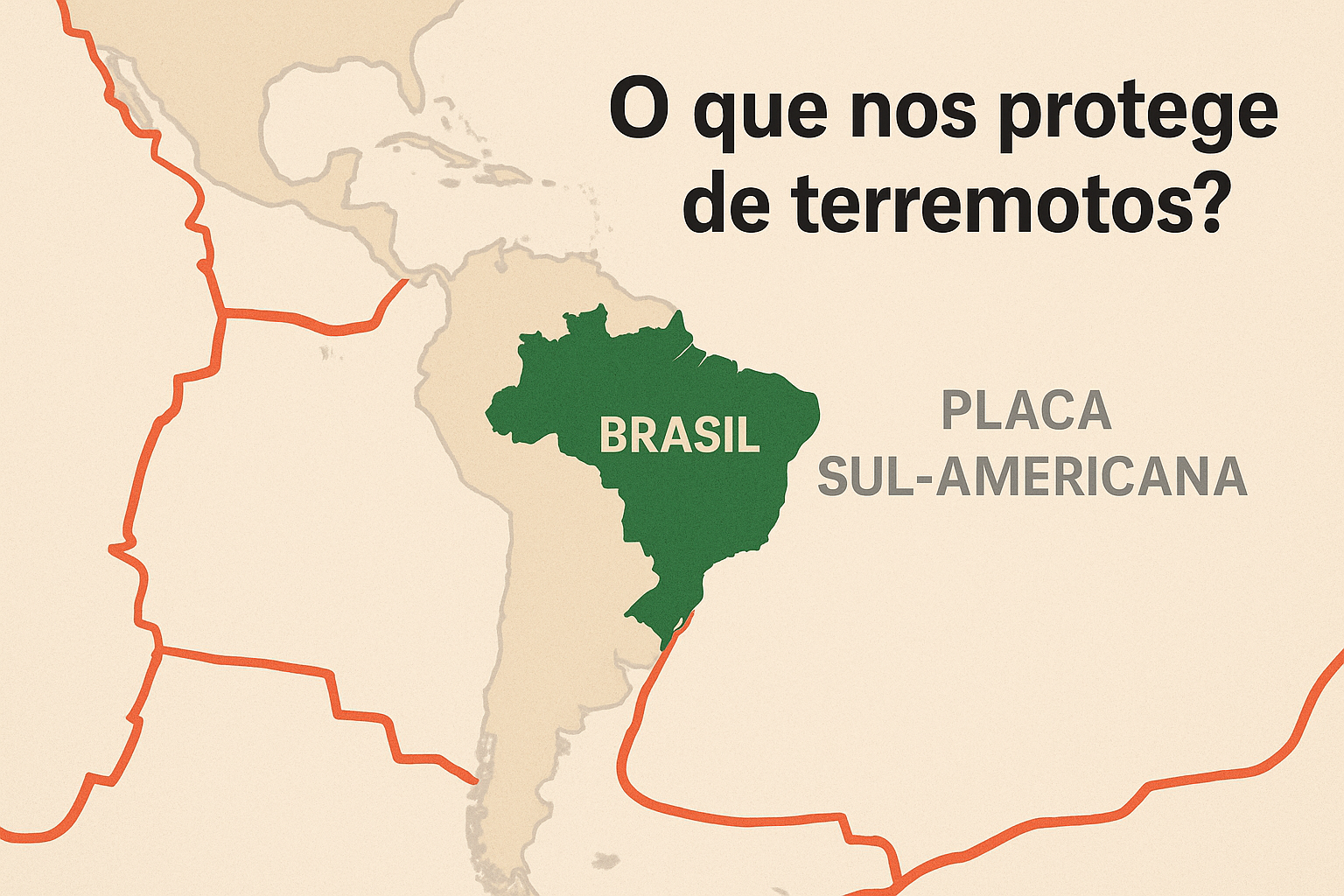
Distant From Tectonic Edges, Brazil Registers Only Light Quakes, With Rare Cases of Greater Magnitudes
Brazil is located in the center of the South American Plate. This distances it from the tectonic edges, where the largest earthquakes on the planet occur. These strong quakes happen when tectonic plates collide or slide against each other. Since the country is far from these edges, the chances of large earthquakes are small.
When The Ground Shakes Here
Even though it is protected, Brazil has recorded earth tremors. They occur at a lower intensity, usually without causing major damage.
These shakes are considered earthquakes, but most of them are weak. The causes of these tremors are varied and include volcanism, plate movement, and geological faults.
-
Motorola launched the Signature with a gold seal from DxOMark, tying with the iPhone 17 Pro in camera performance, Snapdragon 8 Gen 5 that surpassed 3 million in benchmarks, and a zoom that impresses even at night.

-
Satellites reveal beneath the Sahara a giant river buried for thousands of kilometers: study shows that the largest hot desert on the planet was once traversed by a river system comparable to the largest on Earth.

-
Scientists have captured something never seen in space: newly born stars are creating gigantic rings of light a thousand times larger than the distance between the Earth and the Sun, and this changes everything we knew about stellar birth.

-
Geologists find traces of a continent that disappeared 155 million years ago after separating from Australia and reveal that it did not sink, but broke into fragments scattered across Southeast Asia.

The main source of earthquakes in Brazil are geological faults. These are cracks formed in the Earth’s crust. Over time, the internal pressures of the Earth force these faults and cause small seismic shakes.
In some cases, the continuous wear of the plates also generates vibrations so weak that only specialized devices, like seismographs, can detect them.
Epicenter and Propagation of Vibrations
When a collision occurs between parts of the plates, the so-called epicenter forms. From there, the vibrations spread. In Brazil, this situation is rare because the country is far from the regions where these collisions are more common.
In Brazil, the Northeast is the region with the most occurrences of tremors. States like Ceará, Pernambuco, and Rio Grande do Norte concentrate the majority of the records.
The explanation lies in the presence of several active geological faults in these areas. Even so, the tremors tend to be light and rarely pose risks to the population.
The Strongest Earthquakes in Brazil
Despite the low frequency, some earthquakes have marked the history of the country. Seven episodes are considered the most significant.
The largest tremor occurred in 1955, in Serra do Trombador, Mato Grosso, with a magnitude of 6.6 on the Richter scale. There were no casualties or damage. In the same year, in Vitória, Espírito Santo, a quake of 6.3 degrees made buildings and houses shake, but there were no injuries.
In 1980, Pacajus, in Ceará, registered a tremor of 5.2 degrees, felt even in the capital, Fortaleza. In 1986, João Câmara, in Rio Grande do Norte, experienced a quake of 5.1 degrees that damaged some houses.
In 2007, the border between Acre and Amazonas had a tremor of 6.1 degrees. The vibrations were felt in nearby regions but did not cause damage. In the same year, Itacarambi, in Minas Gerais, recorded 4.9 degrees. There was one death and six injuries.
Lastly, in 2008, a tremor of 5.2 degrees struck several states, such as São Paulo, Rio Grande do Sul, Santa Catarina, Paraná, and Rio de Janeiro. There were no reports of damage.
An Important Natural Protection
Brazil’s position in the center of the tectonic plate remains its main defense against large earthquakes. This keeps the risk of seismic disasters very low in the country.
With information from Olhar Digital.







Seja o primeiro a reagir!