





 English
  Francês
  Alemão
  Italiano
  Japonês
  Norueguês
  Portuguese
  Spanish
  6 min of reading
  0 comments


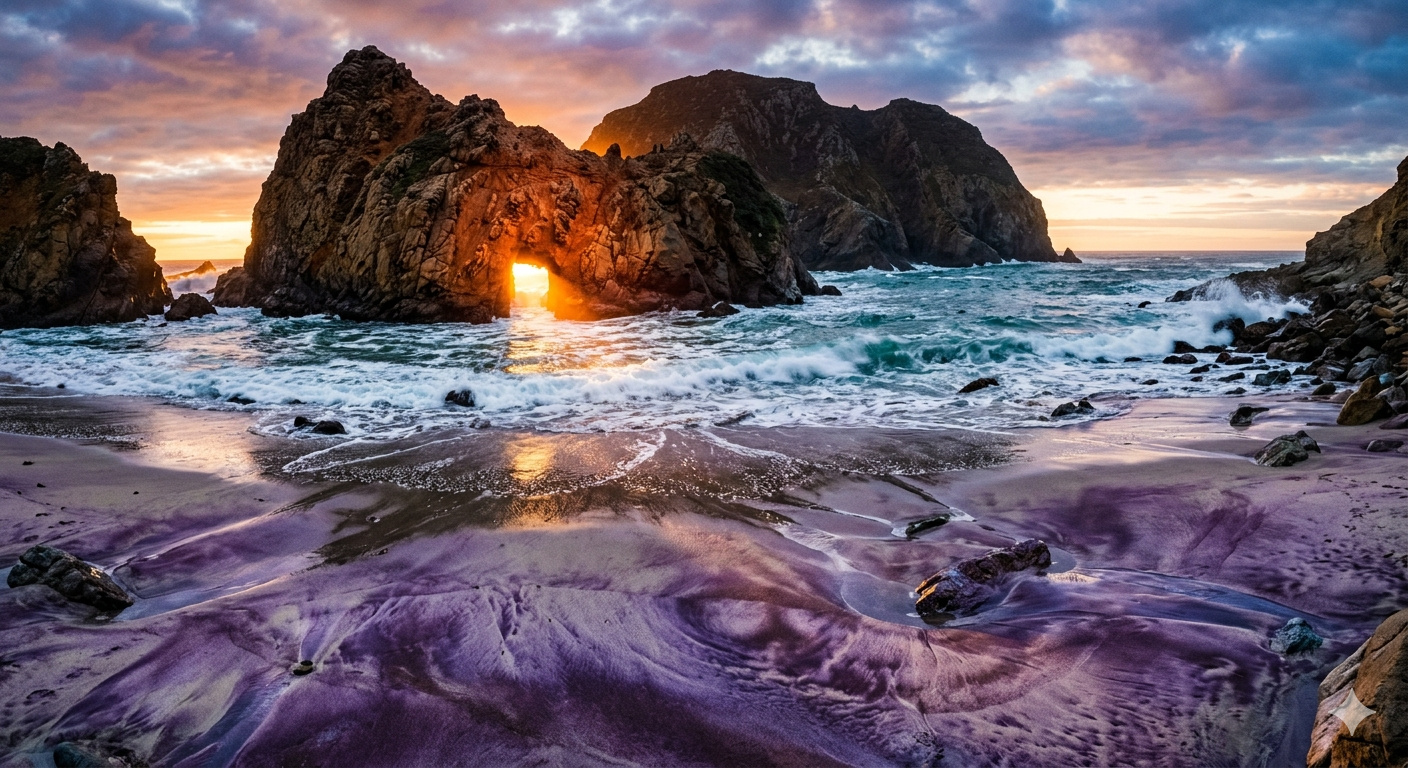
Secret beach in California charms with rare purple sand and arch illuminated by the sun in winter, an ephemeral natural phenomenon that transforms Pfeiffer Beach into a unique and mysterious spectacle of the world.
Hidden along the California coast, Pfeiffer Beach is one of the most unusual places on the American shoreline. At first glance, it seems just another beach in Big Sur, with steep cliffs, rough seas, and typical Pacific rock formations. But one detail completely transforms the landscape: the sand, under certain conditions, takes on intense shades of purple.
This effect is neither permanent nor uniform. It appears in wavy patterns, like brush strokes in the sand, and constantly changes with the action of the waves. What few visitors know is that this coloration is neither artificial nor the result of a temporary phenomenon — it is a direct consequence of geological processes that have been occurring for thousands of years.
Where is Pfeiffer Beach and why is it considered one of the most different beaches in the United States
Located in the Big Sur region, one of the most iconic coastal stretches in California, Pfeiffer Beach is not easily found by those passing along the famous Highway 1. Access is via a narrow and discreet secondary road, which can go unnoticed by inattentive drivers.
-
Seen from space, a colossal ‘Y’ cuts through the largest desert in China, blending a jade-filled river, red and white mountains, and revealing the absurd scale of the transformation of the Taklamakan surrounded by a green wall with billions of trees.

-
Aursjøvegen in Norway is a 100-kilometer gravel road that crosses chasms and dark tunnels carved into the rock at an altitude of 947 meters in the fjords and is only open for four months a year.

-
With about 4,000 m², the building constructed in a traditional neighborhood in France looks like a rainbow, has a colorful facade, mixes vibrant glass, and creates one of the most unusual visuals in Bordeaux.

-
Forget sapphire and topaz because there is a blue aluminum borate crystal that is worth 2 thousand dollars per carat and is only found in gem quality in the mountains of Namibia in a completely artisanal mining operation.


This characteristic contributes to the almost “secret” nature of the location. Even in a highly touristic area, the beach remains relatively isolated, which helps preserve its natural features.

Big Sur, in itself, is already known for its dramatic geography, where mountains meet the ocean abruptly. However, Pfeiffer Beach stands out within this scenery by presenting a rare phenomenon: naturally colored sand due to minerals.
Purple sand: how garnet crystals transform the landscape
The purple hue of the sand comes from the presence of garnets, specifically rich in manganese. These minerals are formed under high pressures and temperatures inside the rocks of the cliffs surrounding the beach.
Over time, natural processes such as rain, wind, and wave action begin to wear down these rocks. Small fragments are released and transported toward the sea.
With each winter storm, this process intensifies. Water flows down the slopes, carrying mineral particles that end up deposited in the sand. Since garnet is denser than regular sand, it does not mix homogeneously.
The result is the formation of unique visual patterns, where purple stripes appear among lighter tones, creating designs reminiscent of swirls or exposed mineral veins.
Why the purple swirls change every day
One of the most fascinating aspects of Pfeiffer Beach is the fact that the appearance of the sand is never exactly the same. This happens because the ocean acts as a constant agent of transformation.
The waves continuously redistribute the sediments. On one day, the concentration of garnet may be more visible in a specific area. The next day, the pattern may completely disappear or appear in another part of the beach.
This dynamic behavior makes the phenomenon ephemeral. There is no “fixed moment” when the beach turns purple. Instead, it is a continuous process, shaped by factors such as tide, wave intensity, and weather conditions.
The role of winter rains in intensifying the purple color
Winter rains play a fundamental role in intensifying the phenomenon. During this period, the erosion of the cliffs significantly increases.
Water seeps into the rocks, loosening mineral particles and creating small flows that descend toward the beach. This newly exposed material tends to have a more intense coloration, as it has not yet been diluted or redistributed by the waves.

After storms, it is common for the purple patterns to be more visible, especially near the areas where fresh water meets the sea.
Keyhole Arch: the stone arch that illuminates with the sun
In addition to the purple sand, Pfeiffer Beach is home to a geological formation that has become one of the main attractions of the site: the so-called Keyhole Arch. This stone arch, naturally sculpted by the action of the sea over thousands of years, has an opening that allows sunlight to pass through at certain times of the year.
During winter, especially in the weeks around the solstice, the sun positions itself so that its rays pass through the arch at sunset. When conditions are ideal — clear sky, relatively calm sea, and appropriate tide — the light illuminates the water passing through the arch, creating an impressive visual effect.
This phenomenon does not occur on a single specific day, but within a limited time window, which attracts photographers and visitors seeking to capture the exact moment.
A phenomenon that depends on time, light, and position
Just like the purple sand, the alignment of the sun with the arch is not guaranteed. It depends on a precise combination of natural factors.
The position of the sun varies throughout the year, and only on certain days in winter does the alignment occur. Additionally, clouds can block the light, and the tide level can interfere with the visibility of the effect. This makes the phenomenon unpredictable and, at the same time, even more valued by those who manage to witness it.
The geology of Big Sur and the formation of mineral-rich cliffs
The Big Sur region is the result of complex tectonic processes. The interaction between tectonic plates along the California coast created a landscape marked by abrupt elevations and varied rocks.
The cliffs surrounding Pfeiffer Beach contain a significant mineral diversity, including garnets. These rocks were formed under extreme conditions deep within the Earth’s crust and later exposed by geological movements. The continuous erosion of these formations is what feeds the cycle of mineral deposition on the beach.
Why Pfeiffer Beach continues to be a little-known phenomenon
Despite its beauty and uniqueness, Pfeiffer Beach is still less known than other tourist spots in California. Part of this is due to the discreet access and the absence of large tourist structures.
Moreover, the main phenomenon of the beach is not immediately visible. Unlike other destinations where the striking feature is evident, here one must observe closely to notice the details. This combination of factors causes many visitors to pass by the location without fully understanding what they are seeing.

An example of how nature transforms minerals into landscape
Pfeiffer Beach is a clear example of how geological processes can create unique scenarios over time. The interaction between mountains, climate, and ocean results in an environment where rare minerals become part of the everyday landscape.
The garnet crystals, formed under extreme conditions deep within the Earth, end up being exposed on the surface and incorporated into the dynamics of the beach.
This continuous cycle shows how nature transforms invisible elements into visual phenomena that, even if discreet, carry a deep geological history.
A phenomenon that happens without being perceived by most
Perhaps the most curious aspect of Pfeiffer Beach is the fact that many visitors do not realize what is in front of them. The purple patterns may be overlooked as mere variations in the color of the sand.
Similarly, the stone arch may be seen as just another rock formation, without understanding the solar alignment phenomenon that occurs there.
This transforms the beach experience into something that depends on the observer’s perspective. For those who understand what is happening, the location reveals a complexity far greater than it appears.
Pfeiffer Beach: a scenario in constant transformation
With each tide, each rain, each change in light, Pfeiffer Beach transforms. The purple swirls appear and disappear, the stone arch changes appearance as the sun moves, and the landscape is never exactly the same.
This dynamic nature is what makes the location unique. It is not a fixed phenomenon, but a system in constant evolution, shaped by natural forces that have been at work for thousands of years.
And it is precisely this combination of science, time, and aesthetics that makes Pfeiffer Beach one of the most intriguing places on the Pacific coast.









Seja o primeiro a reagir!