





 Portuguese
  English
  Spanish
  6 min of reading
  0 comments


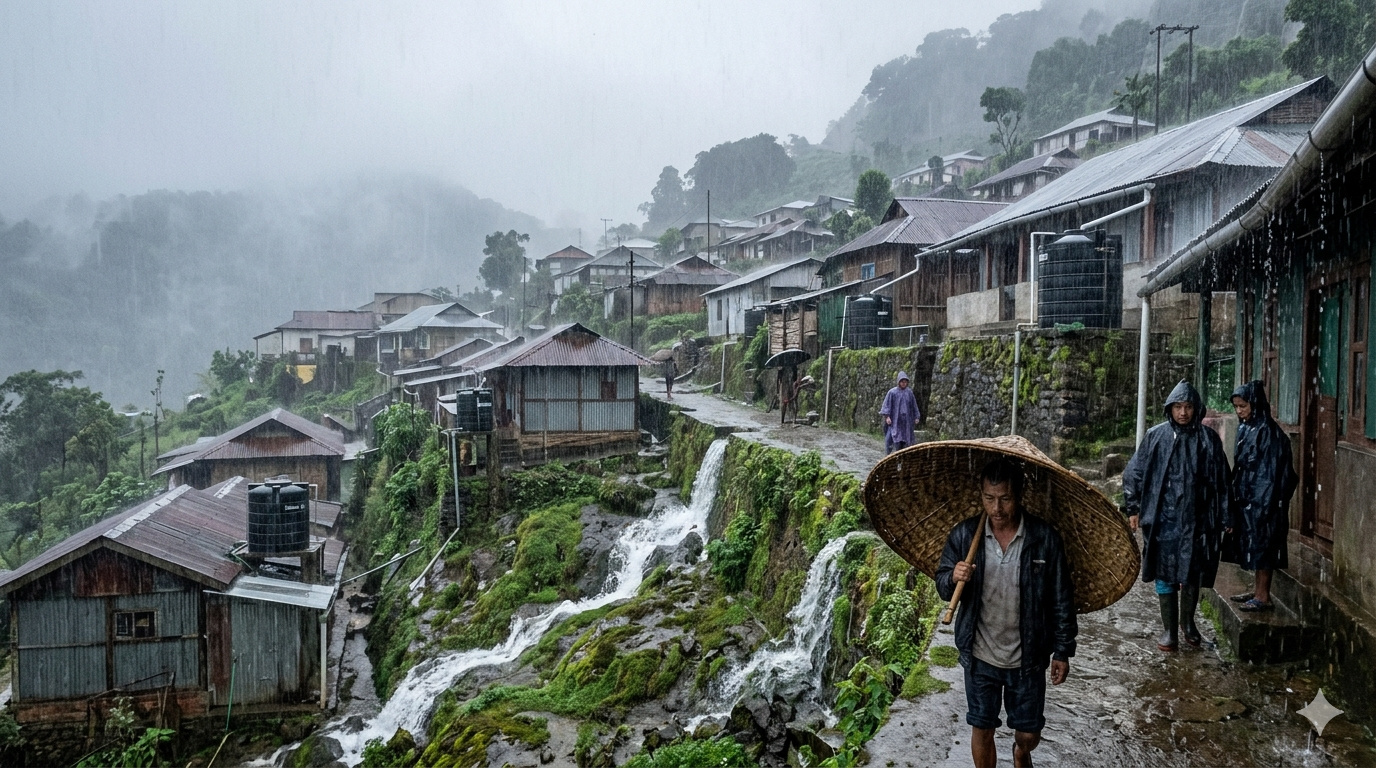
Mawsynram, in India, is the wettest place on Earth, with 11,872 mm of annual rainfall and extreme rain events that shape local life.
In Meghalaya, in northeastern India, there is a village where clouds do not pass through the sky; they pass through the interiors of houses. It is not an exaggeration. It is the account of those who live there. According to an AFP report published by Gulf News, the village chief of Mawsynram, named Moonstar Marbaniang, describes the phenomenon casually: it is not uncommon for clouds to enter through open windows and leave a damp film on the furniture. “We have to speak a little louder to be heard during the monsoon,” he says, winking at the reporter.
Mawsynram holds the official title of the wettest inhabited place on Earth, with an average annual precipitation of 11,872 millimeters, according to the Guinness World Records. For reference: Seattle, in the United States, a cultural symbol of a rainy city, receives an average of 965 mm per year. Mawsynram receives twelve times more. In 1985, it rained 26,000 mm in the entire year. And on June 17, 2022, the village recorded 1,003 mm in just 24 hours, more than London receives in an entire year, in a single day.
Why Mawsynram is the wettest place on Earth
Mawsynram is located about 1,400 meters above sea level in the Khasi Hills, in the state of Meghalaya — a name that, in Sanskrit, literally means “abode of the clouds.” This geographical position is not a coincidence, but rather one of the most efficient natural moisture traps on the planet.
-
Italian researchers have detected what appears to be a second Sphinx buried under the sands of Egypt, and satellite scans reveal a gigantic underground megastructure hidden beneath the Giza Plateau for over 3,000 years.
-
There are 4,223 drums and 1,343 metal boxes concreted with 50-centimeter walls that store the radioactive waste from Cesium-137 in the worst radiological accident in Brazil, just 23 kilometers from Goiânia, with environmental monitoring every three months.

-
Giant Roman treasure found at the bottom of Lake Neuchâtel in Switzerland reveals an advanced trade system, circulation of goods, and armed escort in the Roman Empire about two thousand years ago.

-
He buried 1,200 old tires in the walls to build his own self-sufficient house in the mountains with glass bottles, rainwater, and an integrated greenhouse.


During the summer monsoon, winds from the southwest cross the Indian Ocean, absorb water vapor from the Bay of Bengal, and travel approximately 400 kilometers over the plains of Bangladesh without encountering barriers. Upon reaching the Khasi Hills, they encounter a steep elevation: over 1,300 meters in just a few kilometers. This barrier forces the moist air to rise rapidly.


As it rises, the air cools, the vapor condenses, and precipitation begins intensely. The uniqueness of Mawsynram lies in the shape of the terrain, which acts as a natural funnel. The winds are channeled directly into the region, intensifying the process and concentrating the rain over a single point with a rarity not found anywhere else in the world.
The monsoon cycle defines life in the village
In Mawsynram, the year is not divided into four traditional seasons. It is summarized into two main periods: the monsoon and the preparation for the monsoon. Between May and July, rain is practically continuous, with entire days without direct sunlight and extremely high humidity levels.
The routine of the population is shaped by these conditions. Landslides frequently block the only access road. Houses suffer from constant leaks. Outdoor activities, including classes, are suspended. Life takes place indoors, while the rain completely dominates the environment.

During the winter, families prepare for this extreme period. Roofs are reinforced, firewood is stored, food is stocked, and the production of traditional equipment begins.
The knups: traditional technology to survive extreme rain
One of the most emblematic solutions developed by the residents is the knups — structures made of bamboo, leaves, and plant fibers, shaped like a shell that covers the head and back down to the knees or ankles.
These artifacts function as portable shields against intense rain, allowing residents to keep their hands free to work in the fields, even under constant precipitation. Each piece takes about an hour to produce and lasts approximately one season.
During the monsoon, production is continuous. Women from the village spend days making knups, as well as baskets and other items that are sold to supplement family income.
Houses adapted not against water, but against the sound of rain
The main architectural adaptation in Mawsynram is not aimed at waterproofing, but rather at acoustic control. The constant impact of rain on metal roofs generates a noise level that can become physically unbearable over weeks.

The traditional solution consists of covering the roofs with thick layers of dry grass, which act as natural acoustic insulators. This material absorbs the impact of the drops and significantly reduces the sound inside the houses.
The grass undergoes a specific preparation process, being moistened, compressed, and dried before being applied. However, very intense rains can remove this covering, exposing residents again to the continuous noise.
The paradox: the wettest place on Earth suffers from water scarcity
Despite the extreme volumes of precipitation, Mawsynram faces water scarcity during part of the year. The soil in the region is predominantly rocky and poorly permeable, which prevents the retention of rainwater.
Instead of infiltrating and feeding aquifers, the water quickly runs off the slopes and heads towards the plains of Bangladesh. When the monsoon ends, the watercourses dry up quickly, and the population begins to rely on external sources.
This problem has worsened over time. The irregularity of the monsoons and deforestation have further reduced the capacity for water retention in the region, creating a paradoxical scenario: extreme excess of rain for months, followed by scarcity.
Climate change and alteration in rainfall patterns
Recent studies indicate that the rainfall pattern in Meghalaya is changing. Instead of constant precipitation distributed over time, there is a trend towards more intense and concentrated events.
This change increases surface runoff and reduces infiltration, exacerbating water scarcity during the dry period. Data from 1989 to 2018 show that Meghalaya is one of the regions in India with statistically significant reductions in monsoon rainfall.
In 2025, the government of Meghalaya announced the construction of the world’s first rain museum in Mawsynram. The project includes immersive monsoon simulations and educational content about climate, cloud formation, and environmental changes.
The initiative aims to transform the climatic phenomenon into a tourist and economic asset for the region, connecting science, culture, and sensory experience.
Additionally, the region is home to one of the most impressive engineering solutions on the planet: living root bridges. Built from intertwined tree roots over decades, these structures can withstand centuries of intense rain.
A place where rain is not an event, but a permanent environment
In Mawsynram, rain is not an occasional climatic phenomenon. It defines geography, shapes architecture, determines the economy, and organizes daily life.
The extreme numbers, 11,872 mm per year, over 1,000 mm in a single day, are just the surface of a deeper reality. It is an environment where the relationship between humans and climate has been pushed to the limit, requiring adaptations that do not exist anywhere else in the world.
And while the rest of the planet views rain as an event, in Mawsynram it is a permanent condition of existence.










Seja o primeiro a reagir!