





 English
  Francês
  Alemão
  Italiano
  Japonês
  Norueguês
  Portuguese
  Spanish
  5 min of reading
  0 comments


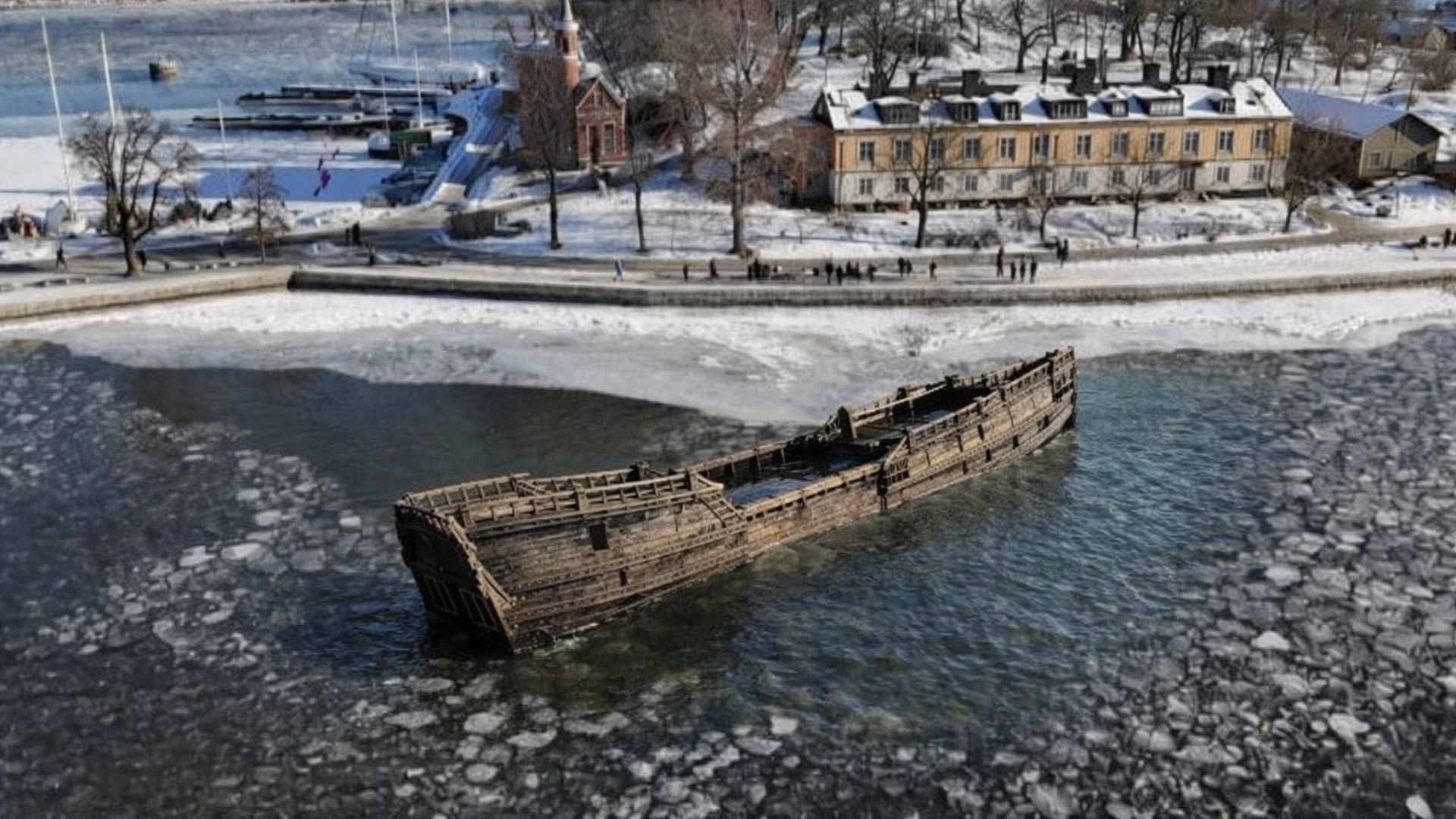
Historical recession of the Baltic Sea exposes preserved hull of the 17th century in central Stockholm, revealing naval reuse practices and highlighting unique subaquatic conservation conditions in the region.
A warship of the Swedish Navy deliberately sunk in the 17th century has become visible again in the central region of Stockholm after an exceptional recession of the Baltic Sea level exposed part of the hull near Kastellholmen.
The vessel, which generally remains submerged, has attracted attention for bringing together two unusual factors in a single episode: the prolonged preservation of a large wooden structure and its reappearance in the urban landscape of the Swedish capital.
The assessment released by Jim Hansson, a marine archaeologist associated with Vrak, the Museum of Shipwrecks in Stockholm, is that it is a ship of the Swedish Navy intentionally sunk, probably around 1640, when it was already out of use.
-
Seen from space, a colossal ‘Y’ cuts through the largest desert in China, blending a jade-filled river, red and white mountains, and revealing the absurd scale of the transformation of the Taklamakan surrounded by a green wall with billions of trees.

-
The Pacific Ocean reveals what the cliffs of Big Sur have hidden for millennia: Pfeiffer Beach, in California, features swirling purple sand formed by garnet crystals and displays a stone arch that is illuminated by the sun in winter for just a few days each year.

-
Aursjøvegen in Norway is a 100-kilometer gravel road that crosses chasms and dark tunnels carved into the rock at an altitude of 947 meters in the fjords and is only open for four months a year.

-
With about 4,000 m², the building constructed in a traditional neighborhood in France looks like a rainbow, has a colorful facade, mixes vibrant glass, and creates one of the most unusual visuals in Bordeaux.


According to him, the hull does not appear to have been lost in combat or abandoned by chance, but reused in a practical port engineering solution, consistent with how old vessels were repurposed at the time.
Researchers have not yet released the definitive identification of the vessel.

Even so, the exposure of the hull gained attention for showing almost at the water’s surface a military structure from the early modern era in a historic point of Stockholm, and not in a remote coastal area, as often occurs in much of the archaeological discoveries related to ancient shipwrecks.
Fall of the Baltic Sea level reveals hidden structures
The reappearance of the ship occurred after an unusual drop in the Baltic Sea level, recorded in early February.
According to information released by research centers, the Landsort-Norra gauge on the Swedish coast recorded on February 5 more than 67 centimeters below the long-term average, the lowest level observed since the beginning of this historical series.
This recession helps explain why normally invisible structures have begun to emerge clearly in different stretches of the Swedish coastline and port areas.
In the case of Stockholm, the low sea level made perceptible a part of the ancient maritime landscape that remained covered by water for centuries, preserving elements that in other marine environments would tend to disappear more quickly.

Although experts have not yet presented a public document that nominally associates the hull with a specific work, the historical context of the area reinforces the interpretation of structural reuse.
Records about Skeppsholmen indicate that the first bridge built to connect the island to the rest of the city was erected between 1638 and 1640, a period that coincides with the archaeological estimate for the deliberate sinking of the now-visible ship.
The proximity between Kastellholmen and Skeppsholmen also weighs in this historical reading.
The two islands have maintained, for centuries, a direct relationship with the military and naval infrastructure of Stockholm, making it plausible that a decommissioned hull was incorporated into fixed port works instead of simply being dismantled.
The secure fact, however, is that the vessel was sunk intentionally, while the exact identification of the ship and the detailed documentary link to a specific bridge have not yet been officially closed by archaeologists.
Why the ship remained preserved for centuries
The preservation of the wood does not surprise specialists in maritime archaeology from Northern Europe.
The Vasa Museum explains that the brackish water of the Baltic, a mixture of fresh and saltwater, prevents or strongly reduces the presence of the so-called shipworm, an organism known for destroying submerged wood in other seas.

Without this intense biological action, hulls can remain intact for much longer periods.
Moreover, studies and outreach materials related to Swedish naval heritage highlight that the Baltic combines low salinity, cold temperatures, and favorable conservation conditions, creating a unique environment for the preservation of ancient vessels.
This combination transforms the region into a singular area for underwater archaeology, with shipwrecks that often maintain shape, structural fittings, and parts of the original material in a way that is rare compared to other marine environments.
Not by chance, the Baltic is regarded as one of the most valuable areas in Europe for the study of historical ships.
Instead of remaining only as scattered fragments, many preserved remains on the seabed allow for the reconstruction of construction techniques, usage patterns, and even forms of adaptation of decommissioned vessels.
The case of Stockholm reinforces this value because it exposes, to the naked eye, a type of heritage that in much of the world tends to degrade before it can be documented with this degree of integrity.
Naval reuse and maritime heritage of Sweden

The reappearance of the hull is also connected to a broader effort to map Swedish maritime heritage.
Vrak presents the program The Lost Navy as an initiative aimed at investigating the so-called “Lost Navy” of Sweden between 1450 and 1850.
The proposal is to inventory all 785 known vessels from this universe in a database capable of gathering historical records, cartography, and archaeological evidence.
In this context, the ship exposed in Kastellholmen is of interest not only for its visual impact but for what it shows about the material logic of the period.
The structure suggests how a military hull could gain a new function after leaving active service, becoming part of the very coastal infrastructure of the city.
At the same time, the episode highlights that relevant portions of the historical landscape of Stockholm remained preserved underwater, rather than being eliminated throughout successive urban transformations.
The reappearance of the hull offers a window into the relationship between naval power, port engineering, and urban occupation in 17th-century Sweden.
It also reaffirms the role of the Baltic Sea as a natural archive that preserves structures, routes, and materials over centuries, even in intensely urbanized areas.








Seja o primeiro a reagir!