





 Portuguese
  English
  Spanish
  5 min of reading
  0 comments


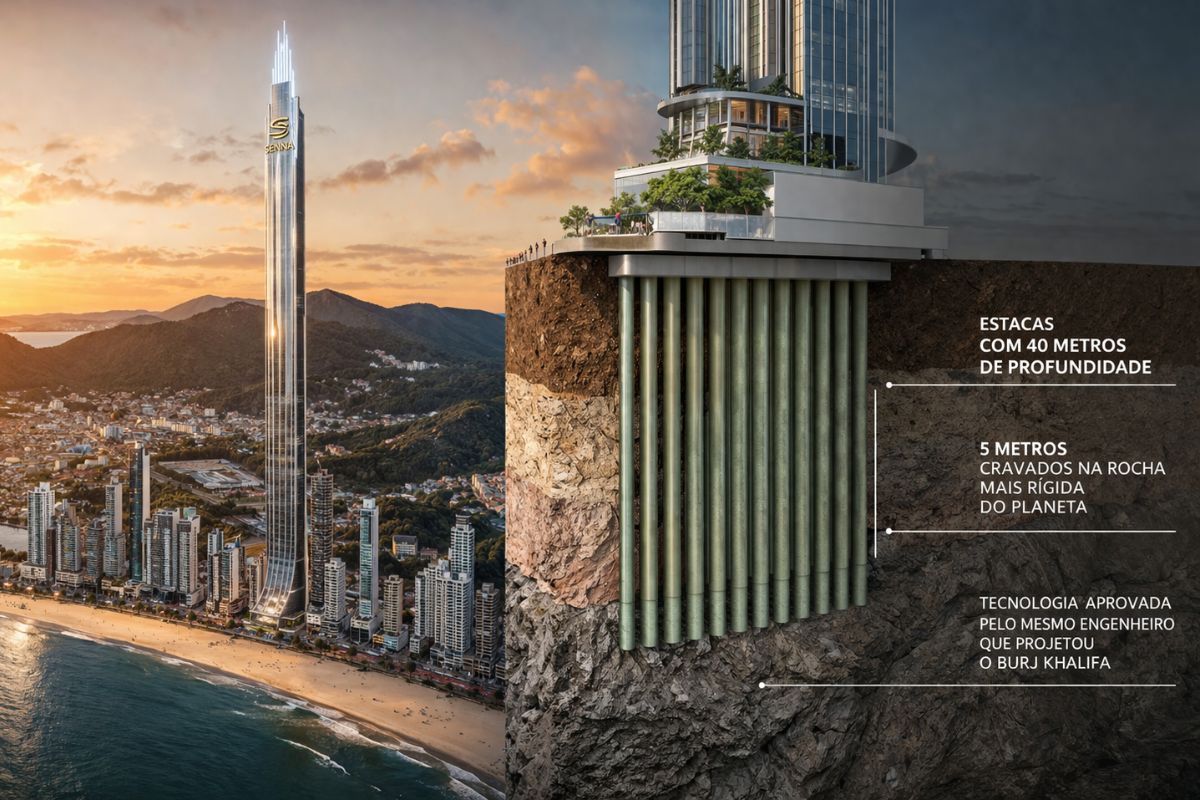
The Senna Tower, in Balneário Camboriú, is using a groundbreaking foundation technology: Auger Caster piles that exceed 40 meters in depth, with about 5 meters driven directly into the rock, supported by a mega drill worth R$ 50 million and with technical approval from the engineer who designed the foundations of the Burj Khalifa.
According to the portal ndmais, the construction of the Senna Tower, in Balneário Camboriú, on the Northern Coast of Santa Catarina, has just revealed a stage that places the project on a technical level comparable to the tallest skyscrapers in the world. The foundation of the Senna Tower uses a groundbreaking technology: Auger Caster piles that exceed 40 meters in depth, with approximately 5 meters driven directly into a rock mass considered one of the hardest on Earth. The solution was designed after four years of technical studies and involved national and international specialists in supertall projects.
The team assembled for the foundation of the Senna Tower includes names who have signed some of the most iconic buildings on the planet: Harry Poulos from Tetra Tech, who worked on the Burj Khalifa and the Dubai Tower; Fatih Yalniz, responsible for 111 West 57th Street, the slenderest skyscraper in New York; and Ricardo Born, a Brazilian reference in foundation projects for high-rise buildings. And as support for this stage, the construction has a mega drill valued at over R$ 50 million, equipment that allows simultaneous drilling and concreting.
What makes the foundation of the Senna Tower groundbreaking in the world

The land where the Senna Tower is being constructed presents an extreme geological condition: an exceptionally hard rock mass just below the surface.
-
The drought may be pushing a much larger crisis than just a lack of water; in addition to affecting crops, reservoirs, and cities, it can also help strengthen bacteria that no longer respond well to antibiotics.
-
A resident of Santa Catarina found a tunnel over 10,000 years old dug by animals the size of a car on her own property, and the video of the discovery has already surpassed 3 million views on social media.
-
The coldest region of Brazil will experience very hot weather in the first days of April, with maximum temperatures reaching up to 35 degrees in Rio Grande do Sul, and only in the last week of the month an intense cold front is expected to finally lower the temperatures in the South and Southeast.

-
Goodbye common refrigerator: essential appliance starts to gain competition with technology that preserves food for longer and reduces waste.


The solution developed for the Senna Tower uses Auger Caster piles, a type of pile that combines continuous helix drilling with direct driving into the rock, something that has never been done before for a building of this size.
Each pile exceeds 40 meters in depth, of which about 5 meters are drilled and driven directly into the rock mass.
According to Stéphane Domeneghini, executive director of Talls Solutions and technical manager for the Senna Tower project, the Auger Caster piles offer a superior level of safety as they are more monitored during execution, throughout construction, and during the building’s lifespan.
Advanced sensors monitor the behavior of the piles and materials in real time, enhancing technical control at all stages of the Senna Tower construction.
The R$ 50 million mega drill that drills and concretes at the same time for the Senna Tower
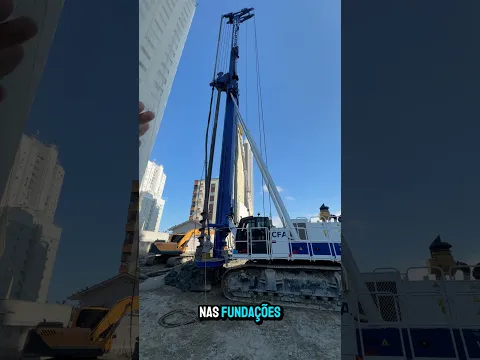

To execute the piles that support the Senna Tower, the construction has equipment up to the challenge: a large-scale mega drill valued at over R$ 50 million, with continuous helix technology that allows simultaneous drilling and concreting.
In practice, this means that while the drill advances through the ground and penetrates the rock, concrete is already being injected behind it, eliminating the risk of hole collapse and increasing the productivity of the operation.
In addition to efficiency, the technology used in the Senna Tower aims to reduce impacts on the surroundings. The piles are considered less polluting and faster than traditional methods, as well as causing less interference in the neighborhood, a relevant factor in Balneário Camboriú, where the construction is surrounded by residential buildings and busy commercial areas.
Even with the large number of piles needed to support the structure, the process is designed to minimize noise, vibration, and dust.
From Burj Khalifa to Senna Tower: the engineers behind the foundation in Balneário Camboriú
The foundation project of the Senna Tower has technical approval from Harry Poulos, an engineer from Tetra Tech who has worked on projects like the Burj Khalifa in the United Arab Emirates and the Dubai Tower in Doha, Qatar—two of the tallest and most complex buildings ever constructed.
The design of the foundation solution is signed by Ricardo Born, a Brazilian reference in foundation projects for skyscrapers.
The structural development of the Senna Tower is credited to Fatih Yalniz, the engineer responsible for 111 West 57th Street in Manhattan, known as the slenderest skyscraper in the world, with a height-to-width ratio that defies the laws of physics.
The concrete technology was developed by Prudencio from Prudencio and Weidman, specialists in solutions for high-complexity concrete in high-rise buildings.
“For a unique project like the Senna Tower, we brought together national partners and the greatest global reference on the subject,” said Jean Graciola, president of FG Empreendimentos.
Four years of studies to solve a problem that no other building faced
The foundation of the Senna Tower was not designed in weeks it took about four years of technical studies to analyze equipment, suppliers, and construction methods capable of meeting the demands of a building of this size on such a rigid rock.
The result is a solution that, according to the technical team, has no parallel in any other construction site in the world.
The Senna Tower is not just another tall building; it is a project that required the creation of a specific engineering solution for its land, involving professionals who have signed the most emblematic buildings on the planet.
When the only way to solve a problem is to invent the solution, the level of complexity of the Senna Tower becomes clear: piles that did not exist, R$ 50 million equipment, engineers from the Burj Khalifa, and four years of research—all to ensure the building stands on one of the hardest rocks in the world, in Balneário Camboriú.
The Senna Tower and the foundation that had to be invented
The foundation stage of the Senna Tower is, in itself, a milestone in engineering: unprecedented piles of 40 meters driven into extremely hard rock, a R$ 50 million mega drill, real-time monitoring by sensors, and a technical team that includes the names behind the Burj Khalifa and the slenderest skyscraper in New York.
All of this in Balneário Camboriú, on the Santa Catarina coast—a city that already had the tallest buildings in Brazil and now hosts a foundation technology that does not exist anywhere else on the planet.
The Senna Tower is still in the early stages, but what has already been done underground impresses more than many completed buildings. The question now is: what will emerge above it?
Are you following the construction of the Senna Tower? What do you think about Balneário Camboriú using the same technical team as the Burj Khalifa? And does it make sense to invest R$ 50 million just in the drill? Leave your opinion in the comments.






Seja o primeiro a reagir!