





 Portuguese
  English
  Spanish
  5 min of reading
  0 comments


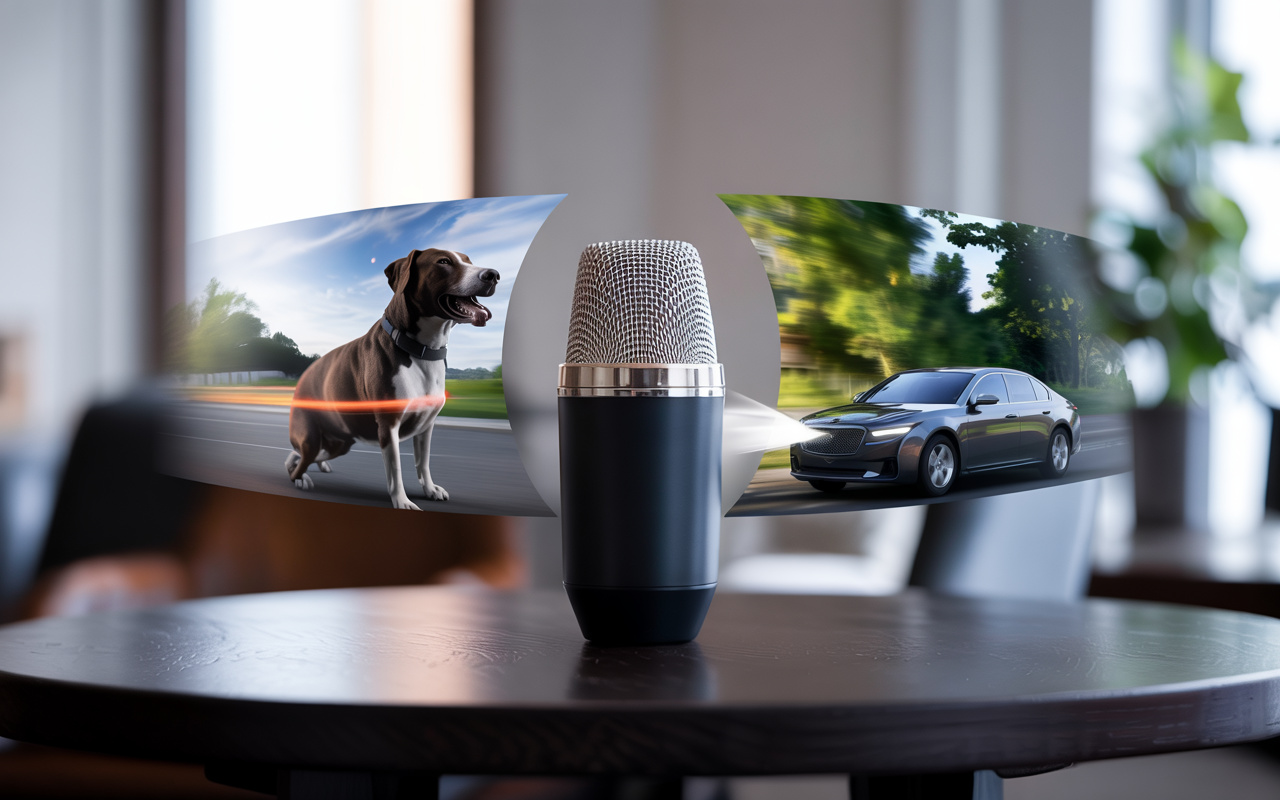
Discover How Neural Cancellation Microphones with Built-In DSP Are Revolutionizing Audio Capture by Isolating the Human Voice with Precision and Eliminating Noise Like Wind, Engines, and Barking in Real Time
Microphones equipped with artificial intelligence are revolutionizing the way we communicate, especially in noisy environments. With neural cancellation technology, these devices eliminate unwanted sounds like wind, dog barking, and engine noise, preserving only the user’s voice with impressive clarity. This innovation has direct applications in video calls, live broadcasts, podcast recordings, and hybrid corporate environments, where audio quality is essential.
Solutions like NVIDIA Broadcast, Krisp, and new microphones with built-in DSP make this technology more accessible, allowing for professional communication in any situation. Artificial intelligence is already integrated into the daily lives of millions of users, shaping the way we interact and produce content.
How Neural Cancellation Works with Artificial Intelligence
Neural cancellation is an advanced technique based on deep neural networks trained to recognize the human voice and distinguish non-vocal noise.
-
Motorola launched the Signature with a gold seal from DxOMark, tying with the iPhone 17 Pro in camera performance, Snapdragon 8 Gen 5 that surpassed 3 million in benchmarks, and a zoom that impresses even at night.

-
Satellites reveal beneath the Sahara a giant river buried for thousands of kilometers: study shows that the largest hot desert on the planet was once traversed by a river system comparable to the largest on Earth.

-
Scientists have captured something never seen in space: newly born stars are creating gigantic rings of light a thousand times larger than the distance between the Earth and the Sun, and this changes everything we knew about stellar birth.

-
Geologists find traces of a continent that disappeared 155 million years ago after separating from Australia and reveal that it did not sink, but broke into fragments scattered across Southeast Asia.
Unlike conventional filters, which apply static algorithms to reduce background noise, neural cancellation learns audio patterns and recognizes them in real time, isolating speech with high precision.


This technology dynamically adapts to changes in the environment, allowing it to handle intermittent and unpredictable noises — such as dog barking, honking, or moving wind. It analyzes frequency spectra in fractions of a second and silences components that do not match the signature of human speech, keeping the audio clean and intelligible.
This precision is the result of prior training on vast databases of audio. The neural networks are fed thousands of samples containing various voices and noises to learn to differentiate what should be kept and what should be filtered out.
Main Solutions for Noise-Canceling Microphones
NVIDIA Broadcast

The NVIDIA Broadcast applies AI and deep learning to enhance the quality of microphones, cameras, and speakers.
Its AI noise cancellation feature is among the most effective available and is compatible with any microphone, making it ideal for content creators, streamers, and professionals who rely on good online communication.
Additionally, NVIDIA Broadcast allows for the application of video background effects, facial tracking, and other visual features that make communication more engaging. Its audio engine can also reduce reverberations and echoes, creating a virtual acoustic environment even in poorly acoustically prepared rooms.
Krisp
The Krisp is a lightweight neural cancellation software used by millions of users in video and voice calls. The solution is already integrated into platforms like Zoom, Skype, Discord, and Microsoft Teams.
Krisp’s differentiation lies in its wide compatibility with operating systems and ease of activation. The app runs in the background and intercepts the audio signal between the microphone and the system, applying filtering even before the sound reaches the recipient.
Microphones with Built-In DSP
Brands like Shure, Rode, and Logitech are launching smart microphones with built-in DSP, which integrate noise cancellation directly into the hardware. This reduces dependence on external software and ensures better performance in real time, even on simpler computers or mobile devices.
These microphones with built-in DSP are especially useful for journalists, podcasters, teachers, and remote professionals who require reliability without complex setups. Local processing ensures lower latency and higher sound fidelity.
Real Benefits of the Microphone That Eliminates Wind, Barking, and Engine Sounds

The adoption of neural cancellation microphones offers a range of practical advantages for diverse user profiles:
- Professional Quality Anywhere: allows for recordings and meetings in noisy environments without compromising speech intelligibility.
- Reduced Need for Acoustic Treatment: makes it possible to record with quality even in non-optimized spaces.
- Time and Resource Savings: avoids rework in audio editing and speeds up content production flows.
- Accessibility and Digital Inclusion: people living in noisy urban areas or with pets can now participate in video conferences or produce content with professional quality.
- Versatility: noise-canceling microphones can be used on both mobile devices and professional studio setups.
The Growth of Smart Microphones in the Technology Market
With the advancement of artificial intelligence, smart microphones have become central to communication devices. Currently, neural cancellation microphones are found in webcams, laptops, headphones, and even high-end smartphones.
Companies like Microsoft and Google have invested heavily in integrating these technologies into their corporate tools. The Microsoft Teams, for example, already uses AI to automatically reduce noise in meetings. Google Meet has also added a noise cancellation feature that operates in the browser.
This movement shows that the market recognizes the importance of sound clarity as one of the pillars of productivity and a good user experience.
Challenges Faced by Microphones with Neural Cancellation
Despite advancements, the technology of microphones with neural cancellation still faces some obstacles. In environments with very intense or chaotic noise, there may be distortion of speech or even suppression of important audio segments. The challenge is to ensure that only noise is eliminated without affecting the intonation or naturalness of the voice.
Another technical issue is the impact on energy consumption. In portable devices, continuous use of AI to process audio may result in reduced battery life. Therefore, balancing performance and energy efficiency is still an active development field.
Privacy is also under debate. Although most solutions, like NVIDIA Broadcast and Krisp, operate locally, there is a growing concern about the collection and use of voice data. Ensuring transparency and security is crucial to maintaining user trust.
Future Trends in the Use of Smart Microphones with Noise Cancellation
With the advancement of machine learning and edge AI, smart microphones will become even more autonomous and contextual. Soon, these devices will be able to identify user behavioral patterns and adapt the level of cancellation according to the type of activity — whether a formal meeting, a casual chat, or a podcast recording.
New applications are also emerging, such as microphones with multiple operating modes: studio recording, live broadcasting, group calls, and more. This flexibility will be made possible through local signal processing and IA-based customization.
A New Standard of Quality in Digital Communication
Investing in a smart microphone with neural cancellation has ceased to be a luxury and has become a fundamental strategy for those who depend on quality communication. Whether for video conferences, live broadcasts, or professional recordings, having a microphone that eliminates wind, barking, and engine sounds is a way to ensure clarity and efficiency.
With the popularization of microphones with built-in DSP and the maturation of solutions like NVIDIA Broadcast and Krisp, crystal-clear audio is becoming the new norm. The trend is that, in a short time, any user — from content creators to remote professionals — will demand this quality as standard.
As artificial intelligence integrates into our daily lives, neural cancellation solidifies as one of the pillars of the digital communication of the future. We are facing a new phase where hearing and being heard clearly will no longer be a differential — it will be a basic requirement of the digital age.







-

-

-

-

-

14 pessoas reagiram a isso.