





 Portuguese
  English
  Spanish
  3 min of reading
  0 comments


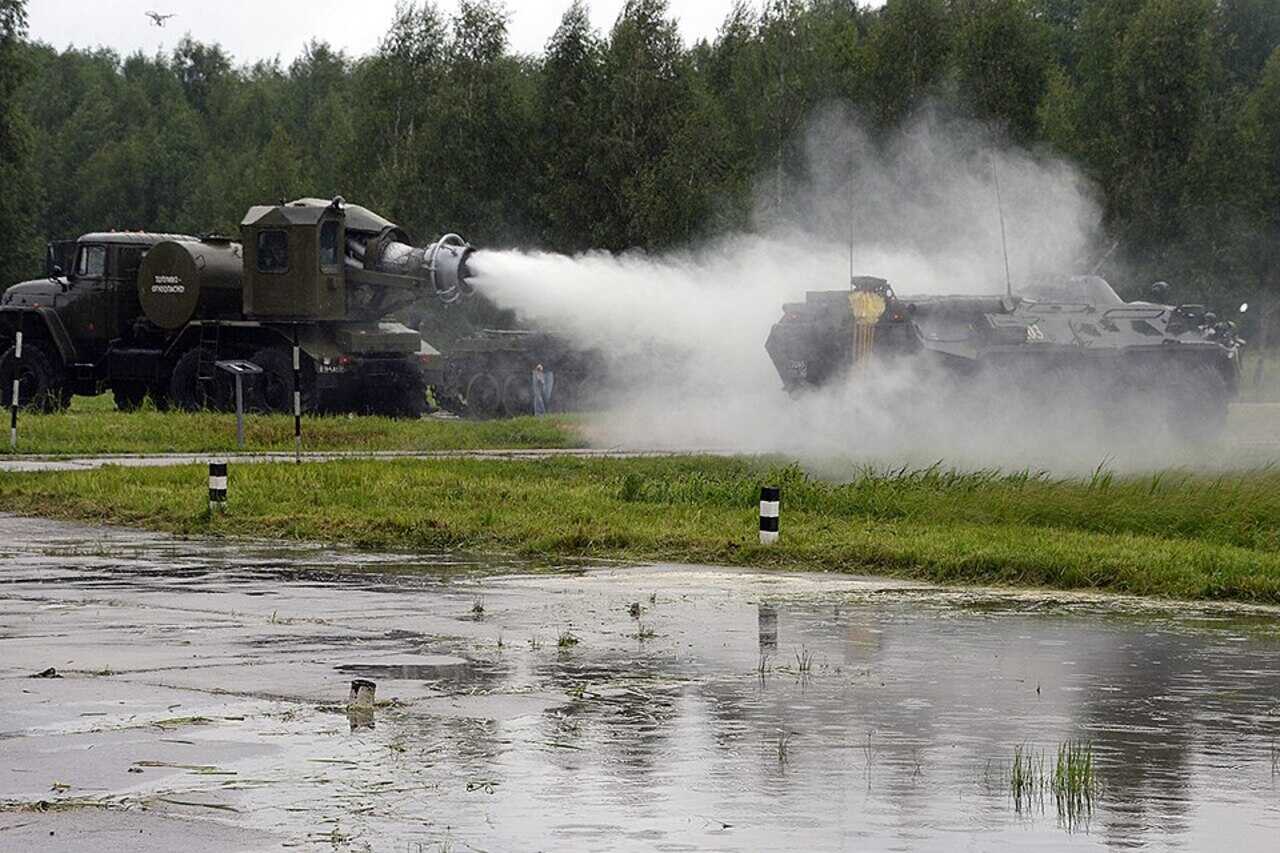
During The Cold War, Soviets Created A Military Truck With A Fighter Engine To Clean Chemical Weapons — And It Still Works
The Soviet Union is known for its bold creations during the Cold War. Among them, one machine stands out for its size, function, and appearance: a military truck with a fighter engine installed in the rear. Originally created for chemical decontamination, the vehicle remains in use in Russia, even after decades.
An Uncommon Idea
During the years of the Cold War, the advancement of chemical weapons led the Soviets to seek solutions to clean exposed equipment.
It was in this context that the TMS-65U emerged, a military vehicle that looks like it came out of a science fiction movie.
-
A French brand placed a car on four huge red balloons to prove that its suspension made the vehicle “float,” and the surreal scene became one of the most iconic and unusual images in automotive history.

-
Jeep Avenger begins production in Brazil, debuting as the brand’s new entry-level SUV and inaugurating an unprecedented phase by becoming the first national Jeep manufactured outside of Goiana, as part of a R$ 3 billion plan.
-
Costing R$ 12,490, the new Shineray Urban Lite 150 “cheap one” arrives in Brazil with a CVT transmission, digital dashboard, and LED lights, making it more affordable than the Biz and targeting those who want to abandon the bus.
-
Ducati brings to Brazil the Superleggera V4 Centenario: 228 hp that become 247 with a track kit, carbon fiber and carbon-ceramic brakes, estimated price between R$ 1.5 and 2 million, deliveries only in 2027.


The system’s structure is formed by a Ural 375 truck, with six-wheel drive and a large payload capacity. At the rear, engineers installed a 900-liter tank and a turbojet engine.
The most curious detail is the origin of this engine. It is the Kilmov VK-1, previously used in combat aircraft such as the MiG-15, MiG-17, and the Il-28 bomber.
After these models were replaced by more modern fighters, such as the MiG-19 and MiG-21, the old engines became obsolete. But instead of being discarded, they were repurposed.
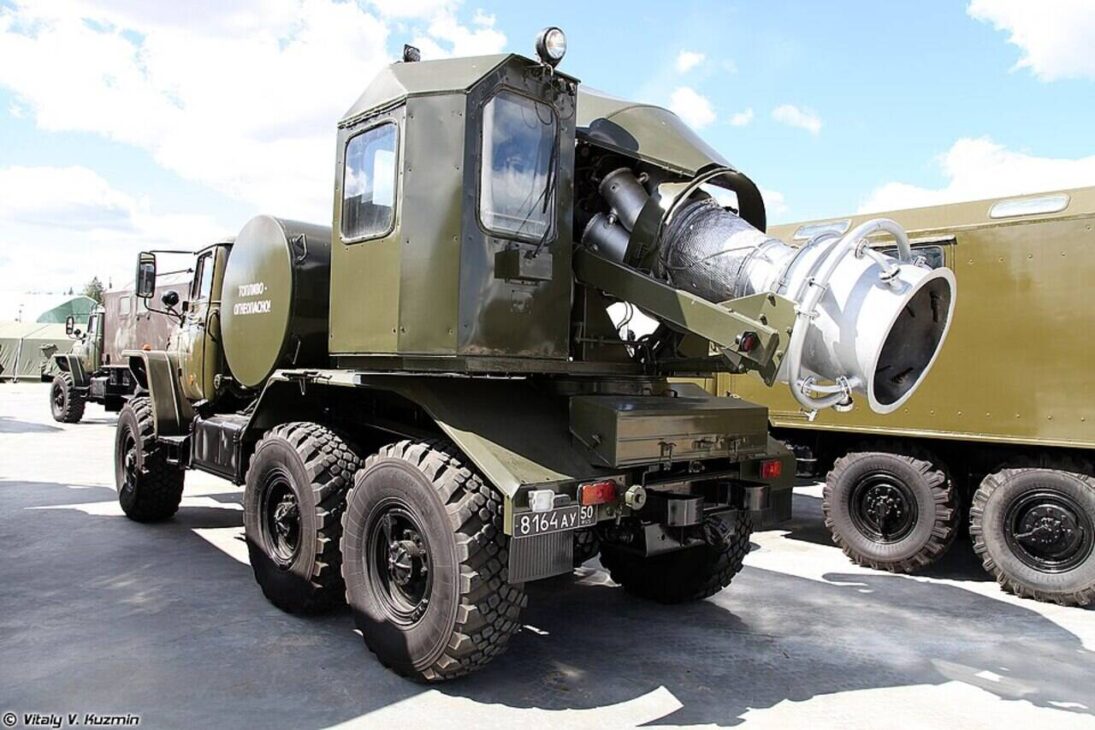
License: CC BY-SA 4.0
How It Works
The operation of the TMS-65U is straightforward. The VK-1 turbojet is modified to release a jet of hot air mixed with decontaminating fluid.
The result is a powerful blast of gas at high temperature, capable of quickly cleaning contaminated surfaces.
This jet is directed by an adjustable tower, allowing the operator to aim it accurately.
The system is effective for removing chemical and biological substances adhered to tanks, aircraft, or ships. The combination of heat with the fluid makes the cleaning faster and deeper than traditional methods. It’s like a turbocharged pressure washer, but adapted for military use.
Despite its efficiency, the TMS-65U has disadvantages. Fuel consumption is high, due to the power of the jet engine.
Another risk is the possibility of spreading chemical contaminants into the surrounding environment if not operated carefully. Still, the vehicle continues to be used, even in present-day Russia.
More Than Decontamination
In addition to its original decontamination function, the TMS-65U also has other applications. One of them is in the battlefield, where it can launch dense smoke screens.
This fog prevents the enemy from visualizing troop movements, functioning as a temporary shield.
Another relevant use occurs in cleaning runways. The VK-1 engine, utilized in the TMS-65U, is also employed to remove snow or debris in places like aircraft carriers, such as the famous Russian ship Kuznetsov. Its power allows it to clear large areas quickly.
Legacy Of The VK-1 Engines
The VK-1 engine, created based on the British Rolls-Royce Nene, has a long history. Its use started in Soviet military aviation in the 1950s.
Even after more than 80 years since its creation, it still finds application in various roles. Besides the TMS-65U and runway cleaning, it was also used in an experimental train in the 1970s that reached 250 km/h.
The versatility and durability of the engine are notable points. Even with the passage of time and technological advancements, it remains useful in various situations.
TMS-65U: A Solution That Survived The Test Of Time
The TMS-65U is one of the most curious machines developed during the Cold War. The idea of transforming a truck into a platform with a turbojet for decontamination may seem exaggerated, but it proved to be functional.
Even with over 60 years of age, the system remains in use. And the engine that powers it, with over eight decades of history, continues to blow hot air wherever needed.
With information from Xataka.









Seja o primeiro a reagir!