





 Portuguese
  English
  Spanish
  5 min of reading
  0 comments


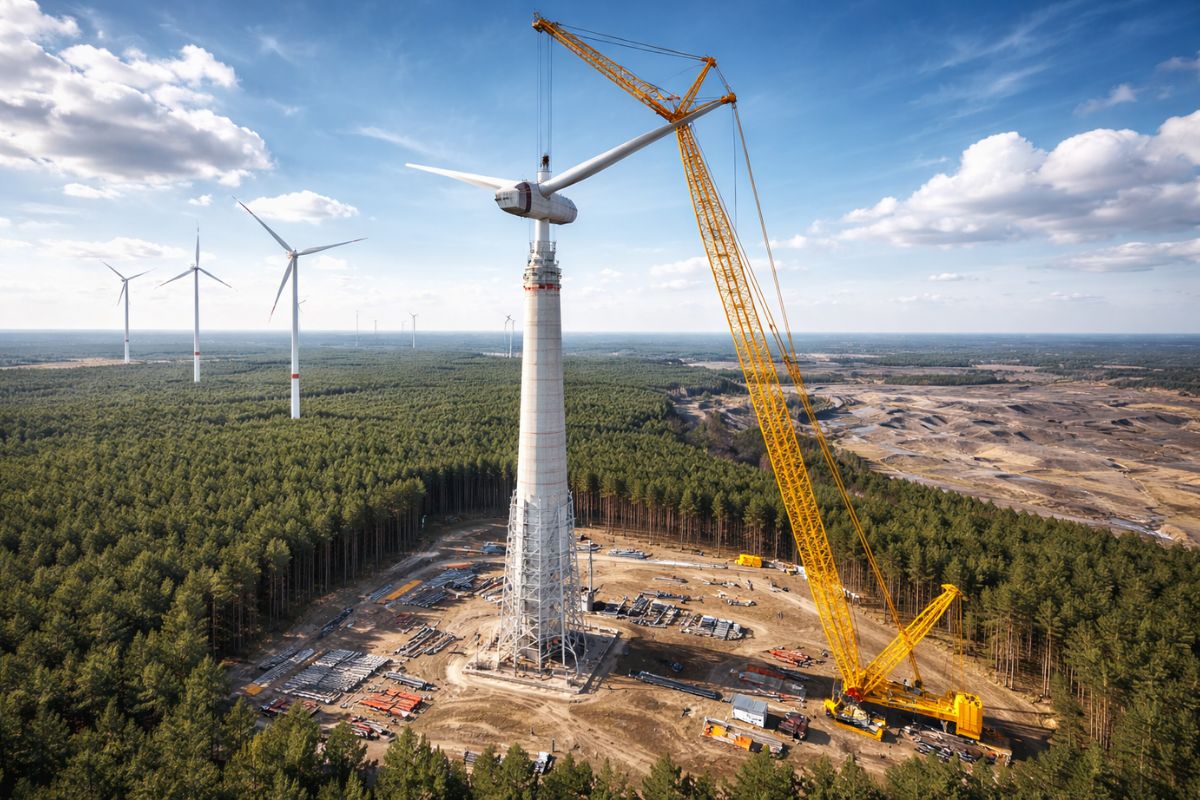
The wind turbine in Brandenburg rises with a telescopic system, seeking stronger winds above 300 meters and promises to increase annual generation with more stable production
The tallest wind turbine in the world is being erected in Schipkau, a small town in Brandenburg, Germany, in an area marked by decades of coal mining. The project symbolizes a concrete turn towards clean energy, with a construction site dominated by a giant crane, steel beams, and a lattice mast that grows towards the sky.
If everything goes as planned, the wind turbine is expected to be connected to the power grid by the end of 2026. The structure relies on a simple yet ambitious concept: to capture stronger and more constant winds at altitudes above 300 meters to produce more energy with greater predictability.
Why a 360-meter wind turbine changes the game
When completed, the wind turbine will stand 360 meters tall, equivalent to a 100-story building. It is expected to become the second tallest structure in Germany, surpassed only by the Berlin television tower, which stands at 368 meters.
-
They spent up to 5 hours a day underwater, and their bodies changed because of it: discover how human populations developed impressive biological adaptations to survive in the most extreme environments on Earth.

-
Shenzhen showcases high technology in China: deliveries by drones and autonomous robots, driverless taxis with sensors, smart hotel with AI, humanoid and surgical robots, automated café, and mega station “Shenzhen Eye.”

-
Cambridge University creates a solar reactor that transforms hard-to-recycle plastic and battery acid into clean hydrogen, operating for over 260 hours and paving the way to add industrial value to two waste materials that currently lead to disposal and environmental costs.

-
Samsung made a mistake and you need to take advantage before they fix it: the Galaxy S25 FE has dropped in price and now ‘humiliates’ the S26 in cost-benefit with plenty of screen, cameras, and performance.

The advantage of rising so high is straightforward. The wind tends to blow stronger and more consistently at high altitudes, which can allow for the production of more wind energy, even in regions where ground-level winds are weak.
The telescopic system that allows for such height
A question arises: how to lift a wind turbine that is so narrow and self-supporting to such heights if conventional cranes cannot handle the task?
The solution described at the base is a patented telescopic device. First, the turbine reaches about 150 meters. Then, the telescopic system elevates the structure to 300 meters and continues to operate to reach the project’s maximum height.
The challenges in construction and the goal to connect by 2026
The construction of the wind turbine faced obstacles. By the end of 2025, issues were identified in steel parts, leading to a halt in progress. The work resumed, with the company highlighting that safety and quality are absolute priorities in a project described as unique in the world.
With the pace recovered, the schedule aims for the connection of the wind turbine to the power grid by the end of 2026, placing the project at the center of bets for renewable generation on a large scale and at unprecedented altitudes.
How much energy the wind turbine is expected to generate and the cost of production
The responsible company claims to expect an annual production of 30 to 33 gigawatt-hours. The projected production cost is less than five cents per kilowatt-hour.
The gain compared to conventional turbines in the region is noted as significant, with an estimated increase of 220%.
The annual production, according to the base, could supply about 7,500 households with four people, a figure that helps to gauge the scale of the project.
The wind measurement that supported the bet on 300 meters
The logic of the high-altitude wind turbine was not put on paper without testing. At the request of beventum GmbH, a subsidiary of the Federal Agency for High-Performance Innovations, the company installed a wind measurement mast in the neighboring town of Klettwitz.
The results indicated that the wind blows stronger and more consistently at 300 meters than at the typical height of conventional turbines. It is this difference that supports the thesis that taller towers can enhance generation in areas with weaker ground winds.
Why the wind turbine is of interest to European countries with less wind
Large regions of Europe, from eastern Poland to the Iberian Peninsula, face difficulties in harnessing wind energy due to weak ground winds. The idea of high-altitude towers is to open an alternative: to generate more stably where conventional turbines yield little.
The strategic vision presented at the base is clear: Europe needs a strong position in the construction of wind turbines to protect its own energy production, reducing external vulnerabilities and increasing system autonomy.
The coal scenario turns into a hybrid hub with wind and solar
Schipkau is located in Lusatia, a region historically associated with coal, but now encourages clean energy projects with space, infrastructure, and political support. The long-term proposal goes beyond a single structure.
The site is set to become a hybrid plant, with two levels of wind energy and a solar park on the ground. The base states that this triple use could quintuple energy production compared to exclusive use of solar energy, in addition to favoring generation throughout the year.
The bottleneck of the electric grid and the waste of clean energy
The advancement of renewable energy faces a growing problem: obsolete electric grids cannot keep up with expansion.
In Germany, this creates a costly irony: when more electricity enters the northeast of the country, a region with many winds, than the transmission can carry to the south, where consumption is high, turbines need to reduce production or shut down.
The base cites an analysis from the Tagesspiegel newspaper indicating that about 9.3 terawatt-hours of wind energy were lost in 2023, with congestion management costs reaching nearly 3 billion euros, passed on to consumers through grid fees.
The bet is that the high-altitude wind turbine can alleviate this dilemma in the long term by allowing for more decentralized expansion, as more uniform winds at altitude can enable economic generation in more places.
Europe accelerates wind energy and Germany leads the pace
By the end of 2025, there were about 304 gigawatts of installed wind energy on land and at sea in Europe. Germany led with 77.7 gigawatts, followed by the United Kingdom with 31.6 gigawatts and Spain with 31.2 gigawatts.
In newly installed capacity, Germany added 5,735 megawatts in 2025, more than any other European country that year.
And the movement continues: the government presented the Climate Protection Program 2026 with 67 measures to save an additional 25 million tons of CO₂ by 2030, in addition to planning more auctions and 12 gigawatts of wind energy in bidding for connection to the power grid by 2030.
Do you think such a tall wind turbine will become the standard in Europe or will it remain an exception due to cost and complexity?





Seja o primeiro a reagir!