





 Portuguese
  English
  Spanish
  5 min of reading
  0 comments


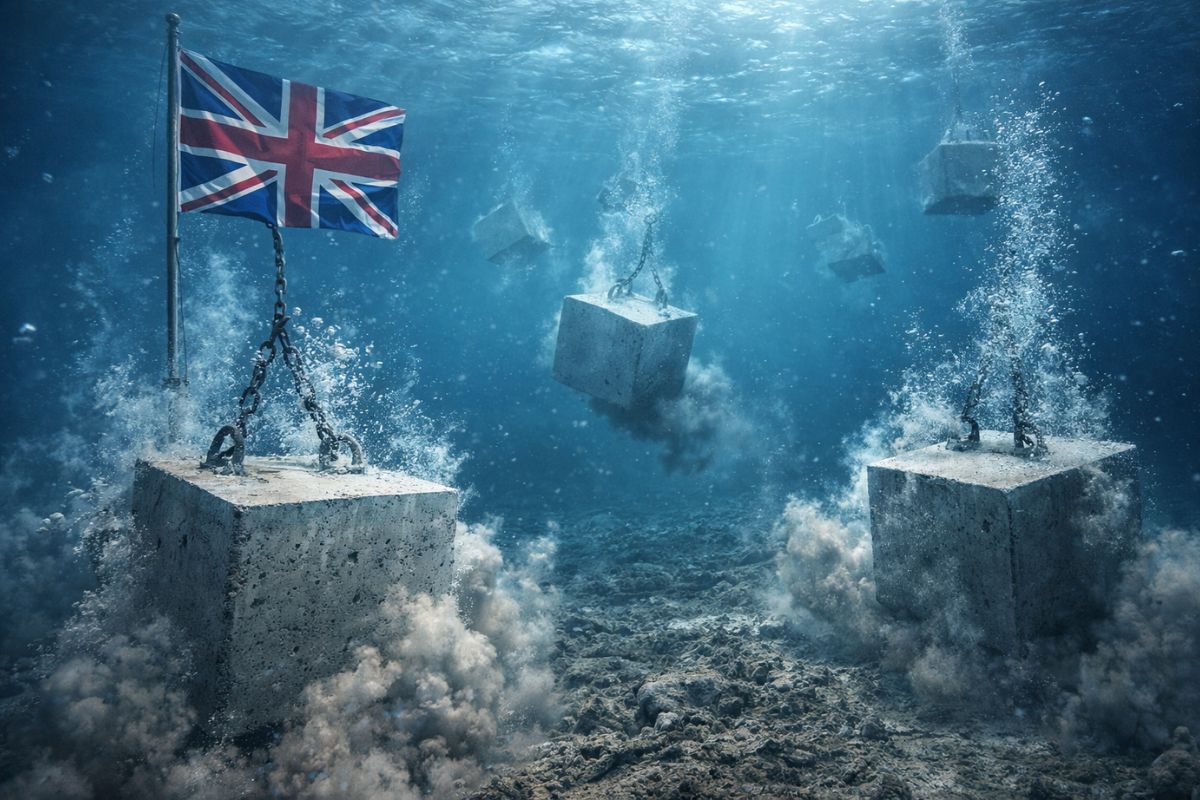
Twenty special concrete blocks, each weighing six tons and carrying 4 thousand native oysters, were dropped to the bottom of the North Sea off the coast of Tyne and Wear, in the United Kingdom. The project led by the Zoological Society of London aims to restore oyster reefs lost for more than a century.
When enormous concrete blocks are dumped to the bottom of the sea, the first reaction is often one of strangeness or indignation. But off the coast of the United Kingdom, this seemingly destructive action has become the spearhead of one of the most ambitious ecological restoration projects in Europe. Twenty concrete blocks made with special technology were recently launched off the coast of Tyne and Wear, in the North Sea. Each weighs six tons, stands one and a half meters tall, and carries 4 thousand native European oysters on its surface. The goal is to bring back to life the oyster reefs that the North Sea lost more than a century ago.
The project is led by the Zoological Society of London (ZSL), the Wild Oysters program, and the Groundwork organization. The concrete blocks were developed by the company ARC Marine under the name Reef Cubes and made with a special material called Marine Crete. The surface of each block was designed with rough textures and artificial pores that mimic natural marine surfaces, transforming each cube into a perfect anchor for marine life. The 4 thousand oysters installed on each structure were placed with the help of 190 local volunteers.
Why the concrete blocks weigh six tons: the lesson of the storms

The weight of six tons for each concrete block is not an exaggeration. It is a necessity imposed by the British climate. In the early stages of the project, the team faced devastating storms that completely destroyed all previous restoration attempts.
-
Family without running water in the interior of Ceará takes out a loan to drill an artesian well and discovers possible oil, but cannot use it, cannot sell it, and is left with a debt of R$ 15,000.
-
At 100 years old, an elderly man who dreamed of “making it to the newspaper” finally shares his story, reaching his centenary with children, grandchildren, great-grandchildren, and great-great-grandchildren, moving his family with a life of hard work, farming, honesty, and without vices.

-
Germany proposes silent propellers to solve a centuries-old problem: the damage caused in the ocean by ship noise.
-
What the Public House of Julius Caesar was like inside in the Roman Forum: layout, atrium with compluvium and impluvium, tablinium and peristyle, and the scandal of the Bona Dea, revealed in an AI recreation.


The violent currents and waves of the North Sea swept away lighter structures, making it impossible to establish any oyster colonies on the ocean floor.
The solution was to design massive concrete blocks that could withstand the extreme conditions of the North Sea. Weighing six tons each, the Reef Cubes do not move a centimeter even under the worst storms.
This robustness ensures that the oysters have time to attach, grow, and begin filtering the water without their new home being destroyed by the forces of nature. The engineering behind each concrete block is as important as the biology of the oysters it carries.
The filtering power of oysters: 200 liters of water per day per animal

Oysters were not chosen just for their gastronomic value. They are considered the great purifiers of the ocean. A single adult oyster can filter up to 200 liters of water per day. While feeding, oysters remove pollutants, nitrogen, and excess nutrients from the water, radically improving the quality of coastal waters.
This natural filtering process allows sunlight to penetrate deeper into the ocean, which stimulates the growth of marine flora.
With 4 thousand oysters in each of the 20 concrete blocks, the project places 80 thousand native oysters on the bottom of the North Sea at once. If each oyster filters 200 liters per day, the set can process up to 16 million liters of water daily.
This volume of filtration transforms the concrete blocks into true biological treatment stations installed on the ocean floor, cleaning the water and restoring conditions that favor the entire surrounding ecosystem.
What are the Reef Cubes and why the Marine Crete material makes a difference
The concrete blocks used in this project are not ordinary construction pieces. They are called Reef Cubes and were developed by ARC Marine with a specific material called Marine Crete, designed to be environmentally friendly and compatible with the marine environment.
The surface of the concrete blocks has been textured with complex roughness and artificial pores that faithfully reproduce the conditions of a natural underwater rock.
This texture is not decorative. It is the factor that allows oysters, crustaceans, and fish to attach to the structure and find refuge. A smooth concrete block would be ignored by marine fauna.
The Reef Cubes serve simultaneously as a new home for bottom-dwelling animals and as an environmental cleaning instrument, as the oysters attached to their surface filter pollutants and improve the quality of the surrounding water. The design of each concrete block is therefore as important as the material it is made of.
From Scotland to Norfolk: the next steps for the largest restored reef in Europe
The project with concrete blocks off the coast of Tyne and Wear is not an isolated case. In Scotland, the technique of using thousands of tons of concrete on the seabed has already been successfully tested.
The results have proven that artificial reefs attract fauna, improve water quality, and create conditions for the natural regeneration of the ecosystem. This success has paved the way for other projects to expand the idea to even larger proportions.
In Norfolk, initiatives like Oyster Heaven and Norfolk Seaweed are already planning the installation of 40 thousand clay reefs by the end of 2026. The goal is to house 4 million juvenile oysters, which would make the project the largest restored reef in all of Europe.
What started with 20 concrete blocks dropped into the North Sea is transforming into a continental strategy for marine restoration. The technique of dumping structures into the ocean has ceased to be synonymous with destruction and has become one of the most promising tools of modern bioengineering.
What do you think of this technique?




Seja o primeiro a reagir!