





 Portuguese
  English
  Spanish
  5 min of reading
  0 comments


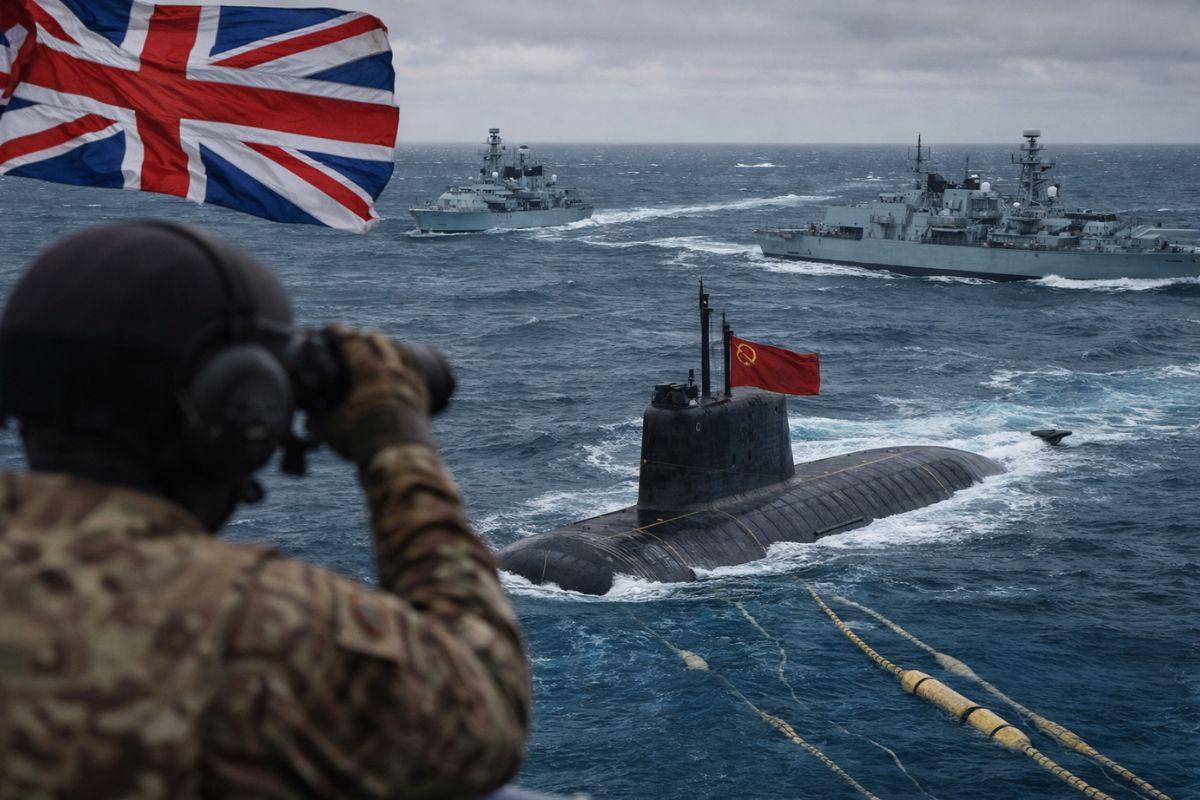
The joint mission with Norway involved frigates, Merlin and Wildcat helicopters, P8 patrol aircraft, and hundreds of military personnel who tracked three Russian vessels until they all retreated northward
The UK government broke its silence on Thursday (9) and revealed a military operation that had been kept secret for weeks. According to the British Ministry of Defence, the country’s armed forces, in conjunction with Norway, monitored for over a month a Russian attack submarine and two spy submarines operating near underwater cables and energy pipelines in the northern British Isles.
The UK Secretary of Defence, John Healey, was direct in the press conference when sending a message to Moscow. According to the Associated Press, Healey stated that “we see your activity around our cables and our pipelines, and you should know that any attempt to damage them will not be tolerated and will have serious consequences.”
And the most concerning thing is that this was not an isolated action.
-
With 10 billion tons of salt, the Salar de Uyuni in Bolivia forms the largest salt desert on the planet, turns into a “giant mirror” visible even from space, and holds one of the largest lithium reserves in the world.

-
With less than R$ 6,000, you can build an underground cistern in your backyard that collects rainwater and eliminates the fear of rationing while reducing your water bill every month.

-
In France, there is a restaurant that prepares its main dish handmade, prioritizes local agriculture, and has become a culinary trend due to a food that Brazilians love.

-
With a lot of talent and creativity, a couple builds a house completely from scratch, using ceramic tiles, a cement base to level the ground, wood for the flooring, ceiling, and entire structure, transforming the construction with slats that fit together and impressing with an impeccable result.

What was a Russian submarine doing so close to the United Kingdom?

According to the British Ministry of Defence, the Russian deployment consisted of an Akula-class submarine, which is a nuclear-powered attack model, and two specialized submarines from GUGI, the Main Directorate of Deep-Sea Research of Moscow. This unit is known for conducting underwater espionage operations and mapping critical infrastructure on the seabed.
The Russian strategy, according to London, was to use the attack submarine as a distraction. While the Akula drew the attention of British forces, the two GUGI submarines were conducting reconnaissance tasks on fiber optic cables and energy systems that run along the North Atlantic seabed. These cables carry most of the international data traffic between Europe and the rest of the world, and any damage to them would have enormous consequences for civil and military communications of various NATO countries.
But how did the United Kingdom discover the operation?
How did the United Kingdom and Norway manage to catch the submarines?

The operation was conducted in partnership with Norway, which signed a defense agreement with the United Kingdom to enhance cooperation in monitoring underwater threats in the region.
On the British side, the Ministry of Defence mobilized the HMS St Albans frigate, the RFA Tidespring logistics ship, Merlin and Wildcat helicopters, and RAF P8 maritime patrol aircraft. The aircraft used sonobuoys to accurately locate the positions of the Russian vessels in the depths of the Atlantic. Additionally, the HMS Somerset and HMS Mersey frigates, along with the RFA Tideforce tanker, monitored the movements of Russian warships in strategic areas such as the English Channel and the North Sea.
According to Diário do Grande ABC, which reproduced the report from the Associated Press, the Russian vessels ended up retreating northward after the operation, failing to cause damage to the monitored underwater infrastructure.
However, the problem is bigger than it seems.
Why is Russia targeting cables on the ocean floor?
Here comes a fact that few people know: more than 95% of all international data between continents passes through underwater fiber optic cables. We are talking about government communications, financial transactions, internet services, and even defense systems of entire NATO countries. Cutting one of these cables is not just about taking someone’s internet down. It’s about paralyzing a country’s infrastructure.
In the last two years, European authorities have recorded a significant increase in Russian naval activity in regions close to cables and underwater pipelines. Incidents in the Baltic Sea, including damage to gas pipelines and telecommunications cables, have already raised suspicions about Moscow’s involvement. The operation revealed today by the United Kingdom reinforces that underwater warfare, discreet and away from the spotlight, has become one of the main fronts of confrontation between Russia and the West.
And this tension has been growing for months.
What had already happened before this operation?
In November 2025, John Healey himself publicly denounced that the Russian spy ship Yantar had entered British waters north of Scotland and directed lasers at RAF pilots who were monitoring its movements. At the time, according to CNN Brasil, Healey stated that the government had changed the Navy’s rules of engagement to allow closer monitoring of Russian activities.
At the end of March 2026, the United Kingdom announced that its armed forces were authorized to seize vessels suspected of being part of the so-called “ghost fleet” of Russia, made up of ships transporting oil in violation of international sanctions imposed due to the war in Ukraine. According to London, about 75% of Russian crude oil is transported by this network, on which the United Kingdom has already imposed sanctions on 544 vessels.
John Healey also made it clear that the United Kingdom’s attention is not divided. According to him, “Putin would like us to be distracted by the Middle East,” but Russia remains the main threat to the security of the country and its NATO allies.
But what does Moscow have to say about all this?
What did Russia respond?
The Kremlin spoke out on Thursday through its spokesperson, Dmitri Peskov, who confirmed that a Russian Navy ship escorted tankers from the “ghost fleet” as they passed through British waters. Peskov stated, as reported by the Spanish newspaper El Español, that “Russia considers itself entitled to defend its interests and will certainly take measures to do so.” The spokesperson also accused the United Kingdom of committing “repeated acts of piracy in international waters” that affect Russia’s economic capacity.
What will the United Kingdom do now?
The British government did not stop at words. London announced that it will allocate an additional £100 million to strengthen the P8 patrol aircraft fleet and launched the Atlantic Bastion program, focused on autonomous systems and state-of-the-art sensors to protect critical infrastructure on the ocean floor.
The message is clear: the bottom of the Atlantic has become a silent battlefield, and the United Kingdom is telling Russia, and the world, that it does not intend to watch from afar.
With information from the Associated Press, UK Ministry of Defence, CNN Brasil, Diário do Grande ABC, and El Español.







Seja o primeiro a reagir!