





 Portuguese
  English
  Spanish
  6 min of reading
  0 comments


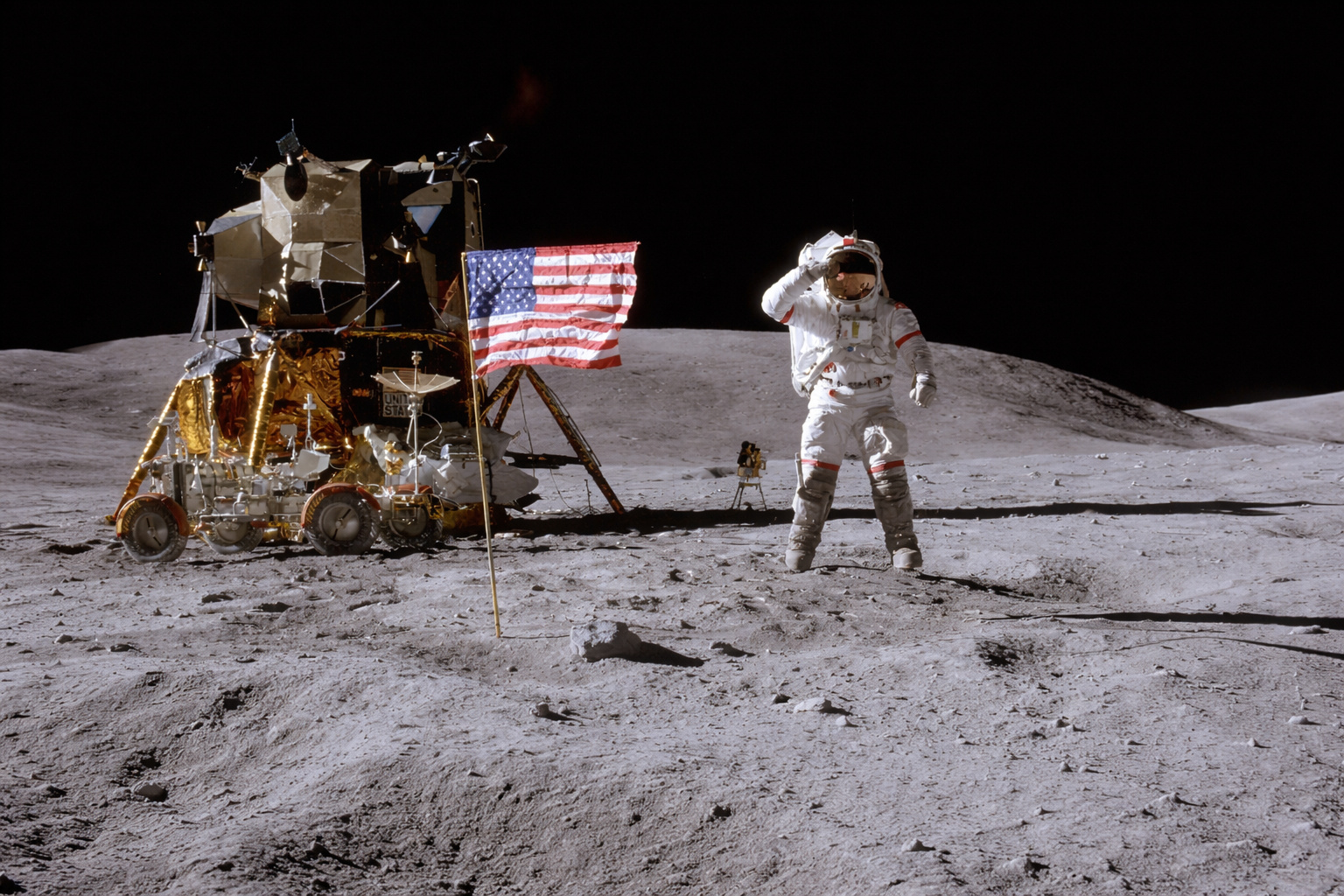
NASA, Moon, United States flag, Apollo, astronauts, Earth’s natural satellite, and the University of California help explain what still exists on the lunar surface, why this legacy has aged brutally, and how it has returned to the center of space debate.
On the Moon, NASA left more than footprints: the United States flag planted by Apollo astronauts on Earth’s natural satellite still sparks curiosity, even among scholars at the University of California, because it has become a rare symbol of how time acts outside of Earth.
Between 1969 and 1972, six successful Apollo missions planted six American flags on the lunar surface. Decades later, images from the Lunar Reconnaissance Orbiter show that at least three of them still appear to be standing: those from Apollo missions 12, 16, and 17.
The one from Apollo 11, the first of all, likely fell at the moment of the lunar module’s launch, as Buzz Aldrin reported.
-
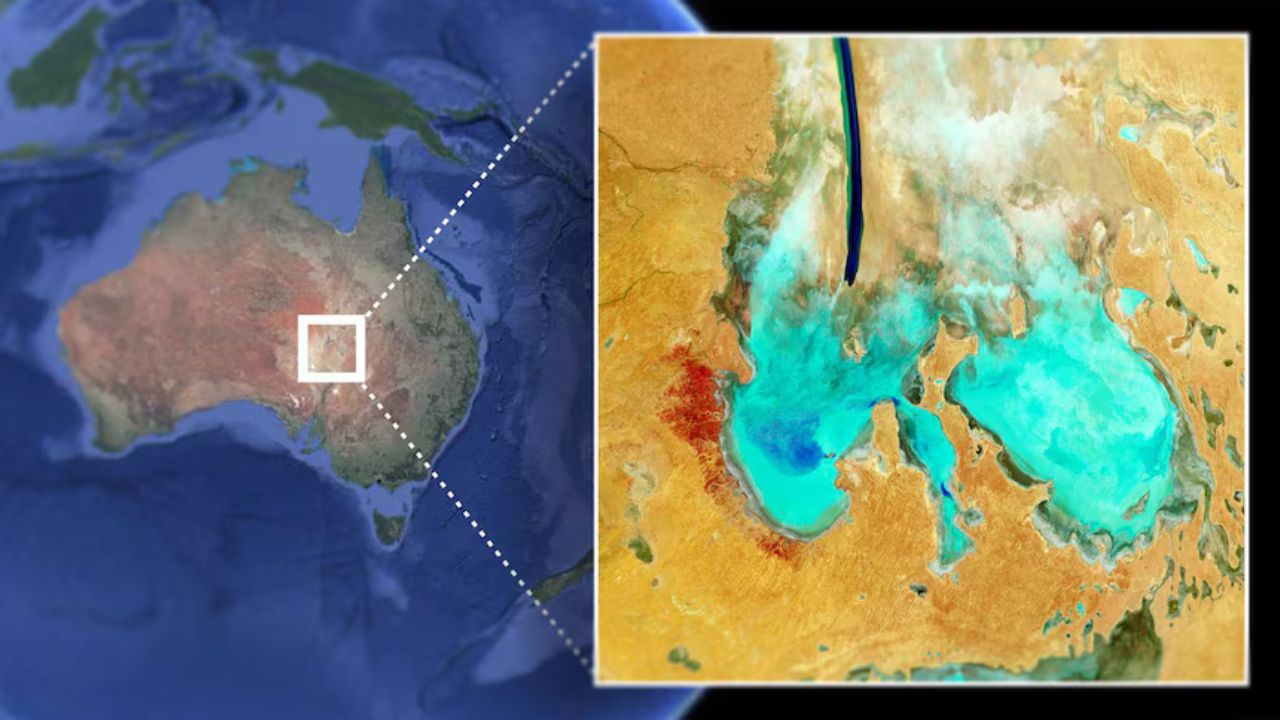
Frequently highlighted in images from NASA, the “lake that shouldn’t exist” in the heart of the Australian desert is 15 meters below sea level and suddenly turns into a colorful inland sea that appears and disappears, reshaping the Outback with each flood.
-
In Antarctica, a building has just achieved a certification that only 1% of accredited buildings worldwide can attain, in an engineering feat erected in one of the most hostile environments on the planet.

-
A Meta employee is accused of downloading over 30,000 private photos of Facebook users, and one of them could be you.

-
A diver found a 900-year-old sword at the bottom of the Mediterranean Sea, and its state of preservation impressed scientists so much that it could rewrite what is known about the Crusades.

As for the flags from Apollo 14 and 15, they remain in limbo: the images do not allow for a definitive conclusion about their current state.


NASA, Moon, Apollo, astronauts, and the United States flag on Earth’s natural satellite
The scene that entered history does not show the full harshness of the place. The flag taken by NASA was a common piece of nylon, in the 3 by 5 feet pattern, adapted to work in a windless environment. To achieve this, engineers created a mast with a horizontal bar, capable of keeping the fabric taut even in the absence of atmosphere.
The detail seems simple, but it was an engineering solution made under pressure, designed for a scenario where even holding an object was complicated due to the astronauts’ suits.
However, standing does not mean remaining intact. Without a real atmosphere to filter radiation and soften the climate, the lunar surface undergoes violent extremes. NASA itself highlights that near the Moon’s equator, temperatures can exceed 121°C during the day and plummet to around -133°C at night.
In this environment, the most accepted hypothesis is that the flags have severely faded, perhaps even turned white, in addition to becoming brittle over time. “The nylon of the flag likely degraded as a result of prolonged exposure to sunlight,” said Anne Platoff, a historian affiliated with the University of California. Add to this the constant bombardment of micrometeorites, and the most likely result is a fragile, torn fabric, far from its original appearance.
University of California explains why the United States flag on the Moon did not escape time
The idea that the Moon preserves everything forever is seductive, but it does not tell the whole story. Footprints and equipment can last a long time there because there is no wind or rain erasing marks as happens on Earth.
At the same time, open space takes a heavy toll on any exposed material. That is why the discussion about the flags has grown: they are not just reminders of Apollo, but a real test of how human objects age in a vacuum, under direct solar radiation, and in extreme cycles of heat and cold.
This topic has gained even more traction now because lunar exploration has returned with full force. Artemis II, launched on April 1, 2026, marked the first crewed flight around the Moon in over 50 years and has placed Earth’s natural satellite back at the center of NASA’s plans.
At the same time, the ESA reminds us that more than 100 lunar missions are planned worldwide by 2030. In other words: what was once a distant historical memory has now returned to a neighborhood of heavy traffic.

NASA, Moon, United States flag, Apollo, astronauts, Earth’s natural satellite, and the University of California in the ethical debate
This is where the conversation changes tone. If new missions are going to land, orbit, and perhaps even pave the way for space tourism in the future, preserving the remnants of Apollo ceases to be a whim and becomes a concrete problem.
Michelle Hanlon, from For All Moonkind, sums this up directly: “Our history is the most valuable and vulnerable resource we have on the Moon at this moment.” The concern is not theoretical. The World Monuments Fund included the Moon on the 2025 World Monuments Watch list, precisely to draw attention to the need to protect historical sites beyond Earth.
The Artemis Accords already recognize the importance of preserving the heritage of outer space, and the number of signatories reached 61 countries in January 2026.
Even so, there is still a lack of a clear manual on how to avoid damage to these historical points if new missions land too close, kick up too much dust, or interfere with the areas left by the astronauts.
The principle exists. Practical protection, for now, continues to chase the speed of the new lunar race.
Apollo, NASA, and the Moon: when the United States flag became a discussion about sovereignty on Earth’s natural satellite
The controversy actually began even before the flag touched the lunar soil. At that moment, there was already a fear that the gesture would be interpreted as a territorial claim.
The Outer Space Treaty, opened for signature in 1967 and in force since October of that year, makes it clear that the Moon and other celestial bodies cannot be appropriated by national sovereignty.
Still, the political pressure in the United States was significant, and the presence of the flag was maintained as a symbol of national achievement within the context of the space race.
Buzz Aldrin recounted that the flag was purchased for just $5.50 at a store in Houston and described that moment as an “almost mystical unification of all the people of the world at that time.”
Even with this discourse of universal reach, the gesture was never neutral. “At the time, the question of whether the United States should raise a flag on the Moon was very controversial,” said Teasel Muir-Harmony, curator of the Apollo collection at the National Air and Space Museum. “But with pressure from Congress, it was decided to raise a flag on the Moon.”
Anne Platoff also pointed out the symbolic layer hidden in the very design of the mast. The system was created to display the flag without wind, which already shows the level of technical improvisation required by the mission.
But there was more than engineering there. “Of course, the legal status of the Moon would not be affected by the presence of an American flag on the surface, but NASA was aware of the international controversy that could arise as a result,” Platoff wrote in a report for the agency.
University of California, NASA, and the Moon: the other objects left by Apollo astronauts on Earth’s natural satellite
The flags draw attention because they are visually powerful, but they are far from being the only remnants of human passage on the Moon.
The astronauts left television cameras, scientific instruments, parts of modules, lunar rovers, golf balls, and even human waste.
One of the most curious cases is that of the lunar retroreflectors: installed during the Apollo missions, they continue to serve for precise measurements of the distance between the Earth and the Moon more than half a century later, and continue to inspire new versions for current missions.
There are also details that almost go unnoticed but say a lot about the historical weight of this collection. NASA itself reminds us that the flag left by Apollo 17 had a special story: it had already been to the Moon and back on Apollo 11, was displayed in Mission Control, and then made another trip to stay there for good.
This helps to understand why these objects have long ceased to be space junk. They are physical documents of an era that changed humanity’s relationship with the cosmos.
In the end, looking at these flags is looking at two stories at once. One speaks of pride, technology, and ambition.
The other speaks of wear, symbolic dispute, and responsibility. The Moon remains silent, but everything that has been left there still says a lot about what humanity was, and what it intends to become again.
Did you like the topic? Leave your comment telling what you think about the preservation of Apollo’s remnants on the Moon and share this publication with those who enjoy space, science, and history.






Seja o primeiro a reagir!