





 Portuguese
  English
  Spanish
  5 min of reading
  0 comments


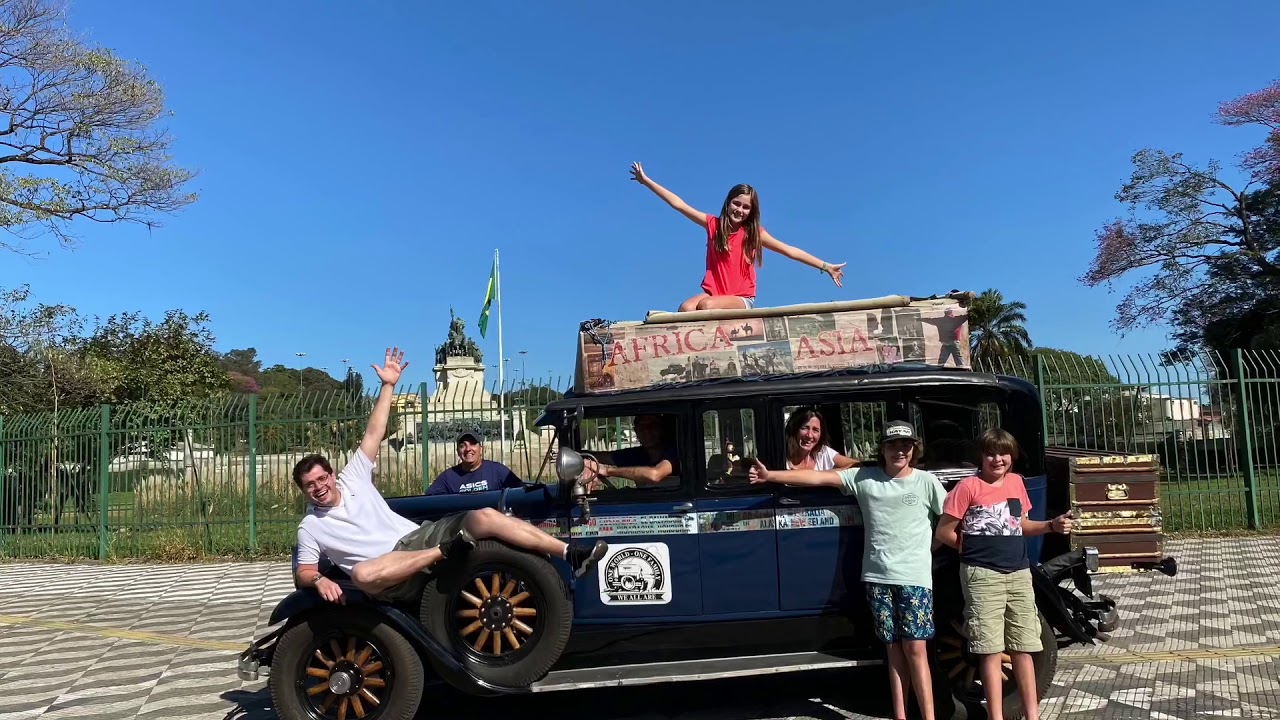
The Zapp Family traveled for 22 years in a 1928 car, crossed more than 100 countries, traveled 362 thousand km, and raised four children during the journey.
In 2000, the Argentine couple Herman Zapp and Candelaria Zapp began a journey that seemed improbable even by global expedition standards. The story was widely documented by outlets such as BBC and Infobae, which followed the family’s return to Argentina in 2022, after more than two decades on the road. The detail that made this trip a unique case was not only the duration of 22 years, but the chosen vehicle: a 1928 Graham-Paige, a car that was over 70 years old at the time of departure.
Throughout this period, the family traveled approximately 362 thousand kilometers, crossed more than 100 countries on five continents and lived practically inside the car. During the journey, they had four children, all born in different countries, turning the expedition into a continuous life experiment, with no fixed base, no rigid route, and no guarantee of return.
The Zapp Family and the 1928 Graham-Paige: how the world tour began
The decision to leave did not come from a complex structure or robust funding. Herman Zapp, a mechanic and adventurer, acquired the car years earlier and restored it with original parts. The vehicle, produced by an American manufacturer active in the early 20th century, had features that were already considered outdated by the year 2000.
-
China has deployed more than 1,400 fishing boats in formation, creating a barrier of 320 kilometers at sea, and the whole world wants to know if this is fishing, a military exercise, or a message of war.

-
Spain surprises the world by erecting 62 artificial dunes, mixing sand with natural remains of posidonia, and causing the structure to lose only 1.4% of its volume in 1 year.

-
With 16 Bulava missiles, improvements in acoustic stealth, and a design focused on silent patrols, Russia’s nuclear submarine was born to ensure Moscow’s invisible retaliation and has become one of the pillars of its maritime strength.

-
‘Populous’ city in Rio among the worst in Brazil in national ranking and exposes silent development crisis.



Even so, it was exactly this car that the family chose as their means of transportation to cross the planet.
The trip began with about US$ 4 thousand, an amount insufficient for any traditional long-term planning. There were no initial sponsors, support teams, or advanced logistical structures. The project was simple: travel as much as possible, see the world, and live on the road.
What started as an open adventure ended up becoming one of the longest family journeys ever recorded.
22 years on the road: how many countries did the Zapp family visit
Over 22 years, the family traveled across all inhabited continents, except Antarctica. The itinerary included North America, South America, Europe, Africa, Asia, and Oceania.
They visited over 100 countries, crossing deserts, mountains, urban areas, and remote regions. The total mileage exceeded 362 thousand kilometers, equivalent to making more than nine complete laps around the Earth.
The route did not follow a straight line. Instead, it was shaped by opportunities, local contacts, invitations, and limitations imposed by visas, borders, and political conditions in each region. The absence of rigid planning was, paradoxically, what allowed the journey to extend for so long.
How the family lived inside a 1928 car for two decades
Transforming a nearly century-old car into a residence required continuous adaptations. The Graham-Paige was equipped with a simple structure, including storage space, basic survival items, and a tent installed on the roof, which served as a bedroom. At many times, the family also relied on the hospitality of local residents, reducing their exclusive dependence on the vehicle.
Food varied depending on the country, as did hygiene conditions and access to basic services. There was no modern comfort.
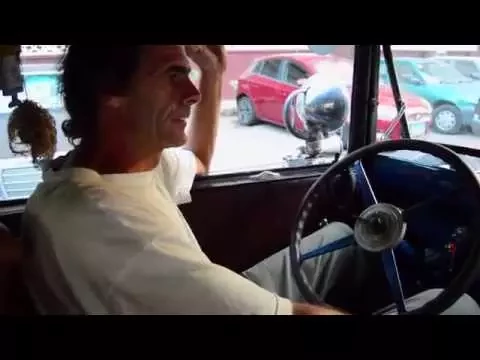
Without air conditioning, advanced onboard technology, and evident mechanical limitations, the car functioned more as a symbol of resilience than as an efficient means of transportation. Still, it was sufficient to sustain a two-decade journey.
Four children in different countries: how the family grew during the journey
During the expedition, Herman and Candelaria Zapp had four children, each born in a different country. This particularity added an additional layer of complexity to the trip. With each birth, the family had to deal with distinct healthcare systems, local legislation, and bureaucratic processes related to citizenship and documentation.
The children grew up on the move, without a fixed residence, being educated outside a traditional school system. Learning occurred practically, based on experiences lived in each country visited.
This lifestyle transformed the journey not only into a geographical crossing but into a continuous educational and cultural experiment.
Mechanical problems and improvisation: how the car survived for 22 years
A vehicle from 1928 traveling over 300 thousand kilometers would inevitably face failures. Throughout the journey, the Graham-Paige experienced various mechanical problems, including engine failures, structural wear, and constant maintenance needs. The scarcity of original parts forced Herman Zapp to improvise solutions using materials available in each region.
In many cases, local workshops adapted parts from other vehicles to keep the car running. Herman’s mechanical skills were a decisive factor for the continuity of the journey.
Maintenance was not occasional. It was part of the routine.
How the family financed the trip around the world
The financial sustainability of the trip was one of the biggest challenges. Without a traditional fixed income, the family began to finance the journey through various strategies. Among them, the sale of books about their own trip, lectures, and occasional support from people who knew the story along the way.
Hospitality also played a significant role. In many countries, the family was welcomed by local residents, reducing costs for accommodation and food.
This hybrid model, based on constant adaptation, allowed the journey to continue even without a stable source of income.
The return in 2022: the end of one of the longest journeys ever recorded
After 22 years, the Zapp family returned to Argentina in 2022. The return marked the end of a journey that began with no defined deadline and became one of the most emblematic cases of continuous family travel.
The arrival was widely reported by international outlets, highlighting not only the duration of the trip but the consistency of the project over two decades. The car, still functional, became a symbol of the journey.
A journey that transcends the idea of tourism and enters history
The trajectory of the Zapp family does not fit the traditional definition of travel. It combines elements of expedition, lifestyle, and continuous adaptation to diverse environments. Over 22 years, the project ceased to be merely a geographical displacement and came to represent an alternative way of living.
The 1928 Graham-Paige was not just a means of transportation. It was the central element of an experience that redefined the boundaries between mobility, residence, and routine.
And it is exactly this combination that keeps the story relevant and widely shared even after its end.







Seja o primeiro a reagir!