





 Portuguese
  English
  Spanish
  6 min of reading
  0 comments


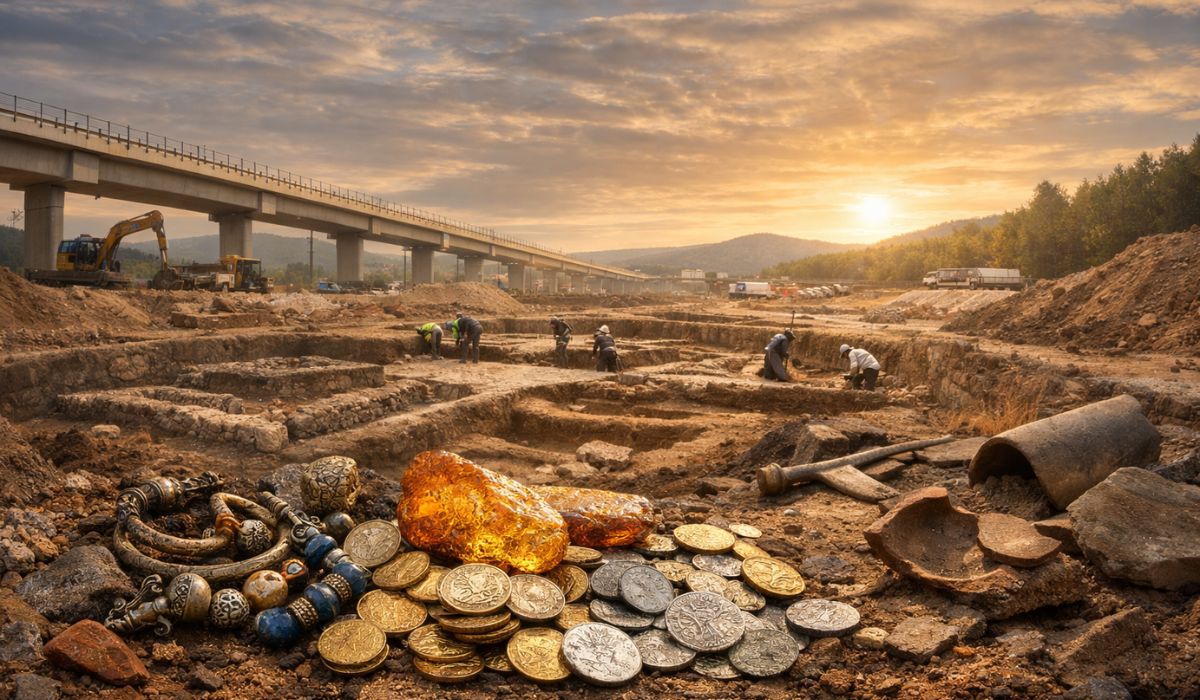
An excavation initiated because of a highway revealed in the Czech Republic a Celtic settlement with coins, amber, workshops, and prestige objects, in a set that expands the debate about commerce, production, and social organization in Iron Age Europe.
What began as a stage of preventive archaeology for the construction of the D35 highway in the Czech Republic ended up revealing a settlement of the La Tène culture, dated to the 2nd century BC, with hundreds of gold and silver coins, amber, fine ceramics, residential structures, production areas, and at least one space for worship.
According to the archaeologists involved, the set is among the largest ever recovered in Bohemia.
The discovery was made near Hradec Králové, in the north-central part of the country, during the preliminary surveys required by the road construction.
-
Archaeologists find lost medieval city in Poland with a central square, cemetery, forge, and more than 500 buried artifacts.
-
A massive warm air mass stretched from Brazil to near Antarctica and caused something that almost never happens: lightning and thunderstorms in Ushuaia, in the Falkland Islands, and in the South Georgia Islands.

-
Larger than a football field, with a wingspan of 117 meters, six Boeing 747 engines, and a capacity of 250 tons, the Stratolaunch Roc turns the sky into a gigantic hypersonic launch ramp and accelerates the way the U.S. tests weapons from Mach 5 to Mach 10.

-
Neuralink, the company specialized in brain chips founded by Elon Musk, announced that it intends to implant thousands of brain chips thanks to large-scale production.


Instead of isolated remains, the teams located an extensive occupation, covering about 25 hectares, equivalent to approximately 62 acres, an unusual size for this type of site in the region.
The collected material totals about 22,000 bags of artifacts, according to coverage based on communication from the Museum of Eastern Bohemia and statements from archaeologist Tomáš Mangel of the University of Hradec Králové, co-director of the excavation.
Celtic settlement in the Czech Republic reveals coins, jewelry, and ancient structures
The finds were not limited to valuable objects.
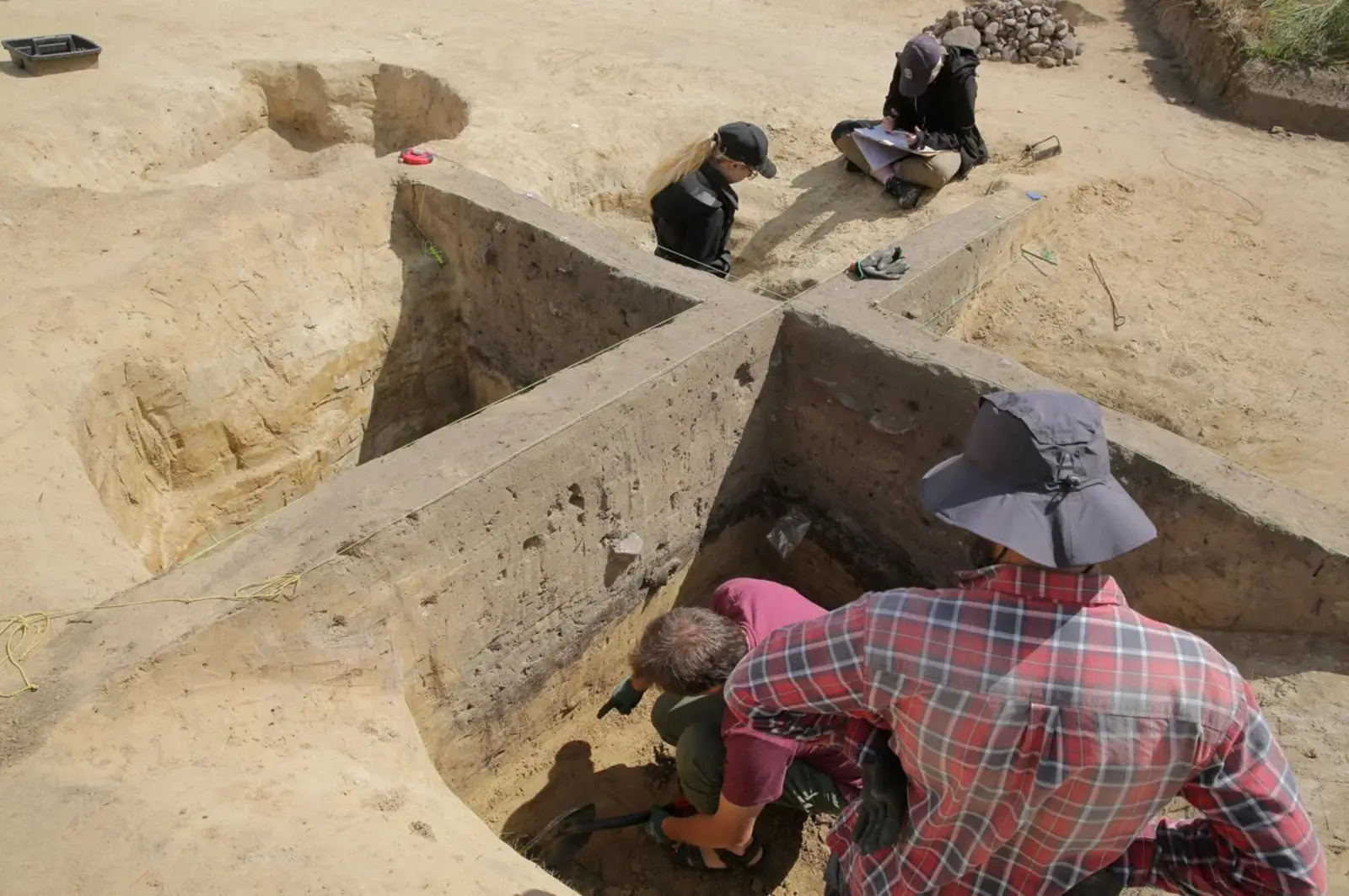
The excavations identified foundations of houses, productive facilities, remains related to the manufacture of prestige ceramics, coin molds, and a sanctuary, indicating that the site functioned as a complex center, not just as a transit point.
In the description reproduced by the international press, the site was classified by researchers as “unparalleled in scale and character in Bohemia.”
Among the recovered materials are Celtic coins of gold and silver, fragments of vessels, metal components of belts, glass beads, bronze and iron brooches, as well as fragments of bracelets.
In an interview cited by Live Science, Mangel stated that the set includes several hundred coins and a collection of jewelry made up of brooches, parts of armlets, and other personal adornments.
The same coverage reports that the number of jewelry pieces exceeds one thousand items.
Another point highlighted by the archaeologists was the concentration of remains in the surface soil and underground.

According to the translated description from the statement cited by the press, the informational potential of the original surface of the settlement is above the standard normally observed in this type of context.
It also drew attention that the site had not been looted, which increased the amount of preserved materials and the possibility of reconstructing daily, productive, and ritual activities.
Gold, amber, and fine ceramics reinforce the hypothesis of a trading center
The combination of coins, amber, and fine ceramics is one of the central elements in interpreting the site.
According to researchers, the settlement appears to have operated as a supra-regional center of trade and production, linked to long-distance routes.
The presence of amber and evidence of high-quality ceramic production reinforces this interpretation.
The finding of coin molds also suggests minting activity at the site.
The most recurring hypothesis among specialists is that the settlement played a significant role along the so-called Amber Road, a trade network connecting areas from the Baltic to the Mediterranean.
Live Science spoke with archaeologist Maciej Karwowski from the University of Vienna, who did not participate in the excavation, and he stated that the site is especially relevant for presenting similarities with other settlements located in this trade corridor.
This association places the discovery in a broader debate about the circulation of raw materials, prestige objects, and production techniques in Iron Age Europe.
In the case of Hradec Králové, the remains indicate a point where local production and long-distance exchange met, impacting the understanding of the regional economy before the consolidation of larger fortified centers.
Size of the site and absence of walls expand the debate about Celtic Bohemia
The area of the settlement also draws attention.
According to Mangel, most Iron Age sites known in the region tend to be much smaller, often only one to two hectares.
Therefore, the 25 hectares of the new discovery place the site on an uncommon scale for Bohemia and reinforce its relevance for studying the organization of space between the 3rd century BC and the 1st century BC.

Another relevant fact is the absence of fortifications.
According to archaeologists, this indicates that the settlement was active before the rise of larger, walled centers with more defined central functions.
The lack of walls, combined with the density of objects and the presence of workshops, is used by researchers to support the interpretation that the site functioned as an open hub of production and exchanges, rather than as a defensive core.
This characteristic is of interest to studies on Central Europe during the Iron Age because it suggests an occupation with specialized production, monetary circulation, and connection to broad trade networks.
This set of evidence supports, in preliminary analyses, the reading of the settlement as an economic and social center of regional reach.
Boii, Bohemia, and the identity of the occupants still open
Despite the quantity of objects and structures, researchers have not yet been able to securely attribute the settlement to a specific Celtic group.
No inscriptions were found that would directly identify its occupants.
The possibility of association with the Boii, a people often historically linked to Bohemia, appears in the debate but is treated with caution by specialists.
In a statement reproduced by Live Science, Mangel stated that Bohemia is traditionally connected to the Boii, but added that more recent research only allows for the assertion that this group was established somewhere in Central Europe.
In the same interview, he contested the more automatic reading that links, without reservations, Boii, Boiohaemum, and Bohemia as an unequivocal historical sequence.
This caution prevents transforming historiographical tradition into archaeological proof.
At the current stage, the site offers robust evidence of material wealth, specialized production, and insertion in exchange networks, but it still does not allow for a conclusive definition of which Celtic group occupied the area.
Preventive archaeology, Amber Road, and the impact of the discovery
The discovery brings together three elements of significance for European archaeology: scale, preservation, and productive context.
The size of the settlement, the quantity of artifacts, and the simultaneous presence of houses, workshops, and structures of possible ritual function transform the site into a reference for studying La Tène culture communities in Central Europe.
It is also noteworthy that the discovery emerged from a contemporary infrastructure project.
Such cases show how preliminary surveys required by large constructions can expand what is known about ancient occupations.
In this case, the opening of a highway exposed a center of production and exchange that remained preserved for over two thousand years under the current landscape of the Czech Republic.
Part of the recovered material is expected to be included in a local museum exhibition, scheduled in international coverage for the end of 2025, while studies continue.
Until then, the site continues to provide data on the circulation of wealth, artisanal specialization, and trade networks between the Baltic and the Mediterranean in a period preceding Roman dominance over much of Europe.







Seja o primeiro a reagir!