





 Portuguese
  English
  Spanish
  5 min of reading
  0 comments


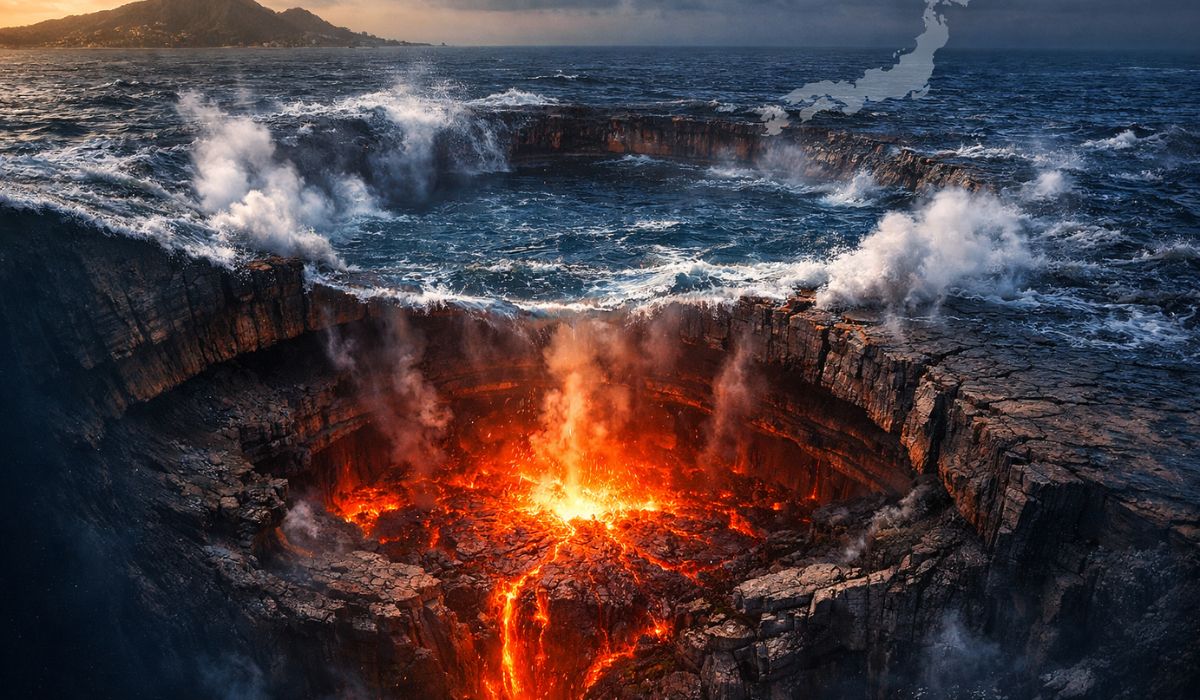
Under the sea, south of Japan, the Kikai Caldera is once again mobilizing scientists with signs of slow magma recharge, in a process that helps to understand how large volcanic systems evolve over thousands of years.
A large submerged volcanic system south of Japan has returned to the focus of researchers after new data indicated that its magma reservoir is being recharged.
The target of the study is the Kikai Caldera, a partially submerged structure associated with the largest Holocene caldera-forming eruption, which occurred about 7,300 years ago.
According to the authors, the same system that fed that extreme event remains active at depth and is now receiving new magma, which helps clarify how volcanoes of this size evolve between major eruptions.
-
China has activated a magnet 700,000 times more powerful than the Earth’s magnetic field that operates for over 200 consecutive hours while consuming little energy, and now the world wants to know what Beijing plans to do with this technology in 2026.
-
Mercado Livre has started selling medications in Brazil with delivery in up to 3 hours, and the project that launches in São Paulo may expand to the entire country, transforming the way millions of Brazilians buy medicines.

-
While the South begins April with sun and heat, a change in the weather already has a defined scenario in Brazil, and forecasts indicate heavy rain in the North and a sharp drop in temperature in the coming days.
-
Elon Musk wants to place humanoid robots in roles currently occupied by people, leading alongside giants like Amazon, Nvidia, and Figure in a race to replace human labor with machines, and advocates for a future where working would cease to be an obligation and become a choice.


The analysis was conducted by researchers from the Kobe University in partnership with the Japan Agency for Marine-Earth Science and Technology, JAMSTEC.
To investigate the interior of the caldera, the team used seismic surveys in the underwater environment, with artificial pulses and sensors installed on the seafloor to record the propagation of waves through the crust.
According to the scientists, this type of imaging allows for the identification of warmer and less rigid zones, consistent with the presence of magmatic material at depth.
Magma reservoir beneath the Kikai Caldera
The results point to the existence of a large magmatic reservoir at an estimated depth between 2.5 and 6 kilometers, directly beneath the central lava dome of the caldera.
Based on the position and size of the structure, the authors state that it coincides with previous estimates of the system linked to the ancient large-scale eruption.
Based on this, the study argues that the region preserves the main magmatic storage system associated with the event that occurred 7,300 years ago.

The conclusion is relevant because the Kikai-Akahoya eruption is described in previous studies as the largest Holocene caldera-forming eruption, with a volcanic explosivity index of 7.
In that episode, the release of magma was followed by the collapse of the area, a process that gave rise to the large volcanic depression now known as the Kikai Caldera.
This type of structure forms when part of the magmatic reservoir is emptied during a large-scale eruption.
Magma recharge and signs of activity in the system
The central point of the work is not only the identification of the reservoir but also the assessment that the material currently present there does not appear to be a direct remnant of the ancient eruption.
To reach this interpretation, the team combined seismic data with geochemical information gathered in previous research on the most recent volcanic products of the region.
According to the authors, these materials have a different composition than that recorded in the Holocene eruption.
From this comparison, the study indicates that the system has received new magma over time, rather than merely preserving the material that would have remained in the ancient magmatic chamber after the major eruptive event.

Another element mentioned by the researchers is located at the center of the caldera itself.
Previous studies had already identified the formation of a large rhyolitic lava dome, with an estimated volume of about 32 km³, built after the caldera collapse.
According to these analyses, the dome began to form about 3,900 years ago and has a composition distinct from the Kikai-Akahoya eruption.
For the authors, this history reinforces the hypothesis that the system was re-fed by magma with characteristics different from those recorded in the older event.
In the most recent article, the researchers estimate that at least a volume equivalent to that of this dome has been re-injected into the reservoir over the last 3,900 years.
The average calculated reinjection rate was above 8.2 km³ per millennium.
The study itself, however, emphasizes that this number represents an average and that the process may have occurred continuously or in pulses over time.
The data, therefore, indicate magmatic recharge, but are not presented by the authors as an indication of imminent eruption.
What the geological history of Kikai reveals
The Kikai Caldera has been monitored by different research groups in recent years.
In 2024, another study conducted by JAMSTEC and Kobe University, based on underwater cores collected in the region, had already reconstructed part of the evolution of the system between a catastrophic eruption that occurred about 95,000 years ago and the major eruption of 7,300 years ago.
According to this work, the recharge and differentiation of magma in Kikai can occur over extensive time scales, with prolonged storage of felsic magmas before a major eruption.
Together with the most recent study, this body of evidence contributes to a more detailed reconstruction of the functioning of the system over thousands of years.
In this scenario, the researchers describe a sequence that includes a major eruption, the partial emptying of the reservoir, the collapse of the area, and then the gradual resumption of supply by new magma.
Although each caldera has its own characteristics, the authors state that this type of record can help in the interpretation of other large volcanic complexes.
Among the examples cited in the study are Yellowstone, in the United States, and Toba, in Indonesia.
Both appear in the article as cases of large calderas with shallow reservoirs investigated by geophysical and petrological methods.
The comparison, according to the researchers, is useful for understanding how different systems can show signs of storage and magmatic recharge over time.
Monitoring a supervolcano on the seafloor
The fact that Kikai is a predominantly submerged caldera imposes operational difficulties but also opens a specific front for scientific observation.
According to the Kobe team, seismic surveys and instruments installed on the seafloor allow for detailed images of the structure beneath the caldera, which is considered essential for monitoring changes in deep magmatic reservoirs.

Commenting on the results released by the university, geophysicist Nobukazu Seama stated that understanding how large amounts of magma accumulate is a necessary step to understand how giant caldera eruptions form.
In the same communication, the institution reported that the next step of the work will be to improve the methods used in this type of investigation to enhance the monitoring capacity of these systems.
The data presented so far do not indicate that the Kikai Caldera is about to repeat the eruption of the past.
What the study shows, according to the authors, is that the system continues to transform long after its last major eruption.
For volcanology, this type of evidence expands the understanding of the life cycle of supervolcanoes and the signs that can be observed when magma begins to occupy space beneath an ancient caldera.





Seja o primeiro a reagir!