





 English
  Francês
  Alemão
  Italiano
  Japonês
  Norueguês
  Portuguese
  Spanish
  5 min of reading
  0 comments


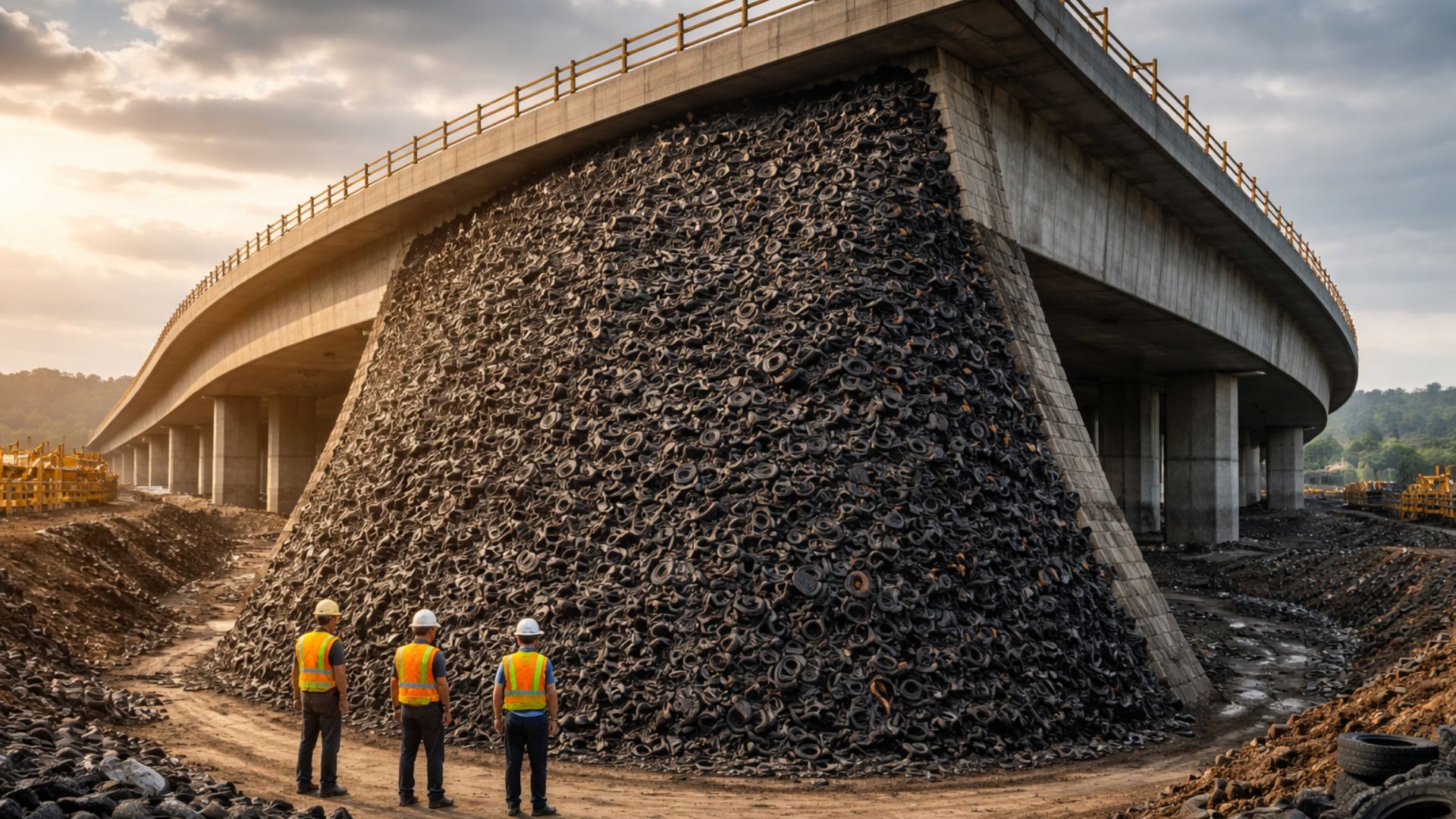
Invisible reuse under the pavement helped to raise a large connector in California, reduced pressure on a soil considered fragile, and shortened the schedule of a roadwork linked to I-880 with structural use of crushed tires.
Thousands of discarded tires were incorporated into the base of a connector ramp in Milpitas, California, in an engineering solution adopted to enable the work over weak soil.
Instead of going to common disposal, the waste was crushed and used as light fill under the structure linked to Interstate 880, reducing the load on the ground and shortening the intervention schedule.
The application occurred in the Dixon Landing Road project, in an area sitting on about 30 feet of bay mud, a geotechnical formation typical of the San Francisco Bay area and known for its low resistance.
-
Seen from space, a colossal ‘Y’ cuts through the largest desert in China, blending a jade-filled river, red and white mountains, and revealing the absurd scale of the transformation of the Taklamakan surrounded by a green wall with billions of trees.

-
The Pacific Ocean reveals what the cliffs of Big Sur have hidden for millennia: Pfeiffer Beach, in California, features swirling purple sand formed by garnet crystals and displays a stone arch that is illuminated by the sun in winter for just a few days each year.

-
Aursjøvegen in Norway is a 100-kilometer gravel road that crosses chasms and dark tunnels carved into the rock at an altitude of 947 meters in the fjords and is only open for four months a year.

-
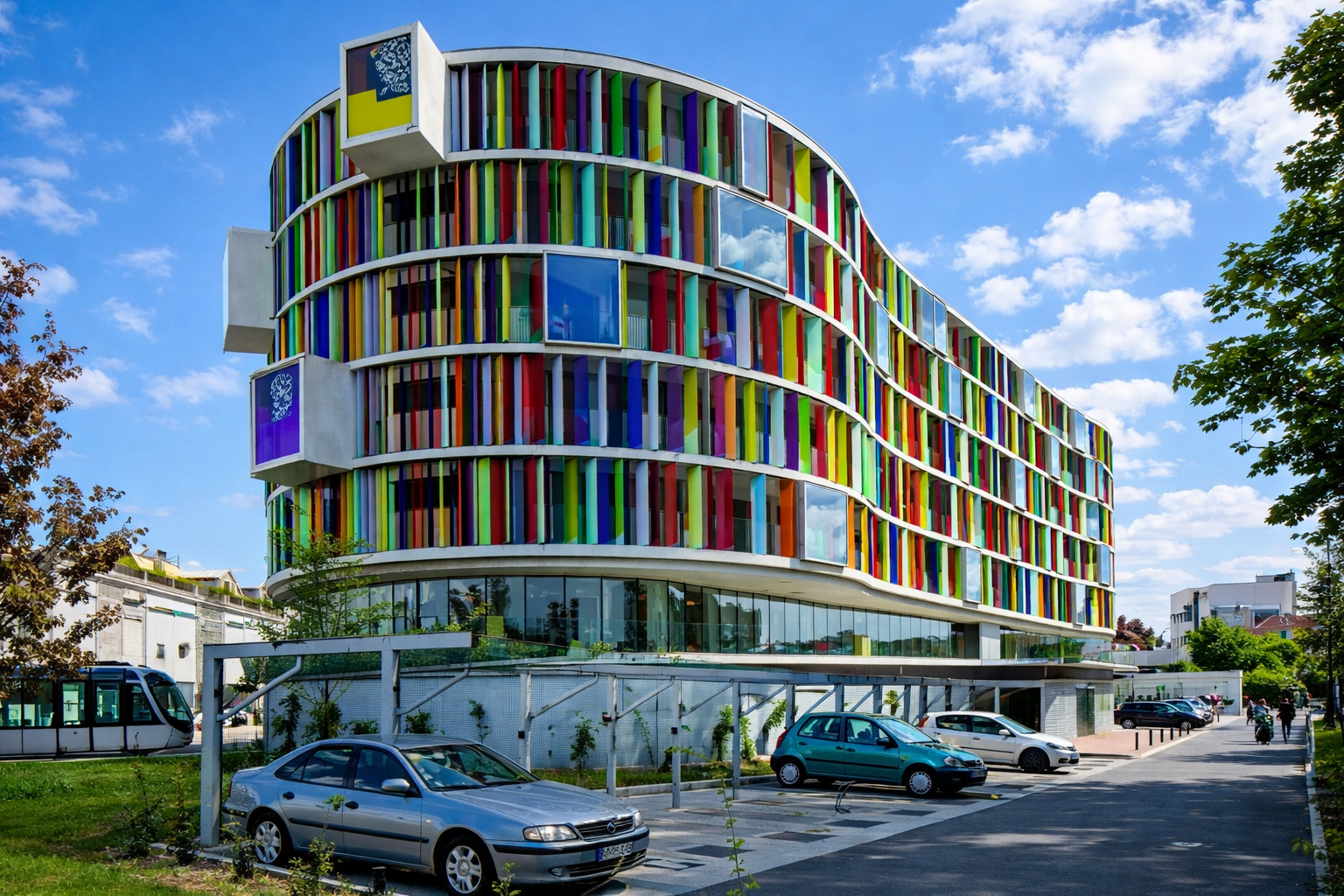
With about 4,000 m², the building constructed in a traditional neighborhood in France looks like a rainbow, has a colorful facade, mixes vibrant glass, and creates one of the most unusual visuals in Bordeaux.
In this type of terrain, the weight of the fill is decisive, because a conventional solution can increase settlements, require more time for the ground to settle, and compromise the execution within the expected timeframe.
It was in this context that Tire-Derived Aggregate, or TDA, material produced from crushed tires and used as light fill in civil works, came into play.
The choice allowed for the replacement of heavier alternatives and reduced the pressure transmitted to the natural foundation, a central point in interventions that need to overcome geotechnical limitations without increasing the structural risk of the overall system.
Work on weak soil required a lighter solution

Data gathered by CalRecycle shows that the south connector of I-880 on Dixon Landing Road was built between 2000 and 2001, with approximately 26 feet in height, 700 feet in length, and 50 feet in width.
In total, the work consumed 6,627 tons of TDA, a volume equivalent to about 662,700 passenger tires, incorporated as part of the light fill supporting the structure.
The time gain was one of the main factors associated with the technical choice.
According to reference materials on the case, the use of tire-derived aggregate avoided an additional delay of approximately one year, a scenario considered likely if the work depended on conventional fill over the same low-bearing capacity ground.
The logic is straightforward, although the practical effect is broad.
Since TDA has a lower specific weight than light mineral aggregates and is much lighter than traditional fills, it reduces the vertical stress imposed on the soil, which helps control settlements and makes it possible to raise significant volumes of fill where the subsoil imposes severe restrictions.
How crushed tires supported the structure
In the case of Dixon Landing, the load difference was measured.
CalRecycle reports that the fill with TDA applied about 2,250 pounds per square foot on the foundation soil, compared to 3,750 pounds per square foot in a solution with conventional soil, representing a reduction of approximately 40% in the vertical stress transmitted to the ground.

Although the term “tire road” helps to convey the curiosity of the project, the material does not appear on the surface and does not alter the wearing course observed by those passing by the site.
The crushed tires remained confined under the structure, in layers executed with conventional equipment and separated by low-permeability soil, according to the arrangement adopted in the project.
This detail helps to understand why the application goes beyond a symbolic reuse.
The waste ceased to be merely an environmental liability and began to fulfill structural function in a real road project, linked to an important corridor in the region, where performance, stability, and operational predictability weigh as much as time and cost.
Economy and performance in a real road project
There was also a financial impact.
A widely cited technical guide on the use of TDA records that the chosen solution saved approximately $230,000 compared to the use of pumice rock, while CalRecycle’s institutional page reports savings of $477,000 compared to lightweight aggregate, a broader category of light fill analyzed in the project.
Both references deal with the same project but use different comparative bases.
The durability observed after delivery reinforced the value of the case for transportation engineering.
The technical guide published by the Minnesota DOT, when citing the California project, states that there were no performance issues related to the fill after 14 years of service, a fact often used as evidence that the material can function stably when applied with proper specifications.

Still, the interest in the project is not limited to the material’s behavior over time.
The case draws attention because it shows how the invisible part of an intervention can be the most decisive, especially in road projects over soft soils, where success depends less on the pavement seen on the surface and more on what has been resolved beneath it.
Reuse of tires gains scale in infrastructure
The ramp built in Milpitas thus became a concrete example of how difficult-to-manage waste on a large scale can gain measurable technical use.
Used tires are often associated with problematic disposal, environmental risks, and accumulation in yards, but when processed under engineering criteria, they can assume a functional role in light fills, stabilizations, and other infrastructure systems.
The history of the project also helps explain why TDA continues to be cited in manuals and reports on light fills in transportation.
The experience of Dixon Landing has been incorporated into later technical references precisely for combining large-scale reuse, load reduction on sensitive soil, savings compared to light alternatives, and satisfactory performance in prolonged operation.
In the end, the driver crossing the completed access hardly notices that the structure rests on hundreds of thousands of crushed tires.
Still, it was this hidden material that allowed the work to be adjusted to the limitations of the terrain, reduce delays associated with subsoil settlement, and transform a difficult-to-dispose waste into a solution applied under one of the region’s road connections.







Seja o primeiro a reagir!