





 Portuguese
  English
  Spanish
  11 min of reading
  2 comments


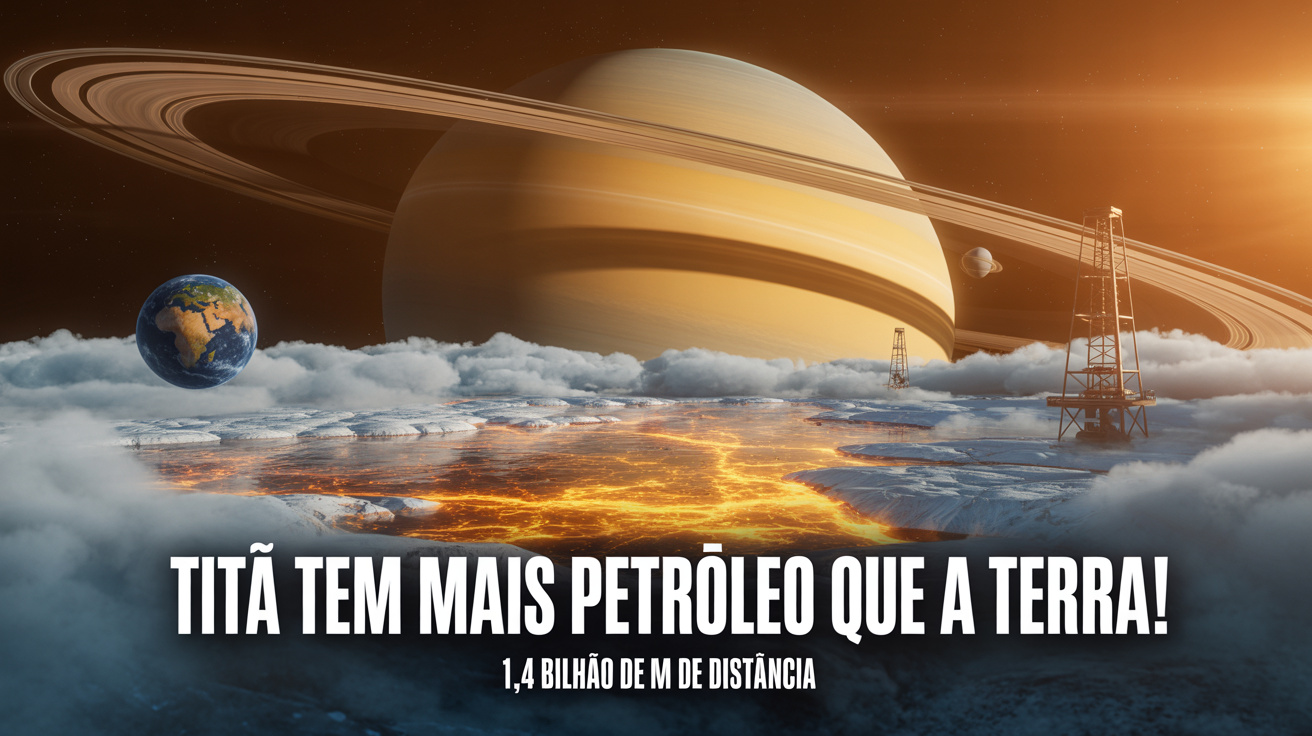


Titan Has More Oil Than the Entire Earth, Saudi Arabia, and Russia Combined: Lakes of Liquid Methane Cover Saturn’s Moon at -179°C, But They Are 1.4 Billion Km Away, According to NASA
While nations wage wars for control of oil fields and humanity rapidly depletes its fossil fuel reserves, there is a place in the Solar System where hydrocarbons literally fall from the sky like rain, form rivers that carve through the landscape, and accumulate in lakes so vast that they would make any oil magnate faint with envy. This place is called Titan, Saturn’s largest moon. And according to data from NASA’s Cassini probe, published in the scientific journal Geophysical Research Letters, Titan holds hundreds of times more liquid hydrocarbons than all known oil and natural gas reserves on Earth combined.
But there is a small detail: Titan is 1.4 billion kilometers away, has a surface temperature of -179°C (where methane exists in liquid form), and its thick atmosphere of nitrogen and methane would make any extraction mission a science fiction fantasy — at least for now.
The Largest Fuel Deposit in the Solar System
“Titan is simply covered in carbon-rich material, it is a giant factory of organic chemicals”, declared Ralph Lorenz, a member of the Cassini radar team at the Johns Hopkins Applied Physics Laboratory, when announcing the discovery in 2008.
-
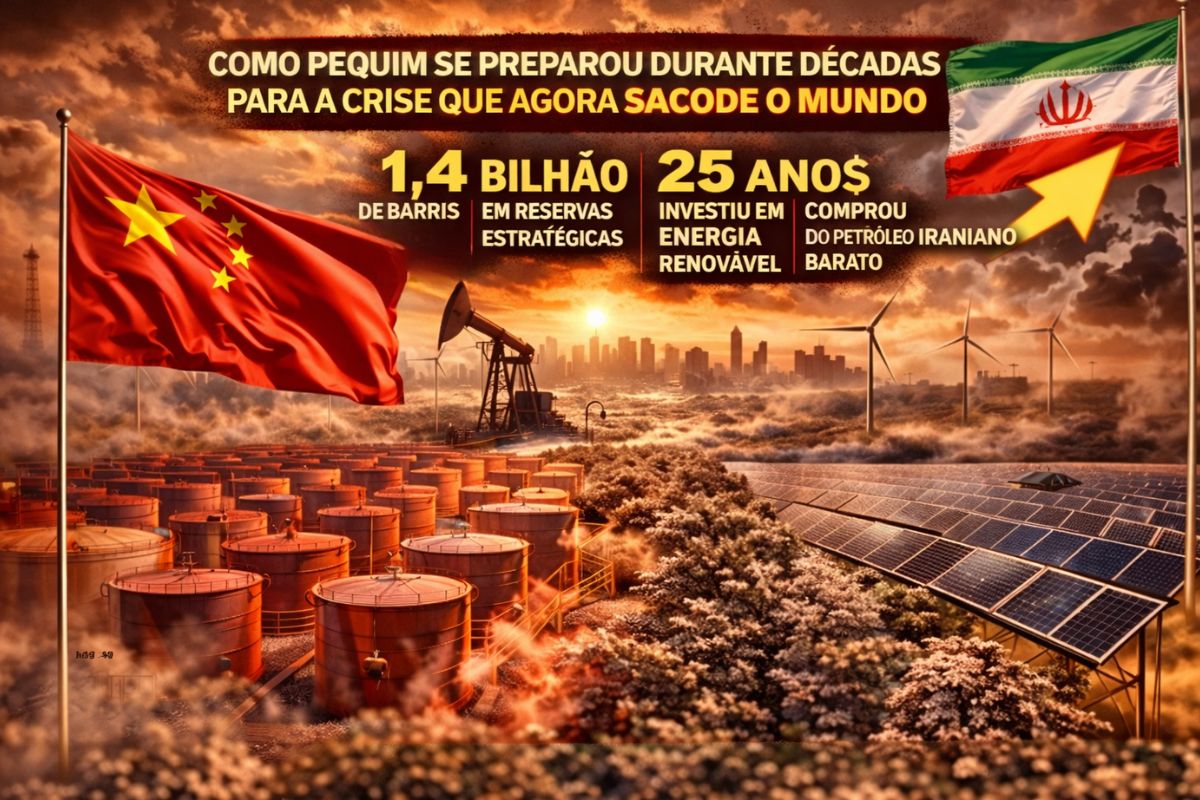
China has accumulated up to 1.4 billion barrels of oil in strategic reserves, invested 25 years in renewable energy, and purchased 80% of cheap Iranian oil: how Beijing has prepared for decades for the crisis that is now shaking the world.
-
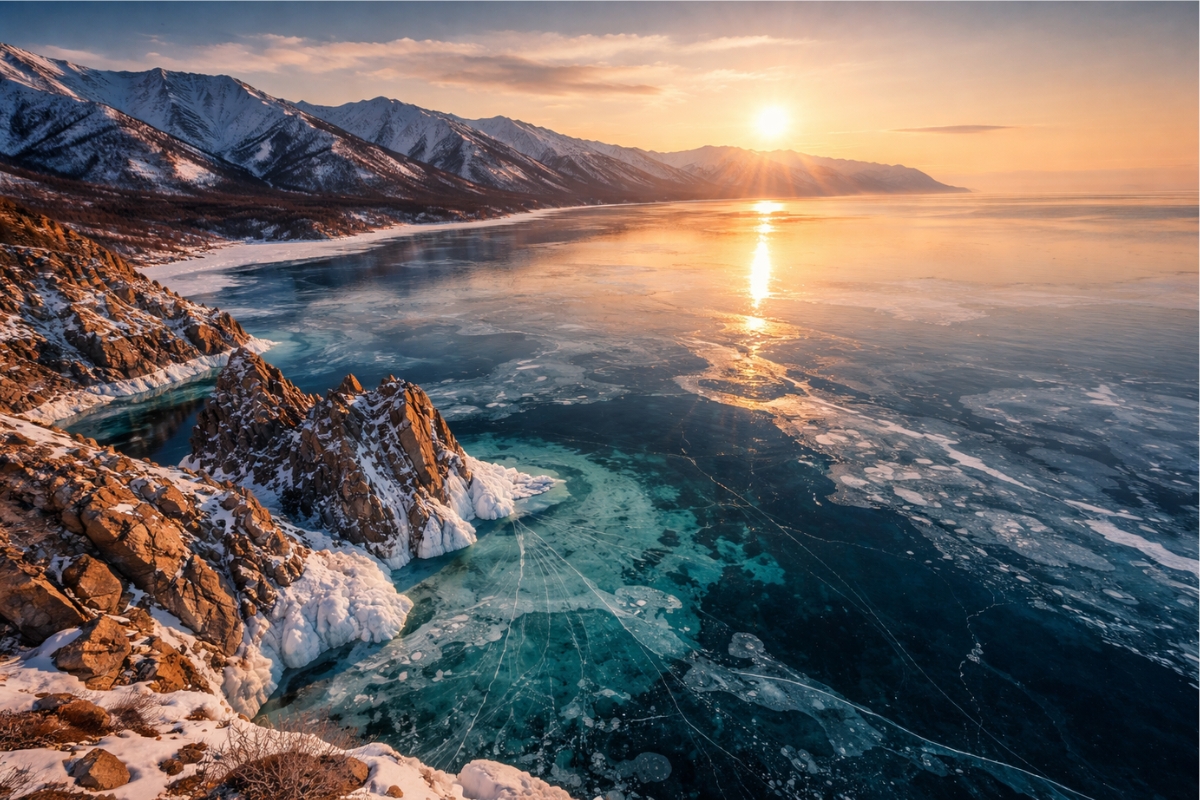
A single lake holds 20% of the planet’s non-frozen freshwater and is also the deepest and oldest on Earth.
-
How 5,000 Indian dabbawalas manage to deliver around 200,000 lunchboxes a day in Mumbai for over 130 years using bicycles, crowded trains, and a manual system that continues to operate with impressive accuracy.

-
While restoring a historic mansion from 1910, a brick structure with an old turbine that generated energy from the Rio do Testo emerged, along with a hidden door and a rare floor concealed under layers of wax.

The Numbers Are Breathtaking
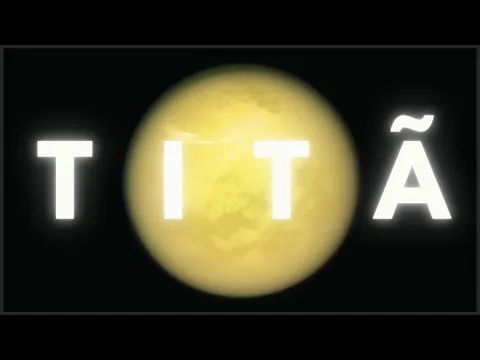

Lakes and Seas: The Cassini probe mapped about 20% of Titan’s surface with radar and identified hundreds of lakes and seas. Only the dozens of largest lakes individually contain more liquid hydrocarbons than all Earth’s oil and gas reserves.
Total Volume: Estimates suggest that Titan’s lakes and seas hold approximately 9,000 cubic kilometers of liquid methane and ethane, about 40 to 300 times the volume of proven terrestrial oil reserves, depending on the calculation methodology.
Equatorial Dunes: The dark dunes running along Titan’s equator contain a volume of organic compounds (called “tholins”, a term coined by Carl Sagan in 1979) several hundred times greater than all of Earth’s coal reserves.
Stored Energy: Proven natural gas reserves on Earth total 130 billion tons, enough energy to supply 300 times the amount of energy that the entire United States uses annually for heating, cooling, and residential lighting.
Dozens of Titan’s lakes individually have the equivalent of at least that amount of energy in the form of methane and ethane.
To put it in perspective: if we could somehow transport Titan’s hydrocarbons to Earth, we would have enough fuel to power human civilization for hundreds of millions of years at current consumption levels.
An Alien World Where Gasoline Rains

Titan is the only body in the Solar System, besides Earth, that has stable liquids on its surface. But while on Earth we have the water hydrological cycle, evaporation, clouds, rain, rivers, lakes, oceans — on Titan, all this process happens with methane and ethane.
Titan’s atmosphere is composed of over 95% nitrogen (like Earth), but the rest is mostly methane, with traces of ethane and other organic compounds. The atmospheric pressure at the surface is 50% greater than that of Earth at sea level.
Here’s How the Hydrocarbon Cycle Works on Titan:
In the Clouds: Methane evaporates from lakes and seas, rises into the atmosphere, and forms dense orange clouds that cover the sky.
The Rain: When the conditions are right, liquid methane rains down. But it’s not a light drizzle — due to the weak sunlight (Titan receives only 1% of the light that Earth gets), the evaporation is slow: only about 1 centimeter per year.
However, the atmosphere can retain the equivalent of 10 meters of liquid before forming rain. Result: when it rains on Titan, it’s downpours of several meters high that cause sudden flooding, followed by decades or centuries of drought.
The Rivers: The rain of methane carves channels and rivers on the frozen surface (made of water ice, which at -179°C is hard as rock). These rivers flow into depressions, filling lakes and seas.
The Lakes and Seas: Concentrated mainly in the polar regions, Titan’s lakes and seas are filled with liquid methane and ethane. Some are so deep that the Cassini radar couldn’t detect the bottom, appearing “literally black” in images, indicating depths greater than 100 meters.
Back to the Atmosphere: Methane evaporates again, completing the cycle.
Cassini also discovered evidence of “aquifers” of hydrocarbons — layers of liquid beneath the surface, analogous to Earth’s water table, but composed of propane and ethane instead of water.
The Largest Lakes of an Alien World
Titan has three large “seas” and hundreds of smaller lakes. The main ones are:
Kraken Mare: The largest liquid body on Titan, approximately 400,000 km² in area, larger than the Caspian Sea on Earth. It contains a mixture of methane, ethane, and dissolved nitrogen.
Ligeia Mare: The second largest, about 126,000 km², the size of Lake Superior in North America. Cassini data confirmed that Ligeia Mare is predominantly composed of pure liquid methane, with depths exceeding 160 meters.

Punga Mare: The third largest sea, also located in Titan’s northern pole.
Ontario Lacus: The only large lake in the southern hemisphere, approximately 15,000 km² (half the size of the Great Salt Lake in Utah). It was the first confirmed liquid body on Titan, in 2008, through the Cassini spectrometer, which detected liquid ethane without a shadow of a doubt.
Interestingly, almost all lakes are concentrated in the northern hemisphere. Scientists believe this is due to regional geological processes, possibly crustal extension that created depressions and faults, similar to what formed the ancient Lake Lahontan in prehistoric Nevada and California.
Why Is Titan So Different from Earth?
The temperature makes all the difference. At -179°C (or -290°F), Titan is so cold that water ice plays the role of “rock” being hard, rigid, and forming mountains. Meanwhile, methane and ethane, which are gases at room temperature on Earth, exist as liquids and form lakes, rivers, and rain.
The atmospheric composition is also crucial. The high proportion of nitrogen in Titan’s atmosphere suggests that the building blocks of the moon formed early in the Solar System’s history, in the same cold disk of gas and dust that formed the Sun (the so-called solar nebula).
But Where Does All This Methane Come From? This Is One of Titan’s Greatest Mysteries.
The methane in Titan’s atmosphere is constantly broken down by the Sun’s ultraviolet radiation and high-energy particles accelerated in the magnetic field of Saturn.
The pieces of these molecules recombine to form a variety of complex organic compounds, including the “tholins” that form the orange dunes at the equator and the thick haze that covers the sky.
If methane is constantly being destroyed, some source must be replenishing it, or it would deplete over time.
Scientists believe that methane could be released from Titan’s interior through cryovolcanoes, volcanoes that instead of molten rock lava, expel “lava” of liquid water and ammonia, potentially bringing methane from below the surface.
Calculations show that, if all the methane observed on Titan is accounted for, it would last only a few million years before depleting. This suggests that the amount of methane and the temperature on Titan may have fluctuated drastically in the moon’s past.
The Formation of Lakes: A Familiar Process on an Alien World
How did Titan’s lakes form? Scientists have found that the process is surprisingly similar to what happens on Earth, but with completely different chemistry.
On Earth, karst landscapes form when soluble rocks like limestone and gypsum dissolve in groundwater and rain, creating sinkholes, caves, and depressions over time.
On Titan, the process is similar, but instead of water dissolving limestone, liquid methane and ethane dissolve organic compounds from the surface.
Scientists calculated that it would take about 50 million years to create a depression 100 meters deep in Titan’s relatively rainy polar regions consistent with the young age of the moon’s surface.
The dissolution process occurs on Titan about 30 times more slowly than on Earth, due to Titan’s longer year (equivalent to 30 Earth years) and the fact that it only rains during Titan’s summer.
At lower latitudes, where rain is reduced, the much longer timescale of 375 million years is consistent with the relative absence of depressions in those geographical locations.
Can Titan Host Life?
Titan is considered one of the most promising places in the Solar System for the search for life — but not necessarily life as we know it.
Subsurface Ocean: Beneath Titan’s icy crust, scientists believe there is a vast ocean of liquid water and ammonia, kept liquid by the moon’s internal heat and pressure. This ocean could potentially harbor water-based life similar to that of Earth.
Surface Life: The extremely cold surface conditions would make it impossible for liquid water-based life.
However, some scientists speculate about the possibility of methane-based life — organisms that would use liquid methane as a solvent instead of water, with completely different biochemistry.
Recent NASA research suggests that in Titan’s frozen lakes of methane and ethane, simple molecules could naturally arrange themselves into cell-like membranes called “azotosomes”.
Prebiotic Chemistry: Even if there is currently no life on Titan, the moon is a natural laboratory to study complex organic chemistry, the same processes that on primitive Earth eventually led to the origin of life.
“We are carbon-based life forms, and understanding how far chemistry can advance in the chain of complexity towards life in an environment like Titan will be extremely interesting”, noted Lorenz.
The Problem of Distance (and Temperature, and Atmosphere…)
So, why don’t we go to Titan to get all that fuel? The answer involves several seemingly insurmountable obstacles:
Absurd Distance: Titan is about 1.4 billion kilometers from Earth (about 9.5 astronomical units).
The Cassini probe took 7 years to get there after its launch in 1997. A crewed mission would take decades and would require technologies that simply do not exist yet.
Extreme Cold: At -179°C, any equipment would need extraordinary thermal insulation. Conventional batteries do not work, metals become brittle, and working fluids freeze.
The very extraction of liquid methane would be challenging; it would need to be kept extremely cold or pressurized throughout the trip back.
Dense and Toxic Atmosphere: Titan’s atmosphere has a pressure 50% greater than that of Earth and is unbreathable — predominantly nitrogen with methane. Any surface operation would require pressurized suits and a constant oxygen supply.
The Gravity of Saturn: To reach Titan, a spacecraft must first enter the Saturnian system, navigating through Saturn’s intense gravitational field and avoiding its dangerous rings.
Energy Cost: Ironically, it would be necessary to burn colossal amounts of Earth fuel just to reach Titan and bring back a relatively small amount of hydrocarbons. The energy equation simply doesn’t add up.
Escape Velocity: Although Titan’s gravity is only 14% that of Earth (weaker even than the Moon’s), its dense atmosphere makes returning to space challenging.
In summary: Titan may have more oil than the entire Earth, but it is completely inaccessible for commercial exploitation with current technology and will likely remain so for centuries.
The Dragonfly Mission: Exploring Titan in 2034
Although we cannot extract hydrocarbons from Titan, NASA has not given up on exploring it.
The Dragonfly mission, scheduled for launch in July 2028, will arrive at Titan in 2034. Unlike any previous mission, Dragonfly is a rotorcraft, essentially a drone with eight rotors, the size of a car, that will fly across Titan’s surface making multiple landings to investigate different locations.

Titan’s dense atmosphere and low gravity make flight surprisingly efficient — Dragonfly will be able to cover hundreds of kilometers, something impossible for conventional terrestrial rovers.
The mission’s objectives include:
- Investigating prebiotic chemical processes and complex organic compounds
- Studying the methane cycle and Titan’s meteorology
- Analyzing the composition of lakes and the surface
- Searching for evidence of past or present life
- Examining the Selk crater closely, an impact site that may have created favorable conditions for complex chemistry
Elizabeth Turtle, principal investigator of Dragonfly at the Johns Hopkins Applied Physics Laboratory, explains: “Titan is an analog of primitive Earth, and it can teach us about how life might have emerged on our planet. We will look for the types of chemical compounds that lead to life.”
Lessons from Titan: Inaccessible Wealth
The story of Titan teaches us an important lesson about natural resources: availability is not the same as accessibility.
Humanity is concerned about the “peak oil” — the point at which fossil fuel extraction will begin to decline irreversibly. We know that terrestrial oil is finite. We know we are burning millions of years of geological accumulation in just a few centuries.
And now we know that there is a moon 1.4 billion kilometers away where it literally rains fuel from the sky, where rivers of natural gasoline cut through the landscape, where lakes of methane extend for hundreds of thousands of square kilometers, reserves so vast that they make terrestrial disputes over oil fields ridiculous.
But we cannot touch any of it. Neither now, nor in the near future, perhaps never.
The solution to humanity’s energy crisis is not on Titan. It is right here on Earth, in the transition to renewable sources — solar, wind, nuclear — and in energy efficiency. Because no matter how vast Titan’s wealth may be, it might as well be in another universe, given our inability to reach it.
The Final Numbers That Leave Any Oil Executive Jealous
To conclude with the most impressive data about the largest fuel reserve in the Solar System:
Comparison with Earth:
- Proven oil reserves on Earth: ~1.7 trillion barrels
- Estimated volume of liquid hydrocarbons on Titan: equivalent to 300-500 trillion barrels (conservative estimate)
- Titan has 170 to 300 times more hydrocarbons than the entire Earth
Geopolitical Comparison:
- Saudi Arabia (largest reserves in the world): ~267 billion barrels
- Russia: ~107 billion barrels
- Total Earth + Saudi Arabia + Russia: ~2 trillion barrels
- One large lake on Titan surpasses that
Available Energy:
- A dozen of Titan’s lakes: energy equivalent to 130 billion tons of natural gas each
- That’s 300 times the annual residential energy consumption of the United States per lake
- Total estimated on Titan: enough energy for hundreds of millions of years of human consumption
The Ultimate Paradox: Titan solves humanity’s energy problem for the next 300 million years. It’s just that it’s 1.4 billion kilometers away, has a temperature of -179°C, a toxic methane atmosphere, and getting there would take decades, if we had the technology, which we do not.
It’s the cosmic equivalent of dying of thirst in the ocean. The discovery of Titan reminds us that the universe is full of extraordinary resources. But it also reminds us that not all wealth is reachable, and that we must take better care of the limited resources we have here, on the only planet we know for sure we can live on.






Distância não é problema para Trump, obviamente ele vai anexar
Então, Titâ já foi habitado ou, esse petróleo não é o mesmo da Terra. A NASA tem destas coisas.