





 Portuguese
  English
  Spanish
  4 min of reading
  0 comments


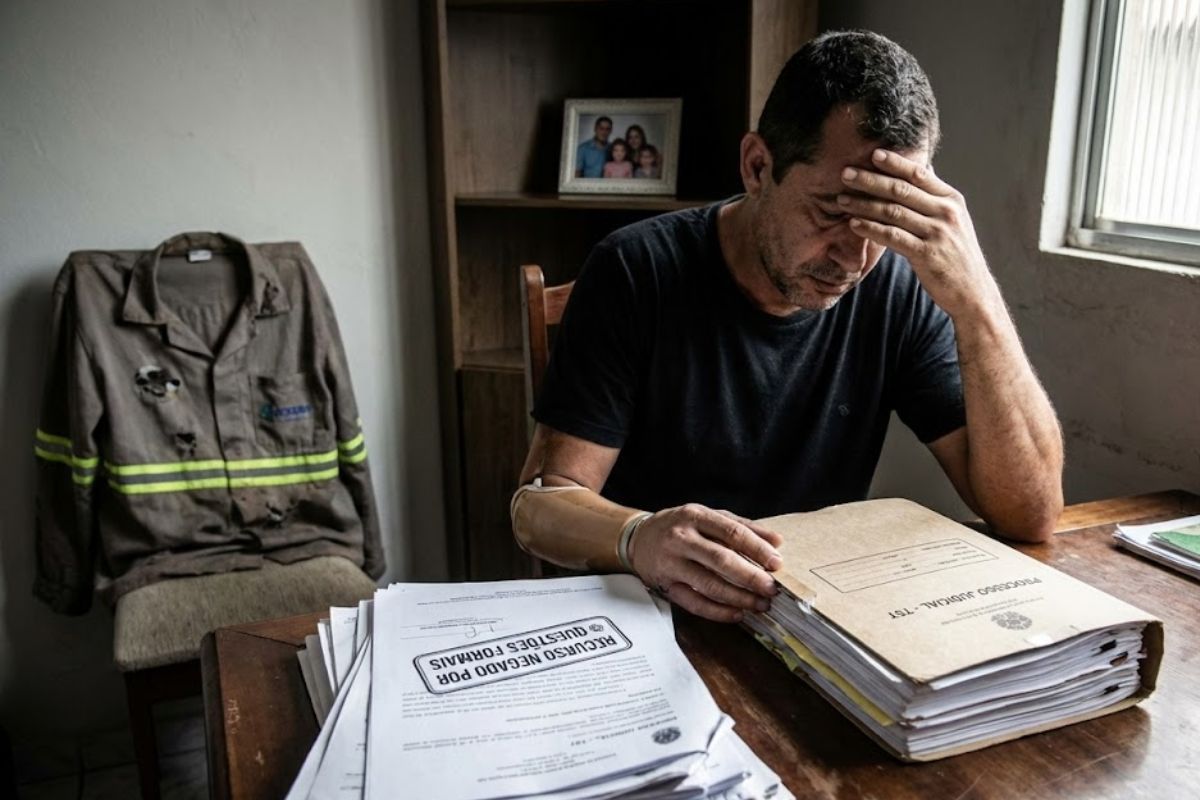
Worker Who Lost His Right Arm in Weaving Machine Accident Tries to Increase Compensation and Dismiss Concurrent Fault, But in Decision, the Third Chamber of the TST Maintains Reduced Amounts Due to Formal Failures in the Appeal Provided for in the CLT, Even in the Face of the Seriousness of the Accident
The worker who had his right arm amputated in October 2015 while cleaning a weaving machine that was still running, could not reverse in the Superior Labor Court the reduction of the compensations granted by the Justice. The Third Chamber of the TST upheld the decision that had limited the amounts, even recognizing the seriousness of the accident and the permanent impact on the employee’s life.
Hired by a plastics company in 2010, the worker sought to dismiss the concurrent fault and increase the amounts set for material, moral, and aesthetic damages, but the appeal was blocked because it did not meet the formal requirements required by the Consolidation of Labor Laws after Law 13.015/2014, which prevented the examination of the merits by the higher court.
Accident Amputated the Worker’s Arm and Ended His Capacity to Work
The worker was hired as a general assistant and, over the years, promoted to weaving leader. In October 2015, while cleaning a machine used to brush textile fibers, his arm was pulled by the equipment cylinders, which remained on, resulting in the total amputation of the limb.
-
Employee Fired After Accumulating 114 Days of Medical Leave in One Year, Labor Court Upholds Company’s Decision

-
Employee Fired While Treating Depression Wins in Court and Vale Is Required to Rehire Him Following Decision Based on the CLT and INSS Benefits

-
Workers Should Be Aware! March 6 Will Be The Fifth Business Day Of March And The Final Deadline For Companies To Pay Salaries According To The CLT

-
2026 FGTS Anniversary Withdrawal Is Released According to Birth Month, Sets Amounts by Balance Range, Establishes Deadlines for March and April, and Changes Rules in Case of Dismissal


The expert report pointed out permanent loss of work capacity, reinforcing the devastating nature of the accident.
The first-degree court concluded that the company was responsible and ordered the employer to pay R$ 890 thousand for material damages, in addition to R$ 100 thousand for moral damages and R$ 100 thousand for aesthetic damages to the worker.
Company Is Considered Negligent, But Concurrent Fault Reduces Compensation
In analyzing the case, the Regional Labor Court of the 2nd Region in São Paulo recognized that the company was negligent in complying with safety standards.
According to the records, the worker had received training, but at the time of cleaning, he disobeyed part of the recommended procedures, performing the operation with the machine still running.
The TRT understood that there was concurrent fault. Therefore, the material compensation was reduced from R$ 890 thousand to R$ 214 thousand, while maintaining the amounts of R$ 100 thousand for moral damages and R$ 100 thousand for aesthetic damages.
The worker, dissatisfied, brought the case to the TST in an attempt to dismiss the concurrent fault and restore or increase the compensations.
Worker’s Appeal Encounters Formal Requirements of the CLT
In the appeal directed to the TST, the worker insisted that the cleaning procedure with the machine on was common in the company and tolerated by management, even reporting that the supervisor required production to continue during cleaning, even though it was an unsafe practice.
Other similar accidents, although of lesser severity, that occurred in previous years were also mentioned, which would reinforce the thesis of systematic negligence.
Despite this, the rapporteur, Minister Alberto Balazeiro, explained that, after the issuance of Law 13.015/2014, the CLT began to require, in the appeal, express indication of the questioned excerpts of the decision, transcription of the reasoning adopted by the judges, and clear demonstration of violation of law or jurisprudential divergence.
In this case, the worker did not fully meet these formal requirements, which made it impossible for the appeal to be recognized.
Severity of the Case Does Not Dispense Compliance With the Law, Highlight TST Ministers
During the trial, the panel made it clear that the seriousness of the human situation does not authorize the TST to ignore legal requirements.
Minister Alberto Balazeiro emphasized that, without the correct fulfillment of the requirements of Article 896 of the CLT, as reinforced by Law 13.015/2014, the Court is prevented from examining the merits, even if the process involves amputation of a limb and permanent incapacity.
Minister Liana Chaib and Minister Lelio Bentes Corrêa accompanied the rapporteur. Both reaffirmed that the TST acts as an extraordinary instance, aimed at standardizing the interpretation of labor legislation, and can only judge resources properly structured within legal parameters.
Thus, the decision to deny progress to the appeal was unanimously upheld by the Third Chamber.
TST Maintains Reduction of Material Compensation and Ends Discussion in Extraordinary Instance
With the decision, the parameters defined by the Regional Court remained valid: R$ 214 thousand in material damages, R$ 100 thousand in moral damages, and R$ 100 thousand in aesthetic damages.
The company continues to be recognized as negligent, and the worker remains a victim of a serious labor accident, but without the compensatory increase intended in the TST.
The case is under number Ag-ARR-1001378-43.2016.5.02.0321, reinforcing an important message for lawyers and workers: without strict compliance with the formal requirements of the CLT, especially after Law 13.015/2014, even work accidents with extreme consequences cannot be reassessed by the highest labor court in the country.
In light of such a serious accident involving a worker and a company deemed negligent, do you think that the Justice should relax the formal requirements of the CLT in extreme cases or should the law be followed strictly in any situation?










-

Uma pessoa reagiu a isso.