





 Portuguese
  English
  Spanish
  6 min of reading
  1 comment


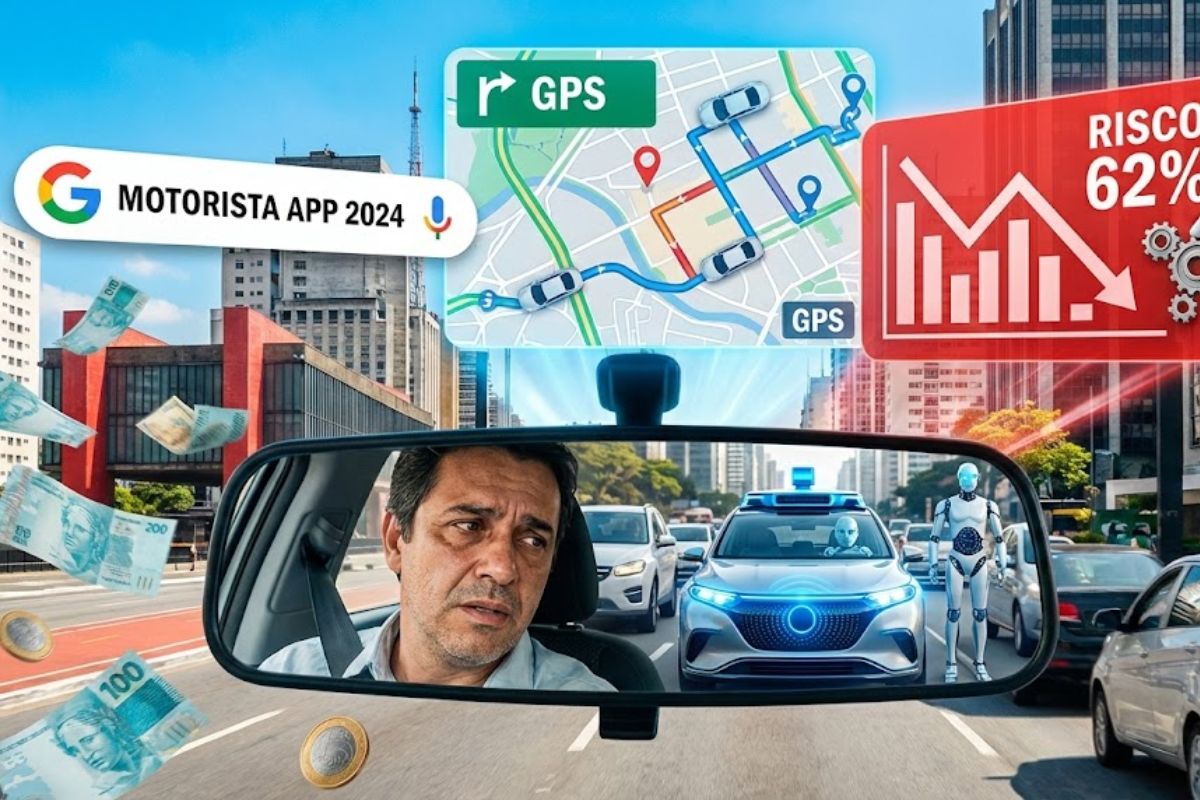


As The Most Sought-After Job on Google in 2024 Becomes an Entry Point for Millions of App Drivers, Uber Tests Autonomous Cars, Incorporates Robots into Uber, and Fuels Studies That Place Jobs at Risk Globally, Exposing the Scale of the Transformation in the Future of Work
The most sought-after job on Google in 2024 is driving for ride-hailing apps, an occupation that has gained entry-level status for those needing to generate quick income in an increasingly informal landscape. Reports cited by researchers show that driving for apps has become one of the most searched careers on Google, while companies like Uber boast over seven million active drivers and delivery personnel in the United States alone. The picture is clear: the steering wheel has become Plan A for millions of workers.
At the same time, tech executives and academic studies describe a horizon where the most sought-after job on Google may simply cease to exist in its current form. There is talk of hybrid networks with humans and robots, fleets of autonomous vehicles on strategic routes, and projections that place up to 62% of global jobs at risk due to automation. In this clash of trends, the central question is how long the current model can sustain itself.
How Driving for Apps Became the Most Sought-After Job on Google

Ride-hailing apps have established themselves as one of the primary immediate responses for those losing formal jobs or needing to supplement income.
-
Future profession with immediate earnings: Specialist reveals how a solar energy technician earns R$ 8,000 per month by taking advantage of the explosion in demand across the entire country.

-
Work from 8:30 AM to 5:30 PM with a 1-hour break at Sicredi as a Customer Service Assistant and receive a salary + benefits such as life insurance, dental plan, partnerships, Gympass, and much more in job openings across various states.

-
Subsea7 has job openings: the company has offshore and onshore positions available in 2026 for operators, pilots, supervisors, engineers, and much more.

-
Unimed is hiring candidates with and without experience! More than 10 job openings for Assistants, Analysts, Kitchen Assistants, and much more!


The barrier to entry is relatively low, the registration process is digital, and the promise of quick earnings is appealing.
It is no coincidence that driving for apps has become the most sought-after job on Google in 2024, a direct reflection of the transformation of the labor market.
This popularity is reinforced by figures from Uber itself.
The company estimates over seven million active drivers and delivery personnel in the United States, a contingent that reveals the economic weight of this type of occupation.
In many countries, the logic is similar, even without such detailed statistics.
The steering wheel has become the entry point for a legion of workers who do not find space in traditional jobs, making any discussion about the future of this most sought-after job on Google even more sensitive.
Uber’s Plan to Combine Humans, Robots, and Autonomous Cars
Few executives speak as directly about the future of the sector as Dara Khosrowshahi, CEO of Uber.
In an interview with the Wall Street Journal, he describes a ten-year horizon where the company’s network becomes hybrid, blending human drivers with robots and automated systems.
In practice, this means that the most sought-after job on Google in 2024 would share space with algorithms and vehicles that do not require a driver.
In the longer-term scenario, between fifteen and twenty years, Khosrowshahi predicts that autonomous vehicles will surpass humans in number and performance, supported by databases equivalent to a lifetime of experience and free from distractions.
If this trajectory confirms, the most sought-after job on Google today may reach the end of its cycle as a mass occupation, paving the way for a deep reconfiguration of the relationship between people and digital mobility platforms.
Autonomous Fleets Are Already Being Tested on the Streets
Practical tests of this transition are already underway.
The presence of Waymo on the streets of San Francisco is presented as a sign that autonomous fleets have ceased to be just a promise.
In Las Vegas, Tesla vehicles are already operating routes like the one between the airport and downtown, a relatively simple type of route that is usually the first target for large-scale automation.
Even with advancements, safety remains at the center of the debate.
Researchers from the University of California analyzed 2,100 accidents involving autonomous vehicles and 35,000 with human drivers.
The results indicate that, on average, autonomous systems tend to behave more cautiously in most situations, even though they are more frequently involved in collisions at night or dawn.
For those relying on the most sought-after job on Google, these pilots serve as a reminder that technology is already on the street and not just in laboratory prototypes.
When Automation Targets the Most Sought-After Job on Google
The impacts of automation are not limited to app drivers.
Based on a model developed by the University of Oxford, Brazilian researchers project that 58.1% of current jobs could disappear in about two decades.
When informal jobs are included, the rate rises to 62%. In this universe, the most sought-after job on Google in 2024 is not an exception, it is a symbol.
It represents a type of repetitive function, highly exposed to algorithms and sensors.
Despite this, the pace of this transformation remains a topic of debate.
Experts like Miguel Lannes Fernandes, coordinator of the MBA in Artificial Intelligence for Business, argue that professionals who learn to use AI gain productivity and, at least for now, stand out compared to others.
The understanding is that technology does not automatically eliminate all jobs but displaces tasks and requires adaptation.
For those in the most sought-after job on Google, this means that the steering wheel may be a step, not a definitive destination.
Robots at Uber, Gaps in the Law, and Jobs in Limbo
As executives project ten years to consolidate a hybrid network and up to twenty for the predominance of autonomous vehicles, pilot projects advance under a blanket of regulatory and technical uncertainties.
Many countries have yet to define clear rules for liability in accidents, operating limits, and minimum safety standards for fleets with little or no human intervention.
In this vacuum, the most sought-after job on Google in 2024 remains a concrete income alternative, but with an increasingly conditional horizon dictated by engineering decisions, public policy, and business.
Drivers who currently rely on this activity deal with volatile fares, fuel costs, maintenance, and, now, the prospect of competing with robots and autonomous cars on the same platform.
The result is a sense of permanent instability, where the present works, but the future is opaque.
What to Do When the Most Sought-After Job on Google May Disappear
In light of this scenario, the central question is not just whether the most sought-after job on Google will disappear, but how each worker positions themselves in the face of automation.
The combination of studies that suggest 62% of jobs are at risk, projects for autonomous vehicles on specific routes, and statements from executives like Khosrowshahi suggests that the change is structural, not conjunctural.
For those currently driving for apps, the challenge is to use the period of high demand to accumulate capital, invest in training, and seek spaces in less automatable areas, whether in system maintenance, specialized service, fleet management, or other activities where human presence is still a differentiator.
The implicit message from the studies is that treating the most sought-after job on Google as a definitive solution can be risky, while seeing it as a transitional phase may open up more sustainable alternatives.
Knowing that the most sought-after job on Google in 2024 is already born under the threat of autonomous cars, robots at Uber, and mass automation, do you think the focus should be on protecting these current jobs or accelerating the migration of workers to new roles before change is imposed?










O ser humano se tornando cada vez mais obsoleto.