





 Portuguese
  English
  Spanish
  6 min of reading
  2 comments


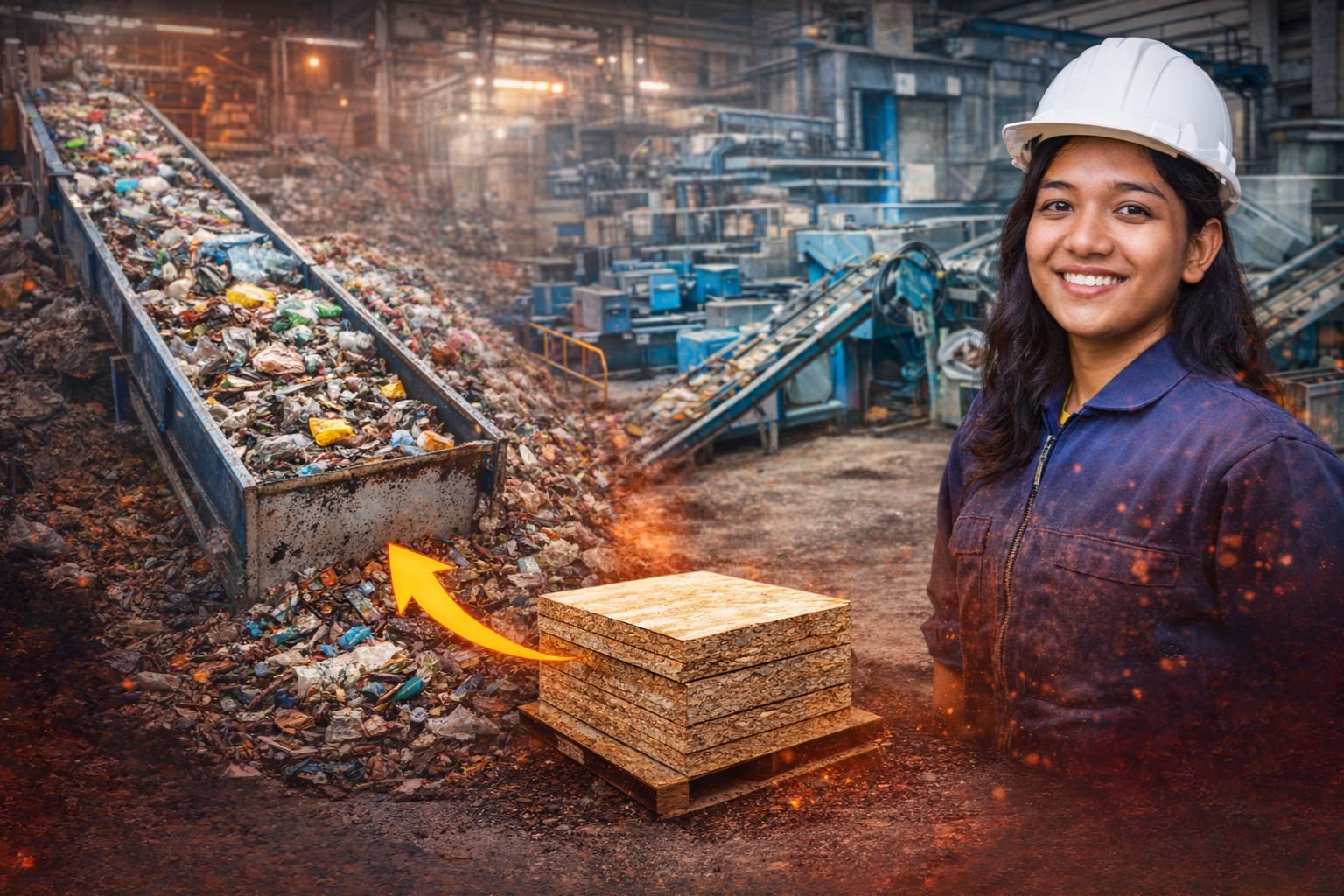


A 23-Year-Old Engineer Developed a Machine in Bangalore Capable of Segregating Mixed Urban Waste with 99.6% Efficiency, Solving One of the Biggest Bottlenecks in Recycling: Sorting.
Nivedha RM was 23 years old, freshly graduated with a degree in chemical engineering, and had Rs 2 lakhs — just over R$ 12,000 — borrowed from her mother, a public school teacher. The problem she wanted to solve was simple to state but impossible to execute: to automatically separate any type of mixed urban waste, the same kind of black bag that comes from homes mixed with food scraps, used diapers, syringes, packaging plastic, and organic waste. Experts said it was impossible. She spent five months in landfills in Bangalore to prove otherwise.
The result was the TrashBot: a patented machine capable of picking up any unsorted household waste and automatically dividing it into biodegradable and non-biodegradable waste with 99.6% efficiency, without any waste picker needing to touch the material. But the biggest problem came after the machine started working.
The Waste That Nobody Wants to Pick Up
When the TrashBot separates dry waste, 70% of what remains is multilayer plastic — the packaging of Kurkure, Lay’s, biscuits, instant noodles, and chocolates that line the shelves of any Indian grocery store. These plastics are classified as unrecyclable because they have alternating layers of polyethylene and aluminum glued together, which are impossible to separate by conventional methods. In India, these materials account for 75% of all plastic waste generated in the country — and have a market value of Rs 2 to 4 per kilogram, compared to Rs 25 to 30 for regular PET. No waste picker voluntarily collects anything worth less than the effort of carrying it.
-
Friends have been building a small “town” for 30 years to grow old together, with compact houses, a common area, nature surrounding it, and a collective life project designed for friendship, coexistence, and simplicity.

-
This small town in Germany created its own currency 24 years ago, today it circulates millions per year, is accepted in over 300 stores, and the German government allowed all of this to happen under one condition.

-
Curitiba is shrinking and is expected to lose 97,000 residents by 2050, while inland cities in Paraná such as Sarandi, Araucária, and Toledo are experiencing accelerated growth that is changing the entire state’s map.

-
Tourists were poisoned on Everest in a million-dollar fraud scheme involving helicopters that diverted over $19 million and shocked international authorities.



The result is predictable: multilayer plastic ends up in landfills, burned in the open, or dumped in sewage channels. None of these options are legal. All continue to happen.
“Waste pickers don’t collect these plastics because nobody wants them. We wanted to give them value,” Nivedha explained in interviews documented by the Indian press. The solution she developed with co-founder Saurabh Jain was to create a second patented technology capable of capturing exactly those plastics that the market rejects and turning them into WoW Boards — sheets that replace plywood, MDF, and particle board in the construction industry and furniture market.
The Paradox of the Material That the Market Rejects
The name WoW stands for “Wealth out of Waste.” The central irony of the product is that it is made from exactly the input that no competitor is fighting over. While conventional recyclers scramble for bottle-grade PET and clean cardboard, TrashCon has almost unlimited access to multilayer plastic without having to pay the market price for it: the material has no market.
The sheets produced have properties that wood plywood cannot replicate. The WoW Boards are water-resistant and termite-proof — two chronic defects of conventional plywood in tropical regions — and cost 30% to 40% less than equivalent green plywood. In construction, the sheet is used as a formwork for concreting: while conventional plywood typically endures between 8 and 12 uses before deforming, WoW Boards deliver double the repetitions, according to data from the company confirmed on TrashCon’s website. Another advantage: no trees are cut down.

TrashCon operates TrashBots with capacities ranging from 5 tons per day — rural village scale — to 250 tons per day, enough to serve a mid-sized city. Three Gram Panchayat (rural municipal councils) are already operating zero waste using the company’s technology. One of the projects near Bangalore serves 23 villages simultaneously. In total, the company claims to have the capacity to stop 500 tons of waste per day from entering landfills and oceans.
From a Dirty Street to a G20 Room
Nivedha’s story begins before college. While still a chemical engineering student at RV College of Engineering in Bangalore, she and friends organized a task force to clean a street in the neighborhood covered in accumulated waste. The action was reported in a local magazine. But the waste returned the next night.
The question she couldn’t stop asking was simple: why does the problem never have a permanent solution? The answer she found was equally simple and entirely ignored: because manually separating waste is unviable at scale. In cities in developing countries, more than 90% of the waste generated is thrown away or burned without proper treatment.

With Rs 2 lakhs from her mother and a co-founder recruited from an accounting firm — Saurabh Jain — Nivedha spent five months in landfills developing the mechanical logic of the TrashBot. The prototype was presented, the company was founded in 2017, and the first major contract was at the Adani Port in Mundra, Gujarat. There were failures. The client covered the process anyway.
Recognition came in sequence: TrashCon was selected for the innovation program of the Smart Cities Mission of the Indian government, implemented in 7 countries, highlighted by the World Economic Forum as a reference in circular economy, and invited to present at the G20 DIA Summit during the Indian presidency of the group. In 2021, Mondelez India — manufacturer of Bis, Oreo, and Lacta in the local market — partnered with the NGO Hasiru Dala to purchase TrashCon’s technology and convert 600 tons of multilayer plastic per year into WoW Boards for public school furniture in Bangalore.
Waste That Becomes School Desks
The most direct image of what TrashCon produces is a public school desk made from snack packaging. The company has made school furniture for several public school networks in India using WoW Boards, and the material has been presented to the very students whose homes generated the waste that became the seat they sit on.
The WoW Boards are worked with the same tools used in conventional wood — saws, drills, screws — and can be painted, finished, and laminated normally. The difference is in the complete cycle: at the end of its useful life, the sheet can be recycled again by the same process, without chemical additives. There is no glue or resin in the manufacturing: multilayer plastic is processed by heat and pressure, and the resulting material is 100% recycled plastic.

The market that TrashCon addresses is the wood panel industry, valued globally at over US$ 170 billion annually. In India, the growing regulation on multilayer plastic creates additional pressure: packaged food companies are legally required to finance the collection and recycling of their own packaging — which turns TrashCon into a compliance solution provider for brands like Mondelez itself.
How the Process Works in Practice
The complete flow of TrashCon has two linked stages. In the first, the TrashBot receives household waste exactly as it comes from homes — without any prior sorting — and uses a combination of magnetic separation, mechanical screening, and density differentiation to divide the material into wet and dry. The wet waste goes to composting or biogas production. The dry waste — papers, plastics, metals — goes for further sorting.
It is at this point that the second stage comes in: the patented multilayer plastic recycling system. The material is processed by controlled heat and pressure, without the addition of any glue, resin, or chemical additive. The multilayer plastic, which typically would require chemical separation of the polyethylene and aluminum layers, is transformed by direct compression into dense and homogeneous sheets. The final product — the WoW Boards — can be cut, drilled, screwed, and painted like conventional wood. The difference is that it does not rot, does not swell with moisture, and is not attacked by termites.
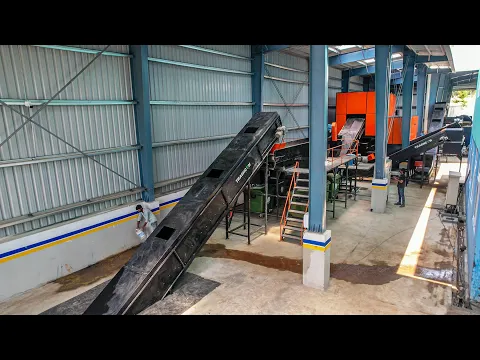

The TrashBot is sold in four capacities: 500 kg, 2 tons, 5 tons, and 10 tons per hour, allowing installation from residential condominiums to municipal treatment stations. The contract with Chennai Airport was one of the company’s relevant deployments.
The Principle That Does Not Change
In 2022, Nivedha wrote to the World Economic Forum a phrase that summarizes the company’s logic: “Someone had to solve this problem. Why not us?” Today, TrashCon has a team of 20 people, operates plants in multiple countries, and continues in the same line of reasoning that guided the five months in landfills: if the market has no interest in the waste, the acquisition cost is zero. If the final product solves a real problem in construction, the market buys. The margin is in the middle.
Multilayer plastic continues to be the material that no recycler wants. It is precisely for this reason that TrashCon wants it.










Fabuloso, técnicas reales, inventos prácticos y protección ambiental, es la solución para eliminar vertederos y proteger el medio ambiente.
Me parece fantastico, esas son las cosas que deberian multiplicarse en todo el mundo, es rentable y lo mas importante ayuda mucho a cuidar nuestro medio ambiente; los felicito Dios les bendiga siempre 🤗🤗💪🙏🙏