





 Portuguese
  English
  Spanish
  5 min of reading
  1 comment


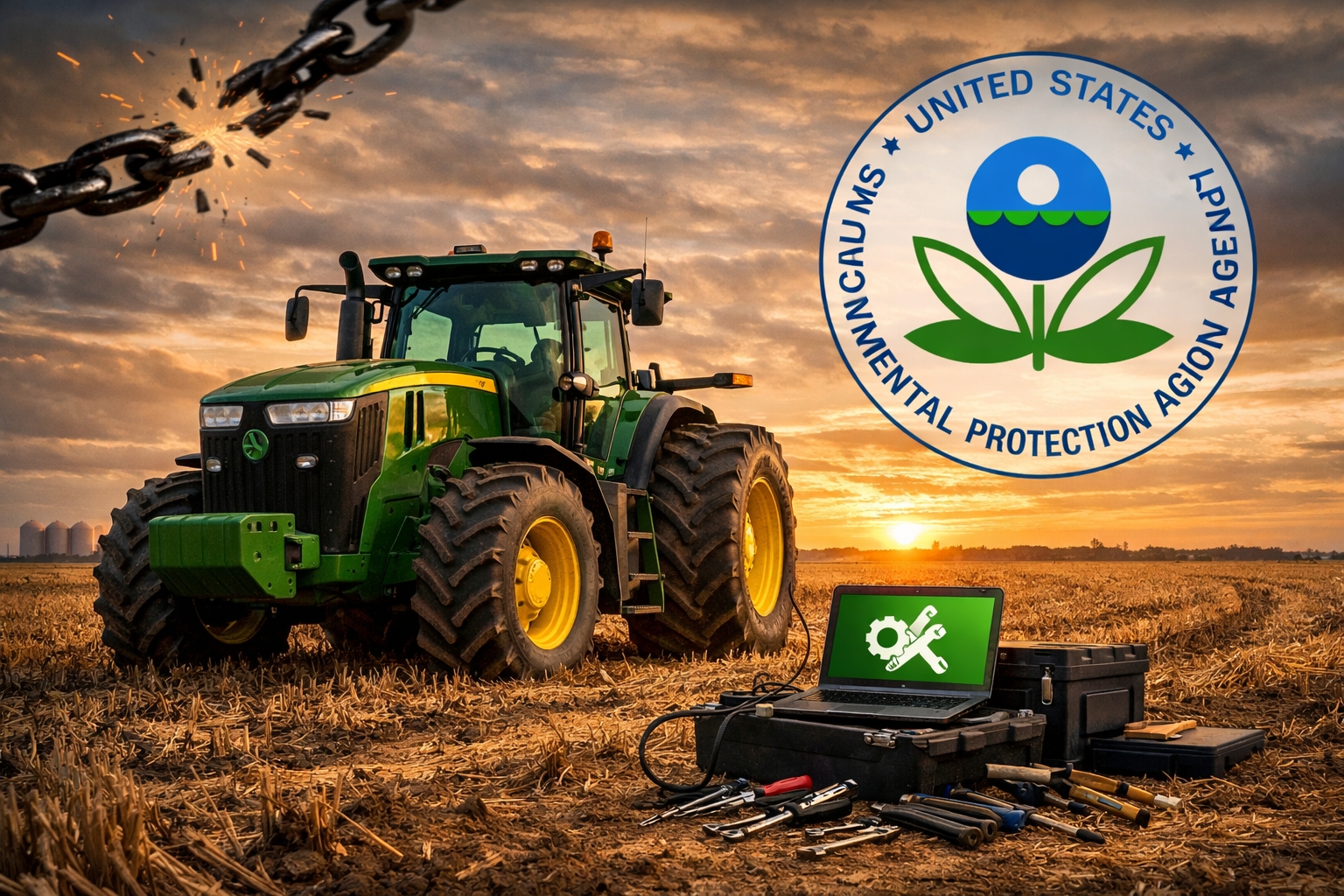


The U.S. Environmental Agency Made It Clear That the Clean Air Act Cannot Be Used to Block Repair Tools and Programs, Which Changes the Game for Those Who Need to Fix Machines in the Field Without Relying on Dealerships
There’s a scene that repeats itself in the field with irritating frequency: the tractor breaks down, the work is underway, the weather is turning, and the solution that should be simple becomes a maze. Not because pieces or labor are lacking. But because access is lacking.
For years, agricultural equipment manufacturers relied on a strict interpretation of the Clean Air Act to limit what farmers and independent shops could do.
In practice, this became a bottleneck: without diagnostic tools, without access to software, without a complete manual, the repair that could be done right there needed to become a trip to an authorized dealership.
-
Motorola launched the Signature with a gold seal from DxOMark, tying with the iPhone 17 Pro in camera performance, Snapdragon 8 Gen 5 that surpassed 3 million in benchmarks, and a zoom that impresses even at night.

-
Satellites reveal beneath the Sahara a giant river buried for thousands of kilometers: study shows that the largest hot desert on the planet was once traversed by a river system comparable to the largest on Earth.

-
Scientists have captured something never seen in space: newly born stars are creating gigantic rings of light a thousand times larger than the distance between the Earth and the Sun, and this changes everything we knew about stellar birth.

-
Geologists find traces of a continent that disappeared 155 million years ago after separating from Australia and reveal that it did not sink, but broke into fragments scattered across Southeast Asia.

The U.S. Environmental Agency decided to intervene in this machinery and established a point that changes industry behavior: the law cannot be used as an excuse to block repairs.
The agency also clarified that temporary shutdowns of emissions control systems may be allowed when the goal is to repair, as long as the equipment is returned afterward to its certified configuration.
Translating to real life, maintenance is no longer treated as an automatic suspicion. And that is significant. Because the fear of “you can’t touch that” has become, for many, the ready explanation to charge high prices and keep the customer trapped in the brand’s ecosystem.
For the U.S. Environmental Agency, the Practical Reason Is Simple: A Stalled Tractor Costs Too Much
When modern agricultural equipment stops, it disrupts not just a routine. It disrupts a planting window, a harvest, a management task, an application that has a specific day and time. And the field does not wait for the dealership’s schedule.
This is the point that gives strength to the story: it’s not just a fight over “the consumer wanting to mess with their own property.” It’s a dispute over productivity and cost.
If the farmer needs to drive miles for a repair that a local mechanic could handle, expenses rise, time is lost, and losses appear in two ways: in the pocket and in the harvest.
This type of limitation has also pushed many people into a curious and somewhat sad behavior: preferring older equipment.
Not because the old is better. But because the old is repairable. Without locked modern systems, without software blocks, without the fear of breaking some invisible rule.
In the end, the technology that should make life easier turns into a reason to maintain an aging fleet.
That’s why this guidance from the EPA was received as a victory by farmers and advocates for the right to repair.
The implicit message is clear: maintenance needs to be timely and accessible, not a privilege mediated by authorization.
Amid this debate, Manufacturing Dive highlighted that the guidance came as a direct response to a request made by Deere last year regarding how to interpret the Clean Air Act in the context of repairs, following a series of disputes and lawsuits related to the issue.
Why Deere Became the Symbol of This Fight, Even Though It Is Not the Only One
Deere is not alone in this universe, but it has become the name that comes first when the topic is repair restrictions. This happens because the discussion brings together everything that irritates the public at once: expensive equipment, technical dependence, closed software, and the feeling that the owner pays but does not control.
In recent years, criticisms have grown, saying that certain practices resemble post-sale monopolization.
If only the authorized network has full access to diagnostics and digital tools, the customer loses power of choice. And when the customer loses choice, prices tend to rise.
There have also been attempts to “resolve it through agreement,” with memoranda and voluntary commitments negotiated with industry entities. The problem is that many people saw these documents as easy promises to sign and hard to fulfill, as they do not create strong enough obligations to ensure broad access, especially to software and diagnostic resources.
Movements by states also show that the topic has left the bubble. Several places have passed broader laws regarding the right to repair for electronics and other products.
In the agricultural realm, Colorado emerged as a pioneer with a specific law for this type of equipment.
And at the federal level, a proposal has emerged to require manufacturers to provide documents, parts, software, and tools for repair, but this path still needs deliberation.
What Changes in Practice for Those Who Depend on Machines Every Day
The immediate effect is psychological and operational.
Psychological because the farmer and the independent repairer gain a sort of institutional backing to demand access.
Operational because the most frequently used argument to block the path is weakened.
This does not mean unleashing chaos. The EPA has emphasized that the guidance does not change the law, does not weaken emissions standards, and does not reduce compliance obligations. The point is different: to allow repairs without turning any intervention into an automatic violation.
And there’s a detail that is often overlooked by outsiders: when the machine fails and goes into safety mode, the risk is not just financial.
Depending on the type of operation, stopping in the wrong place or at the wrong time can create safety, logistics, and productivity problems.
A guideline that recognizes repair as a concrete necessity tends to mitigate this type of cascading effect.
Now it’s up to the manufacturers. The question that lingers is not whether they will comply with the text of the guidance.
It’s how they will commercially adapt to a scenario where the farmer may have more autonomy, including the choice of where and with whom to repair.
Whether this change will consistently lower repair costs still depends on how companies will open access to tools and software.
But one thing has already become difficult to sustain: using the Clean Air Act as a wall to prevent maintenance.







AI slop. Look at the logo in the headline image. Lazy. This should be embarrassing.