





 Portuguese
  English
  Spanish
  6 min of reading
  4 comments


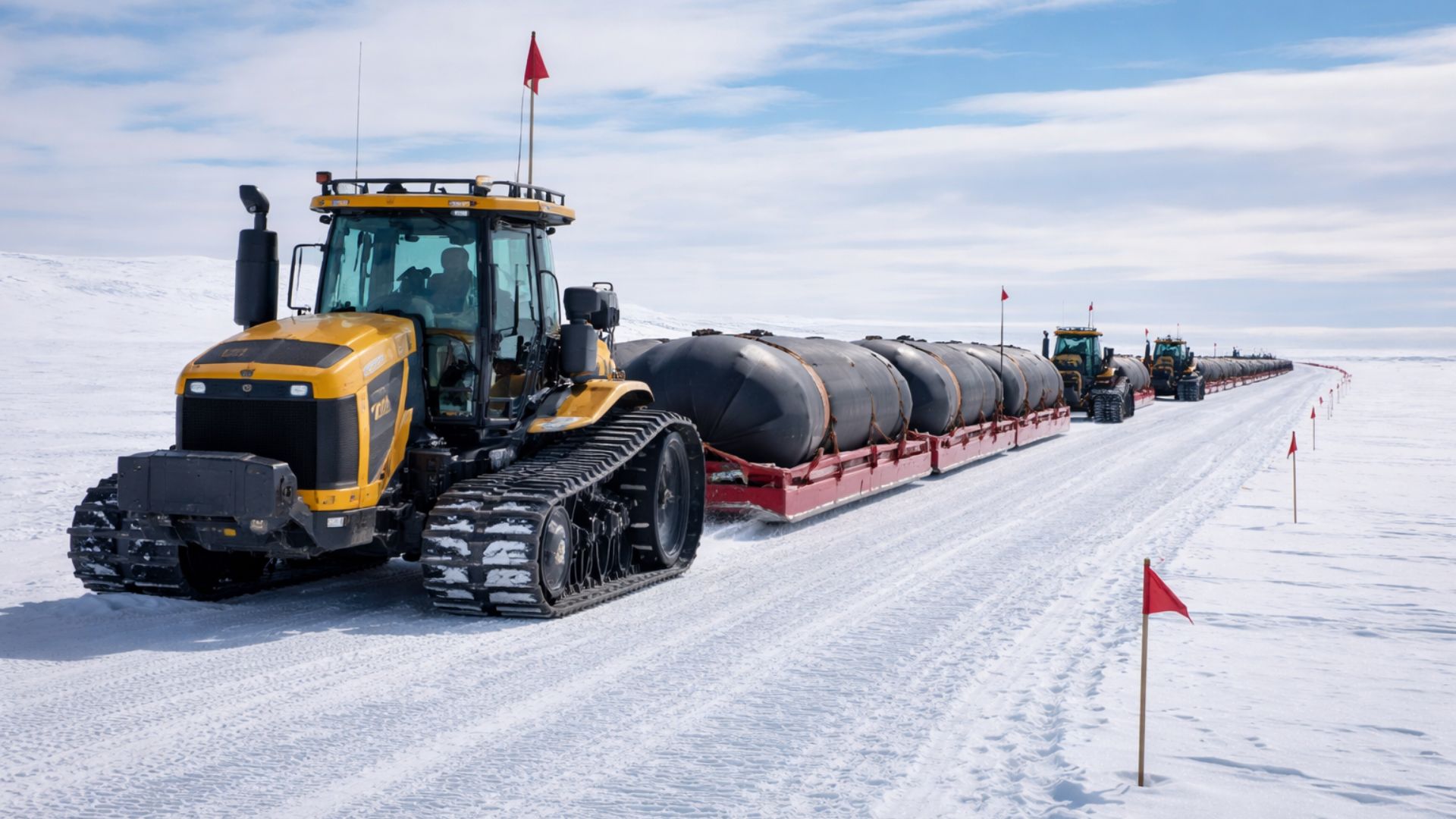


Overland Convoy Crosses the Interior of Antarctica for Weeks, Delivering Fuel and Critical Cargo to the South Pole, Sustaining Science and Infrastructure in One of the Most Hostile Environments on the Planet, Where There Are No Ports, Paved Roads, or Emergency Resupply and Every Logistics Decision Defines the Survival of the Station During the Winter.
A convoy of tracked tractors travels across Antarctica over several weeks to bring fuel and essential cargo to the Amundsen-Scott Station at the South Pole, in an overland movement that has become a central part of scientific logistics on the continent.
Known as South Pole Traverse, the operation departs from the McMurdo area and advances along a marked route over snow and ice, following strict safety protocols to handle an environment where the risks are not always visible to the naked eye.
More than just a long journey, it is a vital cog in keeping a scientific base operational during prolonged periods of isolation.
-
Friends have been building a small “town” for 30 years to grow old together, with compact houses, a common area, nature surrounding it, and a collective life project designed for friendship, coexistence, and simplicity.

-
This small town in Germany created its own currency 24 years ago, today it circulates millions per year, is accepted in over 300 stores, and the German government allowed all of this to happen under one condition.

-
Curitiba is shrinking and is expected to lose 97,000 residents by 2050, while inland cities in Paraná such as Sarandi, Araucária, and Toledo are experiencing accelerated growth that is changing the entire state’s map.

-
Tourists were poisoned on Everest in a million-dollar fraud scheme involving helicopters that diverted over $19 million and shocked international authorities.


With no ports, no paved roads, and limited alternatives when the weather deteriorates, resupply must be planned as a permanent infrastructure, not as an emergency solution.
In this context, hundreds of thousands of gallons of fuel play a central role, powering generators, heating systems, and the daily operations of a station that, at the height of the polar winter, has almost no way to receive external support.
A Supply Line in Absolute White
According to the National Science Foundation, which oversees the U.S. Antarctic program, the traverse functions as a regular supply corridor between McMurdo and the South Pole.
According to the foundation, three traverses per season cover about 990 miles, equivalent to approximately 1,600 kilometers.
During these trips, approximately 300,000 gallons of fuel and up to 540,000 pounds of cargo are delivered with each operational cycle.
Although this number is adopted as an institutional reference, technical reports from polar engineering describe the route as a 1,030-mile one-way path, considering route adjustments and safer areas.
These differences reflect the dynamics of the terrain, which shifts, accumulates snow, and exposes risk zones from one season to another.

Still, the essential aspect remains the same: it is a long, heavy crossing carried out with precision.
Frequently described as a “highway” over ice, the path is far from resembling a conventional road.
There is no pavement, shoulder, or urban signage.
What exists is a marked, compacted path maintained to allow large tractors to pull loaded sleds without sinking or compromising vital equipment.
Why the Traverse Takes Up to 40 Days
Even when conditions are considered favorable, speed takes a back seat.
Technical and educational reports describe the corridor as an unpaved road of more than 1,600 kilometers, where supply delivery can take about 40 days from McMurdo.
This duration results from deliberate choices.
Minimizing risks, controlling mechanical wear, and avoiding hasty decisions is essential in an environment where failures tend to multiply rapidly.
In many sections of the route, the terrain does not impose itself visually.
Nevertheless, it is present.
Snow-covered crevasses, shear zones, and wind-hardened ridges can turn the uniform landscape into an invisible obstruction.
For this reason, continuous inspections and operational discipline accompany every stage of the journey.
Reports from the Cold Regions Research and Engineering Laboratory indicate that the proven route crosses the Ross Ice Shelf, climbs the Leverett Glacier, and proceeds across the Polar Plateau to the South Pole.
This corridor has been developed and tested over the years to be repeatable and predictable, reducing uncertainties in one of the planet’s most extreme environments.
Fewer Planes, More Cargo by Land
The role of the traverse has gained even more weight as it has taken on the transport of heavier and more repetitive supplies.
Fuel.
Technical documents indicate that, until 2008, virtually all supplies to the South Pole relied on air transport.
The main tools during this period were LC-130 aircraft equipped with skis.

With the consolidation of the overland route, flights were not eliminated, but they ceased to be the only option.
The traverse began to offer a high-volume alternative for heavy and repetitive cargo, reducing pressure on the air bridge.
Behind the image of a “train” slowly advancing in the white desert, there are engineering decisions that alter cost, risk, and operational efficiency.
Instead of rigid tanks and heavy structures, the operation adopted lighter sleds, designed to glide better over snow.
The logic is straightforward.
By reducing the structural weight, the share of useful load that actually reaches the destination is increased.
What the Tractors Actually Pull
The performance of the South Pole Traverse depends on both the power of the tractors and the design of the sleds.
Technical reports describe the use of flexible fuel bladders with a capacity of 3,000 gallons, attached to flexible plastic sheets made of high molecular weight polyethylene.
This material was chosen for its ability to withstand low temperatures and minimize friction with the snow over thousands of kilometers.
In one of the described models, the set measures 8 feet wide by 34 feet long and half an inch thick, dimensions designed to reduce drag resistance.
In practice, the tractors tow “trains” formed by several of these connected sleds.
The composition varies according to the section of the route, surface conditions, and consumption strategy throughout the journey.
Even seemingly simple details factor into the operational calculation.
Reports record the use of black bladders, highlighting how thermal balance and heat absorption influence friction between the sled and the snow.
Logistical Economy and Emission Reduction
Beyond being feasible, the overland traverse has altered the financial and environmental equation of resupply.
Technical analyses indicate that, in certain seasons, overland deliveries compensated for about 30 annual flights of LC-130 aircraft.
Within the analyzed scope, the estimated economic benefit reached 2 million dollars per year.
Comparisons of environmental impact reinforce this change.

Assessments based on actual performance indicate significant reductions in atmospheric pollutants associated with fuel transport.
In five analyzed pollutants, the average was below 1% of what would be attributed to air transport in a comparable scenario.
In the case of carbon dioxide, the difference mainly follows the volume of fuel burned.
In this comparative model, the overland operation was estimated at 42% of the equivalent emissions of air transport.
Infrastructure in a Continent with No Margin for Error
None of this makes the traverse simple or free of risks.
Along the way, the surface varies significantly.
There are stretches that wreak havoc on equipment with wind-hardened undulations, while others have fluffier snow, increasing the risk of getting stuck.
In this scenario, the operation combines careful load planning, speed control, and constant maintenance.
A mechanical failure in the middle of the route can cause chain effects on schedules, stocks, and scientific work windows.
The National Science Foundation itself defines the South Pole Traverse as a science traverse, created to reduce costs and increase transportation efficiency between stations and field areas.
In this context, fuel occupies the center of the mission, sustaining generators and vital systems.
It ensures enough operational margin to cross through the period of greatest isolation.
As the convoy approaches the plateau, the traverse takes on an almost industrial character.
Machines, support modules, and scheduled stops form a system designed to be repeated with precision.
Marked routes, standardized equipment, and tested protocols sustain the operation under extreme conditions.
At the South Pole, winter is not just a season of the year.
It is the period when getting out quickly, in most cases, ceases to be a real option.
In a continent where every ton transported redefines what can be installed, maintained, and measured, how far can overland logistics advance to sustain science in one of the planet’s most extreme environments?









Matéria muito interessante, só fica difícil entender os tamanhos e proporções, porque usa unidades de medida dos gringos : galões, milhas, pes. O editor podia ter feito conversão.
Tratándose de gringos no creo en base científica.siempre la mentira.lo que busca son recursos mineros .gringos ladrones..
-“Extraordinário trabalho,incrível engenharia de logística e precisão!Que Tratores Magníficos e as tecnologias dos equipamentos todos.Bravos Homens destemidos ao “Extremo”…bravos.
Muito interessante esse artigo,me ensinou muito,grandecengenharia ,parabe’ns,boa viagem 😉