





 Portuguese
  English
  Spanish
 4 min of reading
  0 comments


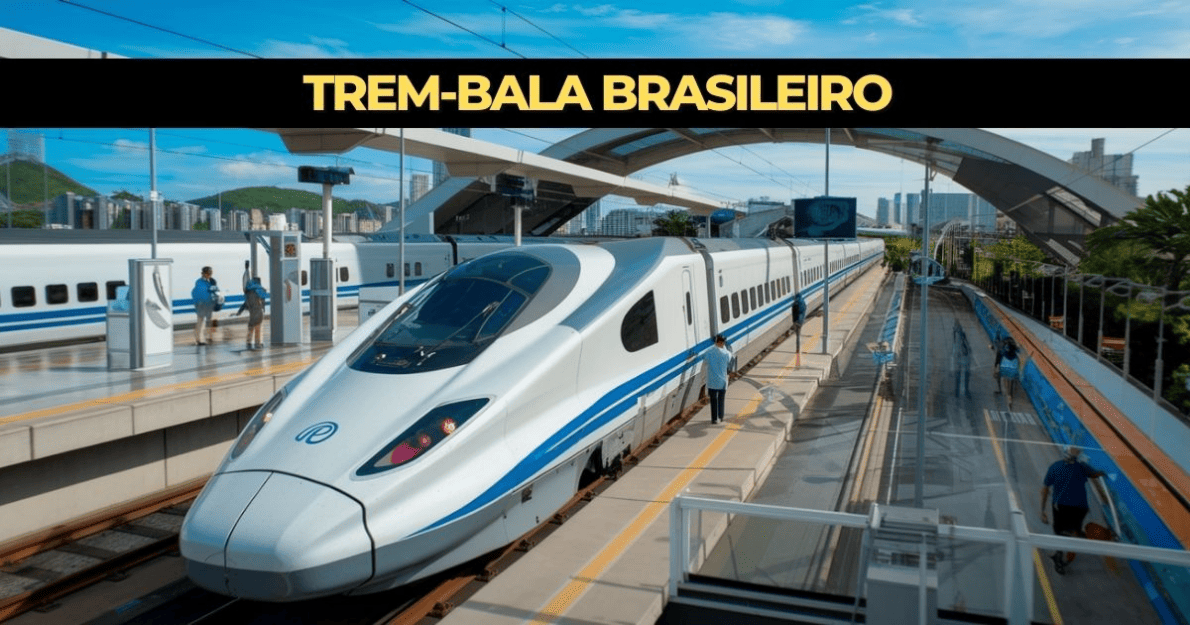
Learn More About The Future Of Rail Transport In Brazil And How The Arrival Of The Bullet Train Between São Paulo And Rio De Janeiro May Impact The Mobility And Economy Of The Country, As Well As Open New Opportunities.
Brazil is preparing for the implementation of a new era in rail transport.
In a revolutionary project that promises to transform mobility between the states of São Paulo and Rio de Janeiro, the bullet train, with speeds of up to 320 km/h, will connect the two metropolises, offering a faster and more efficient travel option.
According to TAV Brazil’s CEO, Bernardo Figueiredo, the details regarding the cost of the project and the fares have already been confirmed, and the forecast is that the project will start operations in 2032.
-
Unlike Brazil, China has banned gambling and casinos to curb the rise of gambling addiction, blocks platforms, punishes operators, and maintains one of the strictest policies in the world to prevent billions from escaping the economy and to protect the population from the social impacts of gambling.

-
China could impose a quarantine on Taiwan without firing a shot, using the coast guard and inspections to force submission, blocking trade, raising insurance costs, and leaving the U.S. divided between reacting or accepting.

-
Millions of Brazilians over 60 years old do not know that they need a second document in addition to their ID to use exclusive parking spaces, and the infraction for not carrying it is considered very serious, with fines and vehicle towing.

-
Paraíba shoots up and has the most expensive square meter in the Northeast, and the increase in labor puts the region at the center of pressure, with Bahia recording the highest monthly increase in Brazil in construction.

The project is under the supervision of the National Agency Of Land Transport (ANTT) and was formalized in March 2023.
With a length of 417 km, the bullet train will feature four main stations: São Paulo, São José dos Campos, Volta Redonda, and Rio de Janeiro.
In addition to these, there will be intermediate stations in Guarulhos, Jacareí, Taubaté, Aparecida, and Rezende.
The expectation is that over 25 million passengers will be transported annually.
Infrastructure And Connectivity
The bullet train will be integrated with existing urban transportation systems, with planned connections to the Intercity Train (TIC) in São Paulo, which will start operating in 2031, as well as connections with Line 6 of the São Paulo Metro (Orange), Line 7 of CPTM (Ruby), and the Santa Cruz Branch, from SuperVia in Rio de Janeiro.
These interconnections aim to optimize passenger mobility and facilitate access to the bullet train from different regions.
The innovation is not limited to transportation infrastructure. TAV Brazil anticipates that the bullet train will have a significant economic impact, with an investment of R$ 60 billion for the construction and operation of the project.
Moreover, the impact on Brazil’s Gross Domestic Product (GDP) could reach R$ 168 billion by 2055, driving the generation of 130 thousand direct and indirect jobs and contributing R$ 46 billion in taxes.
Ticket Prices And Economic Viability
The ticket prices have already been defined. The fare for the complete route between the two cities will be R$ 500, with R$ 1,000 for round trips.
For those opting for shorter segments, such as São José dos Campos or Volta Redonda, the ticket will cost R$ 250 for one way and R$ 500 for round trips.
These values, while higher than bus fares, are competitive with airfare, but with the advantage of being ground transportation, faster than buses that take about six hours to cover the distance between São Paulo and Rio de Janeiro.
TAV Brazil also has a strategic plan to recoup its investment: real estate exploitation around future train stations, which could generate additional revenue of R$ 27.3 billion.
This strategy is based on the successful model of Cheonan and Asan in South Korea, where the development of a new city around the train station generated an urban center with 600 thousand inhabitants.
Expropriation And Impacts On The Real Estate Market
The construction of the railway will require the expropriation of properties, a process that is expected to begin in December of this year.
According to Figueiredo, TAV Brazil will be able to negotiate with landowners to mitigate the costs of expropriation and develop areas that will benefit from the railway operation.
The company is considering purchasing private lands for real estate expansion, which could reduce the financial impact and foster the growth of regions along the train route.
International Partnerships And Financing
The project is in the negotiation phase to secure necessary financing. According to Figueiredo, TAV Brazil is in discussions with Chinese, Spanish companies, and Arab funds to secure the R$ 60 billion needed for the works.
These companies have experience in building high-speed rail lines and are offering complete packages that include equipment, construction, and operation systems.
Figueiredo also revealed that TAV Brazil is seeking support from the Brazilian government to expedite the licensing and expropriation process, essential for bringing the project to fruition.
The government has already been formally requested to classify the bullet train as a priority, which could speed up the processing of applications and ensure that the project becomes a reality as soon as possible.
Sustainability And Environmental Impact
Another crucial aspect of the project is its sustainability. TAV Brazil assured that the bullet train will have a considerably lower CO₂ emission compared to other means of transportation, such as cars, buses, and airplanes.
The carbon emission savings will be equivalent to a forest area of 225 km² per year,
which corresponds to the size of the municipality of Recife in Pernambuco.
This reduction in emissions could represent a significant advancement in the fight against climate change, since high-speed transports tend to be more energy efficient.
Timeline And Future Perspectives
The timeline for project completion is underway, with TAV Brazil forecasting the completion of technical studies by the end of 2026 and the start of construction in 2031.
The works are expected to last approximately one and a half years, with inauguration scheduled for 2032.
TAV Brazil hopes that by the end of 2035, the operation of the bullet train will already be a consolidated reality and continue to expand its routes in the future.
Do you believe that the bullet train can really transform mobility in Brazil? Or will financial and logistical challenges be greater than expected? Leave your opinion in the comments and join the discussion!







Seja o primeiro a reagir!