





 English
  Francês
  Alemão
  Italiano
  Japonês
  Norueguês
  Portuguese
  Spanish
  4 min of reading
  0 comments


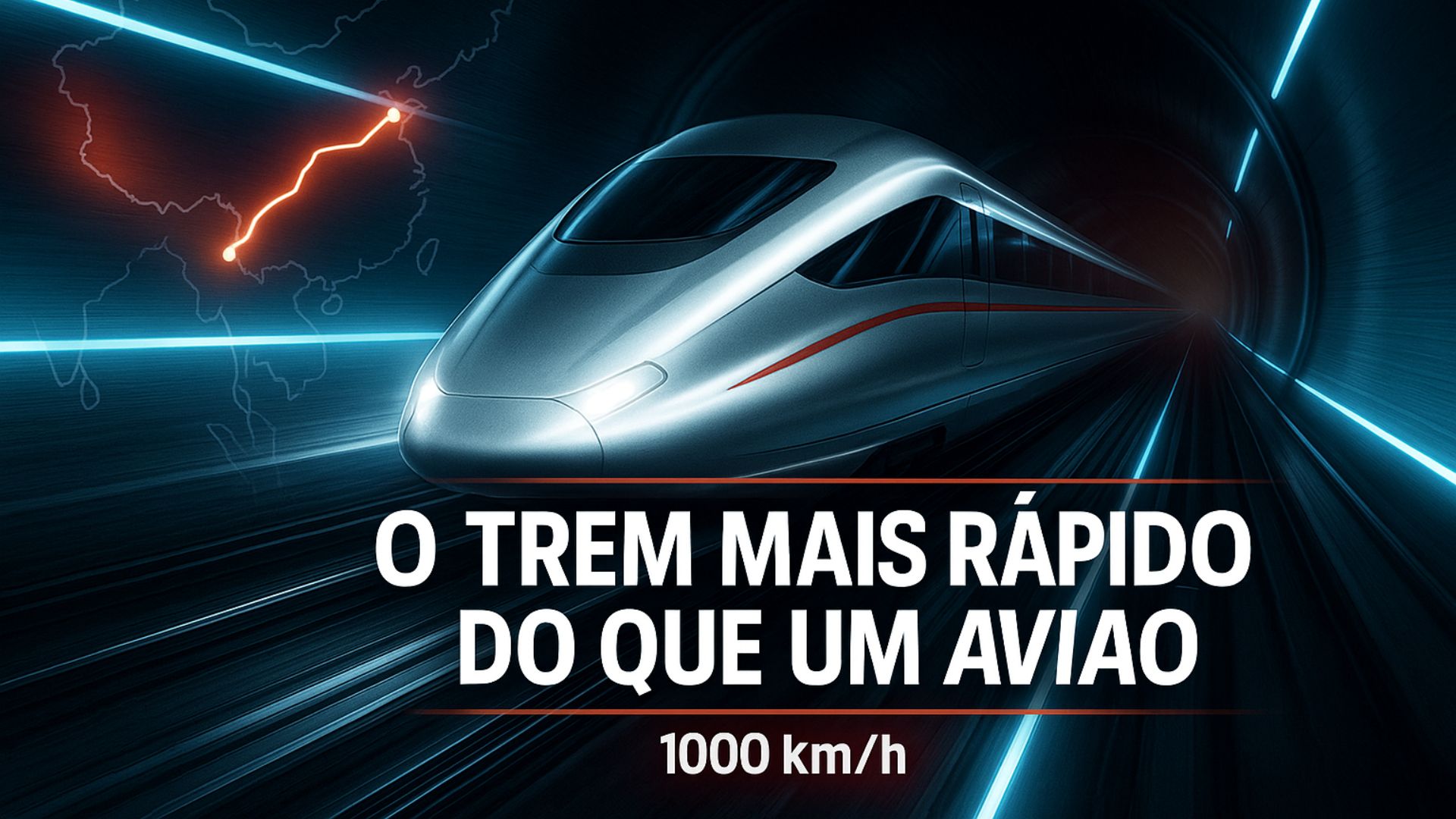
A New Magnetic Levitation System Under Development in China Promises to Change High-Speed Transport by Combining Low-Pressure Tunnels and Speeds of Up to 1,000 km/h.
A new transport system under development in China promises to reach 1,000 km/h and compete with air transport on medium-distance trips.
Based on magnetic levitation and low-pressure tunnels, the project known as T-Flight has already undergone testing in Shanxi province and is presented by its developers as a decisive step towards journeys between major urban centers in about an hour, on routes equivalent to the distance between the capitals of neighboring countries.
Low-Pressure Technology and Extreme Speed
The T-Flight is being developed by the China Aerospace Science and Industry Corporation, a state-owned enterprise linked to the defense and technology sector.
-
Explorers find Roman treasure trapped between rocks on the seabed for nearly 1,600 years and reveal a desperate attempt to hide 53 gold coins during the invasions of the Empire.

-
Archaeologists discover Roman vase buried for over 2,000 years with more than 175 intact gold and silver coins, revealing a desperate strategy to protect wealth during the collapse of the Empire.

-
With 241 meters, 48 thousand tons, and a structure designed to accompany aircraft carriers at sea, the Chinese ship that refuels fleets in motion was born to push Beijing away from the coast and has become the hidden gear of its naval projection.

-
“Discreet” city in the interior of SP stands out among the smartest in Brazil thanks to a national ranking.


The system combines magnetic tracks with low air pressure tunnels, reducing both friction with the tracks and air resistance.
In recent demonstration tests conducted in Yanggao, in the Datong area of Shanxi province, full-scale prototypes have been put into operation over an experimental stretch.
According to Chinese authorities, the system has been designed to achieve speeds of up to 1,000 km/h, surpassing the typical cruising range of commercial airplanes.
In previous trials, the company had already reported reaching speeds above 600 km/h in a low-vacuum test tube, validating the concept under real operating conditions.
The results indicated by the engineers show that the train can remain stable and controllable at high speeds, paving the way for longer testing phases.
In addition to performance, the experiments also aim to evaluate safety aspects, energy consumption, and aerodynamic behavior within the tunnel.
How Magnetic Levitation Works
The basis of the system is magnetic levitation, or maglev.
Instead of wheels touching the tracks, the train floats a few centimeters above the rail thanks to the interaction between electromagnets installed on the vehicle and metal coils positioned along the track’s structure.

When the train begins to move, electric currents are sent to these magnets, creating magnetic fields that repel it from the tracks and keep it suspended.
At lower speeds, contact may still occur, but at a certain speed, the magnetic force becomes sufficient to lift the entire system, eliminating mechanical friction.
At the same time, another set of magnets is responsible for propulsion, pushing the train forward via a linear motor.
In low-pressure environments, air resistance decreases, allowing acceleration to be maintained up to levels much higher than those of a conventional train.
Advantages of the 1000 km/h Maglev
One of the main advantages of high-speed maglev is the reduction in travel time.
In the case of the route between Beijing and Shanghai, currently covered by high-speed trains in 4.5 to 6.5 hours, projections indicate that a system like the T-Flight could shorten the journey to approximately 1.5 hours.
This performance puts the train in a position to compete directly with air transport over distances of about 1,000 kilometers.
Air travel at these distances often involves travel to distant airports, boarding time, and security checks, significantly increasing the total travel time.
Another benefit is the lower mechanical wear.
As the train does not touch the tracks, maintenance is likely to be less frequent and more cost-effective over the system’s lifespan.
There are also environmental advantages, as electrified rail systems can emit fewer greenhouse gases per passenger compared to air transport, depending on the energy matrix used.
Costs and Challenges of Implementation
Despite the advantages, the T-Flight requires large investments in infrastructure.
The system relies on extensive tunnels or ducts capable of maintaining reduced pressure over hundreds of kilometers.
The implementation includes stations, control centers, pumping systems, and specific safety structures for low-pressure environments.

The layout also needs to be highly straightened, which increases the complexity of licensing and expropriations.
Even countries that already operate commercial maglevs, like China with the Shanghai train, maintain short routes due to the high cost of construction.
In the case of the T-Flight, security and precision requirements are even more stringent due to the planned speed.
Possibility of Adoption by Other Countries
The adoption of similar magnetic levitation systems depends on economic, geographic, and regulatory factors.
Regions with major urban centers separated by 500 to 1,500 kilometers would be natural candidates for the model.
In practice, however, countries tend to prioritize already consolidated technologies when seeking to expand rail transport networks.
In Latin America, there are research projects involving maglev, such as MagLev-Cobra in Brazil, aimed at low-speed urban transport.
However, there are still no signs of implementing a regional high-speed corridor based on magnetic levitation and vacuum tunnels.
Potential Impact on International Travel
If the promised performance is confirmed, the T-Flight could redefine the standard for travel between megacities.
Trips that currently take hours could be reduced to about an hour, even between neighboring countries, provided there are appropriate agreements and infrastructure on both sides of the border.
Systems of this type could strengthen economic integration between regions, facilitating the flow of people and goods without relying exclusively on air transport.
Experts, however, point out that the necessary investment is high and involves long-term planning.
With tests advancing and new experiments being planned, the debate grows over the role of ultra-fast magnetic levitation trains in the future of mobility.
In a scenario where travel time and energy efficiency gain importance, to what extent can technologies like this transform the way we travel between cities and countries?






Seja o primeiro a reagir!