





 Portuguese
  English
  Spanish
 4 min of reading
  1 comment


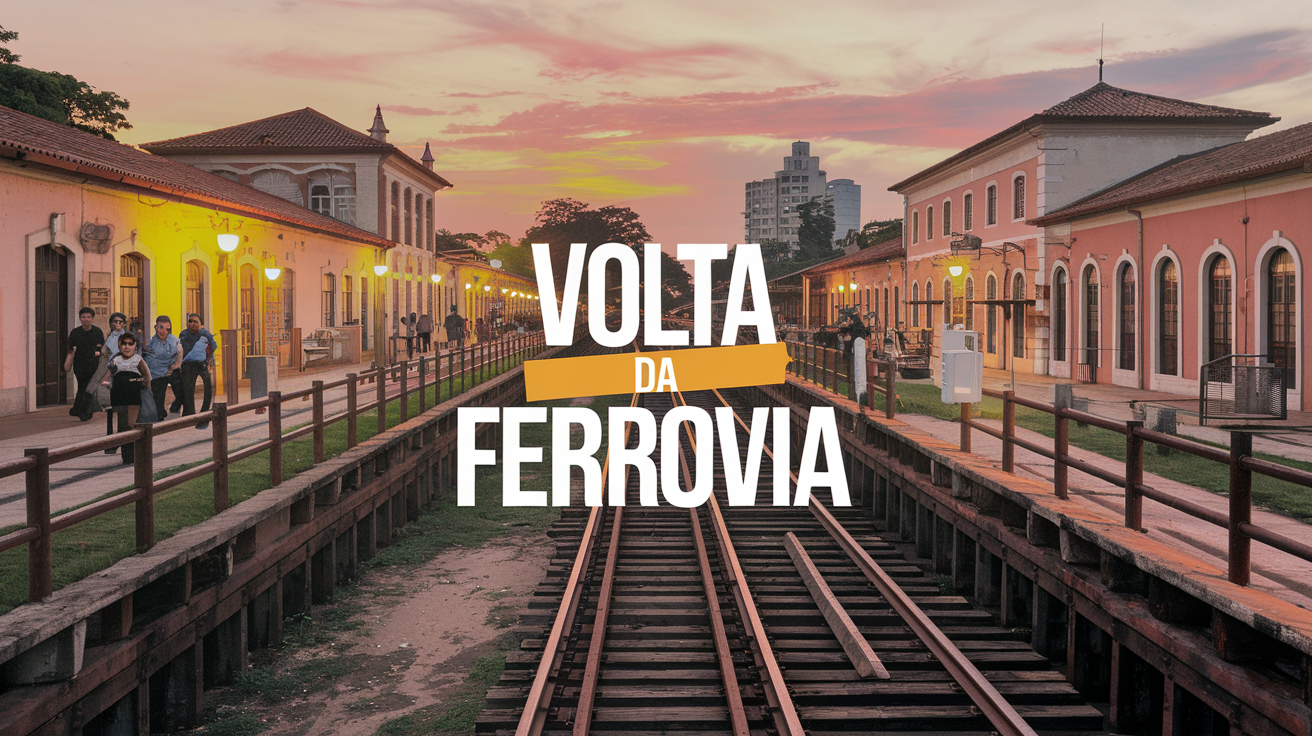


The Federal Government Announces R$ 800 Thousand for Restoration Projects of the Railway Complex of Campo Grande, an Icon of Brazilian Railway History. Abandoned for Years, the Site Faces Severe Deterioration and Needs Significant Investments. Is This Initial Funding Sufficient to Preserve a Heritage of More Than a Century? Find Out All the Details.
If you think that trains belong to the past and that historical railway complexes are just forgotten relics, it’s time to rethink.
In an initiative that promises to boost the preservation of Brazilian cultural heritage, the federal government decided to release a multimillion-dollar fund for the restoration of one of the most emblematic symbols of national railway history.
But is the amount sufficient to tackle years of neglect and abandonment?
-
A new Brazilian shopping center worth R$ 400 million will be built in an area equivalent to more than 4 football fields, featuring 90 stores, 5 cinemas, a supermarket, a college, and parking for 1,700 cars, potentially generating 3,000 jobs.

-
Larger than entire cities in Brazil: BYD is building a 4.6 km² complex in Bahia with a capacity for 600,000 vehicles per year, but the discovery of 163 workers in conditions analogous to slavery has shaken the entire project.
-
With an investment of R$ 612 million, a capacity to process 1.2 million liters of milk per day, Piracanjuba inaugurates a mega cheese factory that increases national production, reduces dependence on imports, and repositions Brazil on the global dairy map.
-
Brazilian city gains industrial hub for 85 companies that is equivalent to 55 football fields.

Last week, it was confirmed the release of R$ 800 thousand for the restoration of the Railway Complex of Campo Grande, belonging to the former Noroeste do Brasil Railway and listed as a historical heritage site.
The funds will be directed towards the development of architecture, engineering, and restoration projects for the most damaged areas, such as the Rotunda and the warehouses.
The decision was formalized with the publication of the commitment term extract in the Official Gazette, signed by the president of Iphan (Institute of National Historical and Artistic Heritage), Leandro Antonio Grass Peixoto, and by the mayor of Campo Grande, Adriane Lopes.
A Decision Awaited for Months
The expectation for funding is not new. Since April 2024, when heavy rains caused the roof of the locomotive shelter, one of the main components of the Railway Complex, to collapse, the situation demanded an urgent response.
At the time, Mayor Adriane Lopes met with the head of Iphan in Mato Grosso do Sul, João Santos, to discuss solutions.
According to Santos, the project approved via PAC (Growth Acceleration Plan) includes priority actions for the most deteriorated areas.
“These are the most deficient parts and with more problems to be resolved in the short term,” explained João Santos, referring to the Rotunda and the warehouses.
The validity of the commitment term runs from December 20, 2024, to December 15, 2025, allowing for a broader timeline for the initial revitalization projects.
Judicial Decision Reinforces Urgency
In addition to the federal government’s action, a decision by the Superior Court of Justice (STJ) in September 2024 pressured the city hall to repair the damages to the complex.
The court concluded that the municipality had been neglecting its “legal and constitutional obligation to manage and preserve cultural-historical heritage” since at least 2015.
According to the STJ, this omission worsened the state of abandonment and neglect of one of the most important historical landmarks in Mato Grosso do Sul.
The Court of Justice of Mato Grosso do Sul (TJMS) had already issued similar opinions, highlighting that the Railway Complex suffered from severe structural problems and prolonged negligence.
The Railway Esplanade, the main area of the complex, houses significant buildings such as the Railway Station, the Cultural Warehouse, and the warehouses, as well as open spaces that still maintain original tracks.
A Legacy of More Than a Century
The Railway Complex of Campo Grande is much more than a set of old buildings.
It occupies an area of 22.3 hectares, with 135 buildings constructed of masonry and wood, representing different periods of Brazilian railway history.
Among its structures are workers’ homes, schools, offices, workshops, and an iconic water tank.
The railway station, built in 1914 and expanded in 1924 and 1930, is a milestone of the expansion of the railway network in the Midwest region.
According to João Santos, the Railway Esplanade comprises the main large buildings, while the complex as a whole also includes streets, workshops, and public and private properties.
“It is still possible to see tracks that have not been removed from the urban area, a living reminder of the historical importance of this space,” he pointed out.
Resources Are Just the Beginning
Although the R$ 800 thousand released by the federal government represents a significant step, experts point out that the amount is just the beginning of a much larger effort needed to fully restore the complex.
The restoration of structures over 100 years old requires specialized labor, specific materials, and detailed planning, which can considerably increase costs.
Moreover, it is crucial for society and the private sector to also get involved in this process, ensuring that the complex not only recovers its structure but also becomes a dynamic space capable of attracting visitors and fostering cultural tourism in the region.
Heritage Under Threat: What Is at Stake?
The preservation of the Railway Complex of Campo Grande is essential for Brazil’s historical memory.
Its deterioration not only represents the loss of an architectural and cultural legacy but also undermines the potential for urban and economic revitalization in the region.
For Mayor Adriane Lopes, the restoration goes far beyond the physical preservation of the buildings.
“It is an opportunity to reclaim history and return to the population a space that symbolizes the development of our city and the country,” she stated.
With preliminary projects already underway, it remains to be seen whether the deadline set for December 2025 will be sufficient to complete the initial stages and if new investments will be secured to complete the revitalization of the complex.
A Question for the Reader
Do you believe that the government’s efforts will be sufficient to transform the Railway Complex of Campo Grande into an example of historical preservation in Brazil? Leave your opinion in the comments!






E fundamental que todos os ramais sejam reformados e volte a operar. Não podemos nos conformar com este descaso. Os morros cortados estão aí, os túneis estão aí, as pontes pequenas e grandes estão aí, as Ferroviarias estão aí, as cidades cresceram e o numero de empresas e pessoas também e estao ai, E só reformar, colocar novos vagões e locomotivas e divulgar, promover e nunca mais abandonar. Não existe país no mundo que tenha se desenvolvido sem os Trens. Os Trens provocam menos dano ambiental, sua vias são finas e uma locomotiva arrasta 200 vagões. Rodovias estão estragando com cargas pesadas. Os Trens transportando o pesado e mais caminhões Toco para distribuição nao faltaria empregos. Caminhões grandes transportariam cargas leves. Os Trens são os melhores transportes terrestre do mundo, são mais baratos, seguros, viaveis e possuem multiplas funcoes: carga, passageiros, turismo, excursões, estudantes, trabalhadores, romarias, podem ser utilizados para distribuicao de itens da educacao, saude, escolta de presos etc. além do que as Ferroviarias poderiam se transformar em FerroShoppings, com telões mostrando empresas amigas patrocinadoras e outras, bem como contando a história da linha, do local e de outros., praças de alimentação,
Cinemas, salas de reuniões. Estados e municípios devem se empenhar para retorno deste modal. O ramal Noroeste do Brasil passa no Pantanal, tem uma ponte inglesa linda no Rio Miranda e outra no Rio Paranáe diversas Estacoes lindas. É um dos ramais que podem ser interligados a linha Madeira-Mamore, Bolivia, Paraguai e ainda Manaus e Boa Vista. O Brasil precisa dos Trens.