





 Português
  Inglês
  Espanhol
  4 min de leitura
  0 comentários


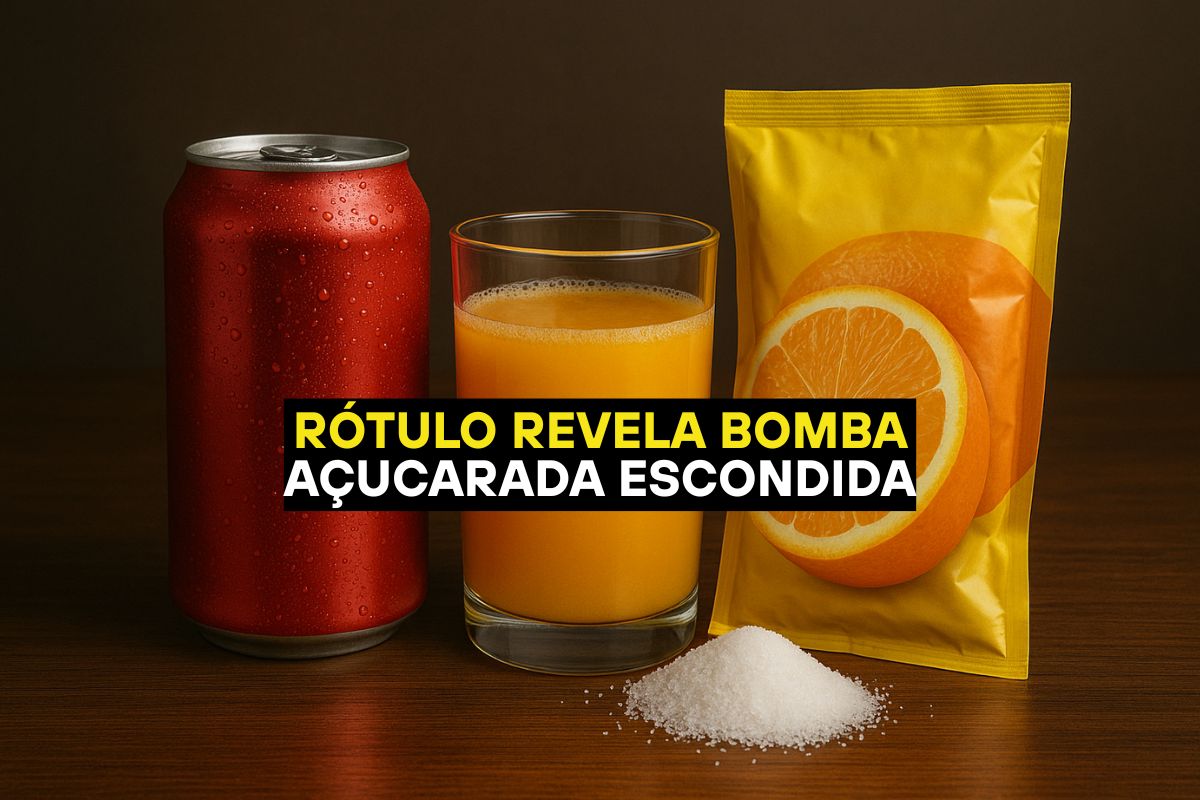
Labels Reveal: There Are Powdered Juices with Less Sugar Than Soda and Others with MORE; Understand How to Read the Packaging and Make Better Choices.
The debate “powdered juice vs. soda” gained new chapters with a detailed analysis from the channel Hello, Science!, which debunks myths and exposes what really goes into the glass. The comparison shows that, depending on the brand and the dilution, powdered juice can have much less sugar than a traditional can but can also be worse when it has a high sugar load combined with additives.
Before deciding what goes into your pantry, it’s worth looking at the numbers and categories outlined on labels: a 350 ml can of regular soda has about 37 g of sugar (≈149 kcal), while a solid preparation when diluted can range from 0.9 g to 11 g per 100 ml, varying wildly between brands, as highlighted by Hello, Science!. Reading the label is the turning point.
What’s in Your Glass: Categories That the Label Doesn’t Let You See at First Glance
Even when the packaging is filled with fruits and “natural” promises, not everything is juice. By definition, “juice” must be 100% fruit (whole or reconstituted) and, when there is addition, it cannot exceed 10% sugar or contain artificial flavors/colors. “Nectar” allows for dilution and addition of sugar/sweeteners and additives. “Drink/fruit-flavored beverage” is the most diluted level.
-
The world’s first octopus farm wants to open in the Canary Islands and is already provoking an international reaction: the plan aims to produce 3,000 tons per year.

-
Drought may be creating stronger superbugs in the soil and helping antibiotic resistance reach hospitals, warns a study highlighting a problem that could grow alongside extreme weather.

-
The biggest scam in history: Napoleon’s France deceived the United States by selling them a territory that was Spanish.

-
Why is the Danakil Desert so dangerous? It has unstable terrain and how extreme temperatures and toxic gases turn the region into one of the most hostile environments on Earth.


The systematic explanation in Hello, Science! helps to avoid falling for shelf tricks.
A detail that confuses: there is “solid preparation for refreshing drink” that, after dilution, becomes a drink with minimal traces of fruit; the channel cites a case with 0.056% juice.
Result: you buy “orange” on the label and take home flavored water with sugar and additives. Pay attention to the ingredient list (in descending order) and to juice percentages when declared.
Sugar: When Powdered Juice Loses (or Gains) to Soda
Hello, Science! starts with a direct comparison:
- Traditional soda (e.g., cola): 37 g of sugar in 350 ml (≈9.45 g/100 ml), plus acidulants, colorants, and flavorings.
- Powdered juice (most known brand): the powder is almost 100% sugar, but after dilution it is ≈0.9 g/100 ml — almost flavored water with colorants/preservatives.
- Powdered juice (cheap brand): 11 g/100 ml when ready — more sugar than soda — with a “high in added sugar” label on the packaging.
Technical conclusion: there is no single answer. “Powdered juice” is not a nutritional category; it is an umbrella with extreme variations. The label is the boss, reinforces Hello, Science!.
Real Risk: Why Frequency Matters More Than the “Smart Swap”
Even when the sugar number “helps,” powdered juice and soda are ultra-processed. The problem is not occasional consumption; it is incorporating them into the daily routine.
The sum of free sugar + additives + low satiety (liquids do not satisfy hunger) increases cardiometabolic risk over time, a warning repeatedly highlighted by Hello, Science!.
Besides sugar, acidulants (e.g., phosphoric) and colorants (like caramel IV, subject to debates) come into play. Beverages with fruit “only in name” do not provide fibers, we don’t chew (lower satiety signal), and the glycemic spike is often higher. Swapping a can for “powder” without reading the label could be trading six for half a dozen — or worse.
Pocket Guide: How to Choose (from Best to Worst)
1) Best Scenario — Whole Fruit or 100% Juice
If you cannot chew the fruit, prefer “100% juice” (whole or reconstituted). It is still fruit sugar, but without additives. Moderation matters.
2) Middle Ground — Nectar Without Added Sugar
If you opt for nectar, look for zero sugar versions. Still, it is diluted and may have flavors/preservatives.
3) Last Resort — Powdered Juice
- Check sugar/100 ml already diluted. If it is below 1–2 g/100 ml, nutritionally it is close to flavored water (still ultra-processed, use occasionally).
- Avoid formulas with >9–10 g/100 ml (in practice, worse than soda).
- Look for labels (e.g., “high in added sugar”). If it appears, skip it.
4) Practical Shortcuts
- Make “water + fruit”: squeeze ½ lemon and add ice + leaves (mint). Zero additives.
- Cold Infusions (hibiscus, chamomile): flavor without sugar.
- Make “concentrate” at home (orange/grape) and mix with water — you control the sweetness.
5) Smart Label Reading
- Ingredients in order: if water and sugar open the list, it’s not juice.
- % of juice: the higher, the better. 0.056% is marketing, not fruit.
- Sugar per 100 ml: compare brands on the same basis.
And What About Your Wallet? Savings That Take a Toll on Health
The appeal of powdered juice is the price and convenience. But Hello, Science! reminds us: real savings come from simple substitutes like flavored cold water, blended fruit with a lot of water, and cold infusions that cost less and provide more satiety and quality. It is possible to drink better while spending little.
Verdict
“Powdered juice” does not save your health by definition. It can be less sugary than the can or worse than it depends on the label. Neither is healthy for daily consumption.
Whole fruit always wins; 100% juice follows; zero nectar is a middle ground; powder comes last and occasionally just as highlighted by Hello, Science! in its analysis.
In your home, what was the biggest label trick you ever fell for? Have you compared sugar per 100 ml among powdered juice brands? What real swap would you make today (e.g., lemon water, cold infusion, 100% juice) to reduce the impact on global prices of your health oops, your own metabolism?
Share in the comments what works in your daily life and tag that person who still thinks all powdered juice is “fruit juice”.









-

-

-

-

-

6 pessoas reagiram a isso.