





 Português
  Inglês
  Espanhol
  6 min de leitura
  0 comentários


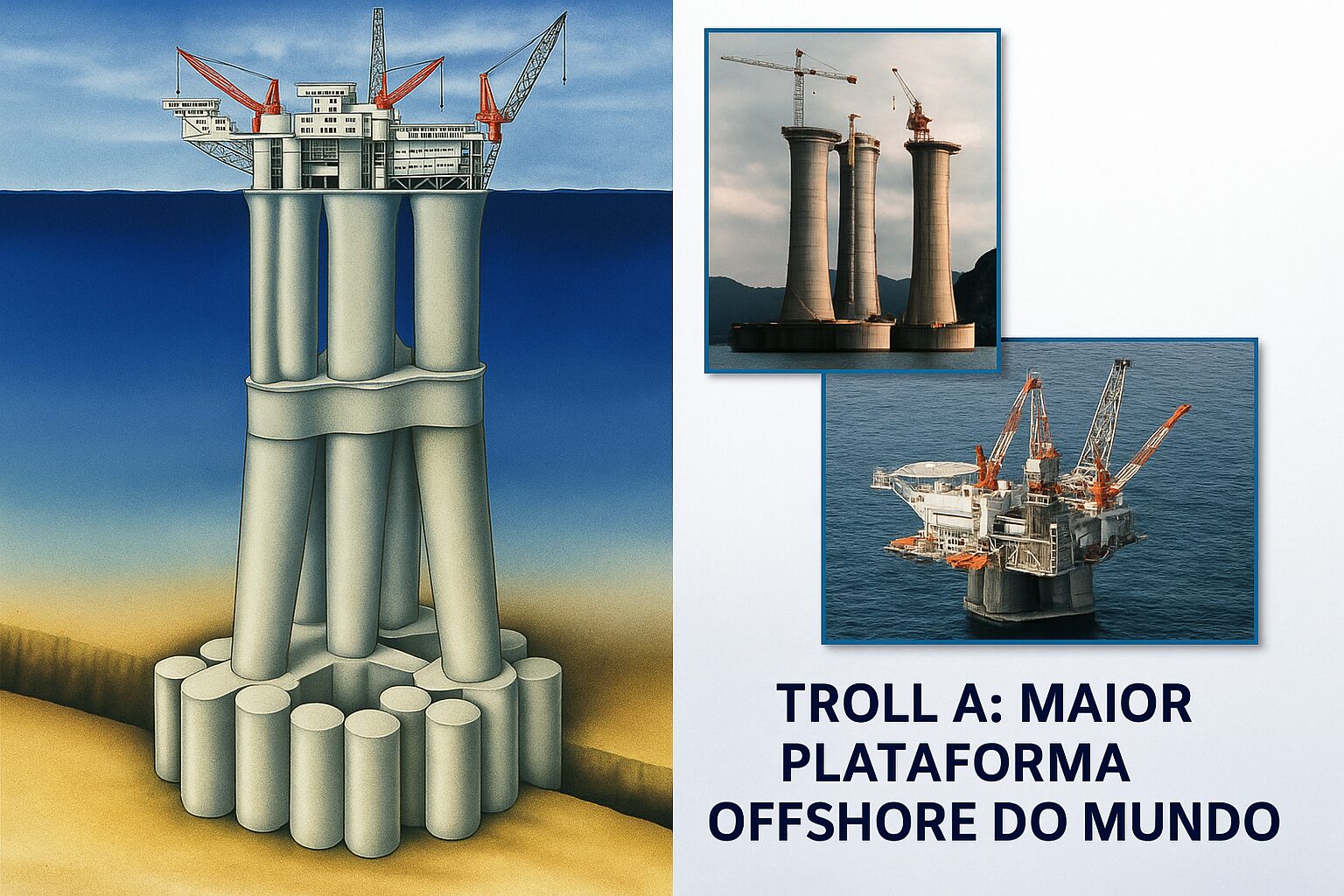
With 472 Meters Tall, More Than One Million Tons and the Ability to Withstand the Pressure of the Depths of the North Sea, Troll A Is Not Just the Largest Existing Offshore Platform — It Is the Largest Structure Ever Moved by Humans. And It Continues to Operate as a Key Component of Norway’s Energy Production.
Troll A — the largest existing offshore platform, is one of the most impressive structures ever built by modern engineering. It is a natural gas extraction platform located in the North Sea, operated by the state-owned Equinor (formerly Statoil). It is part of the Troll field, responsible for about 40% of the natural gas reserves on the Norwegian continental shelf. But what really makes Troll A extraordinary is its size and weight: the structure is 472 meters tall — taller than the former World Trade Center in New York — and has an estimated weight of 1.2 million tons when fully equipped, making it the largest structure ever moved by humans. For comparison, it weighs more than 10 Eiffel Towers combined.
The Largest Offshore Platform in the World
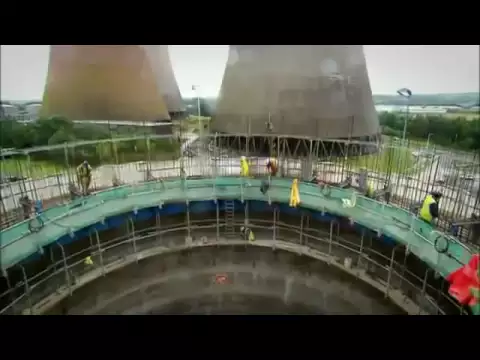

Troll A is not just the largest existing offshore platform. It is also the heaviest structure ever built and transported to sea. Made with 245,000 cubic meters of concrete and 100,000 tons of steel, its foundation is anchored over 300 meters deep into the seabed with vacuum anchors.
Its cylindrical legs have walls over one meter thick, made of reinforced concrete to withstand the intense pressure and the continuous action of ocean currents. In addition, these columns house internal elevators and technical tunnels, allowing access to the submerged base for inspections and maintenance.
-
The world’s first octopus farm wants to open in the Canary Islands and is already provoking an international reaction: the plan aims to produce 3,000 tons per year.

-
Drought may be creating stronger superbugs in the soil and helping antibiotic resistance reach hospitals, warns a study highlighting a problem that could grow alongside extreme weather.

-
The biggest scam in history: Napoleon’s France deceived the United States by selling them a territory that was Spanish.

-
Why is the Danakil Desert so dangerous? It has unstable terrain and how extreme temperatures and toxic gases turn the region into one of the most hostile environments on Earth.


From the Village of Vats to the Sea: The Most Impressive Transportation Operation in Engineering
After its construction in Vats, on the coast of Norway, Troll A needed to be moved to its final location in the North Sea. The journey, of 200 km, was made in seven uninterrupted days, using highly specialized tugboats. The operation was broadcasted on Norwegian television, given its magnitude.
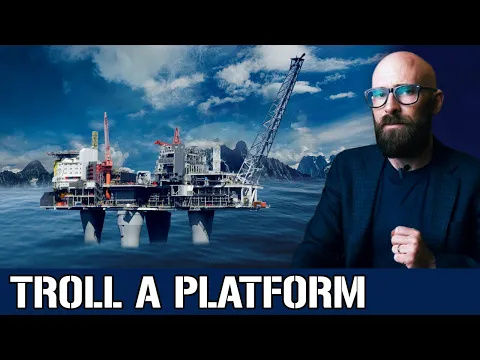
During the journey, the structure’s balance was maintained through highly sophisticated ballast systems, controlling the platform’s flotation with millimeter precision. Every meter traveled was planned in advance — a calculation error could jeopardize years of work.
This crossing went down in history as the largest displacement of a structure ever carried out, both in weight and logistical complexity.
The Strategic Importance of Troll A for Norway
The Troll field is considered a cornerstone of the Norwegian economy. According to the official website of the NPD (Norwegian Petroleum Directorate), the area contains about 40% of the country’s known natural gas reserves, making Troll A the main source of energy production and export for Norway.
The platform supplies European countries with natural gas, mainly through the Zeepipe gas pipeline, which connects the Norwegian coast to Belgium. As a result, Norway remains one of the largest gas exporters in Western Europe, alongside Russia and Algeria.
In addition to being crucial for energy supply, Troll A also generates billions of euros in annual revenue for the Norwegian government, which invests these resources in education, health, and infrastructure through its famous sovereign fund.
A Masterpiece of Underwater Engineering
The structure of Troll A defies physics. With about 472 meters of total height, over half is submerged, resting on the seabed at a depth of 303 meters. The main columns have diameters exceeding 20 meters and house essential systems for the platform’s operation, such as technical rooms, elevators, electrical cables, and inspection tunnels.
At the top, above the waterline, is the living unit, control, and processing of the extracted gas. Troll A is also equipped with state-of-the-art safety systems, capable of withstanding impacts, leaks, and even maritime collisions.
This technical set makes Troll A the largest offshore platform in the world still in operation, and an example of how civil engineering can reach almost unimaginable levels.
Troll A and the Energy Transition: Clean Energy for a Fossil Platform
Although it symbolizes the fossil fuel industry, Troll A also leads energy transition initiatives within the sector. In 2021, Equinor announced that the platform was the first in the country to operate on electricity from the coast, replacing natural gas generators with high-voltage underwater cables.
According to the company itself, this change allowed a reduction of 466,000 tons of CO₂ emissions per year. The goal is for all platforms in the Troll field — including Troll B and Troll C — to also receive clean electrical energy by 2026, increasing the total emissions cut.
This initiative shows that, although still dependent on oil and gas, Norway seeks to reduce the environmental impacts of offshore operations, balancing energy efficiency with climate responsibility.
The Global Critique: Giants Like Troll A Still Represent the Challenge of Decarbonization
Despite the efforts of Equinor and the Norwegian government, the existence of structures like Troll A raises intense debates in environmental forums. During the COP27 in Egypt, world leaders, including the UN Secretary-General, António Guterres, once again warned that the world is on a “road to climate hell with its foot on the accelerator.”
Reports from Folha de S. Paulo, for example, revealed that the number of lobbyists from the fossil industry at COP27 increased by 26% compared to COP26, showing the influence power of the sector even in a global scenario that cries out for decarbonization.
Still, Troll A illustrates a duality: it is at once a landmark of human engineering and a reminder of the climate urgency.
Curiosities About Troll A
- Total Height: 472 Meters (Taller than the Eiffel Tower and the Empire State Building).
- Total Weight When Loaded: Approximately 1.2 Million Tons.
- Concrete Volume Used: 245,000 m³ (equivalent to 100 Olympic swimming pools).
- Steel Volume Used: 100,000 Tons (15 times more than the Eiffel Tower).
- Anchoring Depth: 303 Meters.
- Transport Distance: 200 km towed for seven days.
- Start of Operations: 1996; modernizations and expansions occurred until 2014.
Why Troll A Remains Unmatched?
Since its creation, several offshore platforms have been built worldwide, especially in the Gulf of Mexico, Southeast Asia, and the Middle East. However, none have surpassed Troll A in height, weight, or structural complexity.
Even after nearly three decades in operation, Troll A remains a reference for civil engineers, naval architects, and oil and gas specialists. Its longevity is the result of constant maintenance, technological innovation, and long-term planning.
More than just a gigantic work, Troll A is a symbol of the human capacity to master nature — and, at the same time, to be challenged by it.
The story of Troll A is as impressive as it is contradictory. It represents the pinnacle of modern engineering, but also the permanence of an energy matrix based on fossil fuels.
Being the largest structure ever moved by humans, the largest existing offshore platform, and the structure that weighs more than 10 Eiffel Towers is not just an engineering feat — it is also a reminder: humans are capable of moving mountains, but they also need to learn to move towards sustainability.








Seja o primeiro a reagir!