





 Portuguese
  English
  Spanish
  4 min of reading
  1 comment


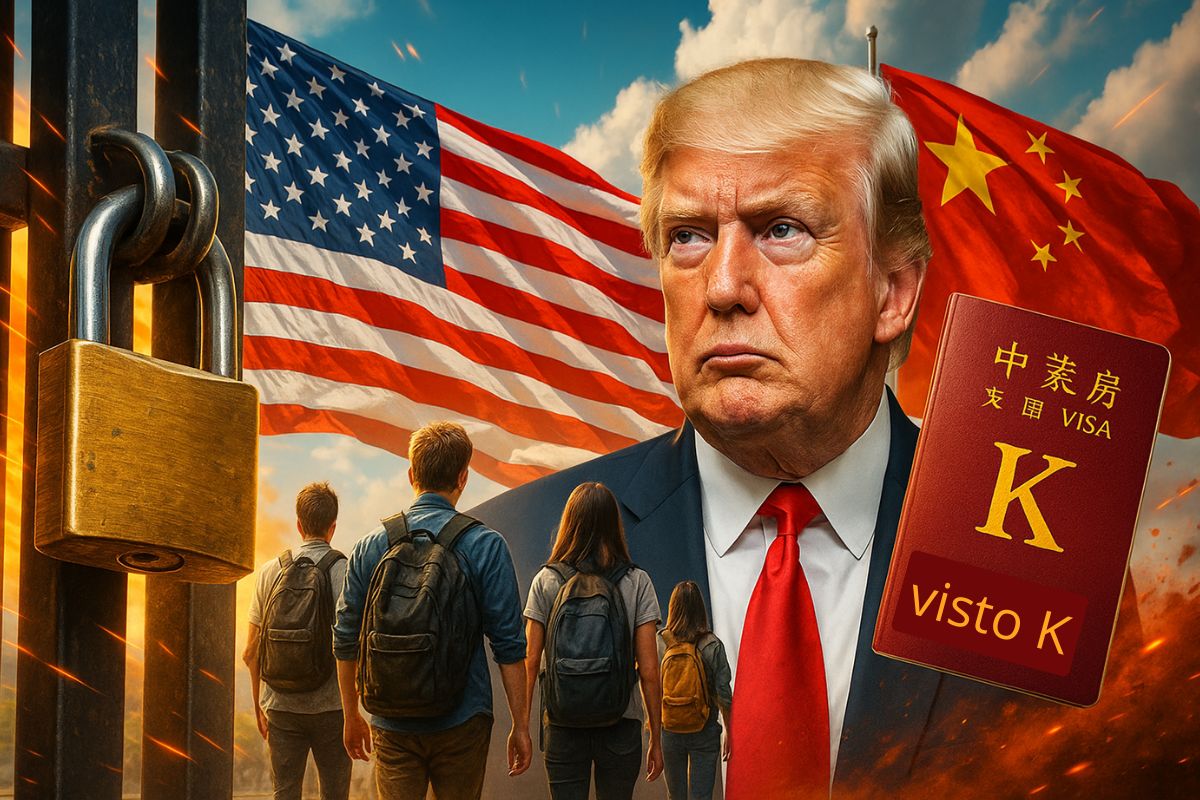


New Chinese Policy Eases Entry of Young Professionals in Science and Technology Fields and Expands Rivalry with the United States.
The United States, under the administration of Donald Trump, tightened rules for foreign students and imposed barriers to hiring immigrant professionals. At the same time, China launched the K Visa, an initiative aimed at attracting global young talent in the fields of science, technology, engineering, and mathematics (STEM).
According to g1, experts say that the Chinese measure inaugurates a new phase in the global brain competition, with the potential to alter the balance of technological innovation between the two largest powers on the planet.
USA Restrict Foreign Students
In recent years, the Trump administration intensified measures against the entry and stay of international students in American universities.
-
A new Brazilian shopping center worth R$ 400 million will be built in an area equivalent to more than 4 football fields, featuring 90 stores, 5 cinemas, a supermarket, a college, and parking for 1,700 cars, potentially generating 3,000 jobs.

-
Larger than entire cities in Brazil: BYD is building a 4.6 km² complex in Bahia with a capacity for 600,000 vehicles per year, but the discovery of 163 workers in conditions analogous to slavery has shaken the entire project.

-
With an investment of R$ 612 million, a capacity to process 1.2 million liters of milk per day, Piracanjuba inaugurates a mega cheese factory that increases national production, reduces dependence on imports, and repositions Brazil on the global dairy map.

-
Brazilian city gains industrial hub for 85 companies that is equivalent to 55 football fields.


Among the actions are the cancellation of student visas, restrictions on enrollment of foreigners in renowned institutions, an increase in detentions and deportations, as well as the requirement of US$ 100,000 annually from companies that employ staff on H-1B visas, widely used in the technology sector.
These policies, seen as an attempt to prioritize American workers, ended up driving away thousands of young people seeking academic qualification in the United States.
For analysts, this void opened up space for other countries, primarily China, to position themselves as an alternative destination.
The K Visa Strategy
In response, China created the K Visa, which allows the entry of young foreign professionals without the need to prove prior employment ties.
This means that candidates can move to the country and then look for a job. The validity of the document is also expected to be longer than that of other visas.
According to experts consulted by g1, the measure is part of Xi Jinping’s government effort to strengthen self-sufficiency in innovation and accelerate progress in strategic areas such as artificial intelligence, chip design, and sensitive military technologies.
Competition for Innovation and Soft Power
China already has more than 40 graduate programs in rare earths, crucial for defense and high technology sectors.
According to analysts, attracting foreign talent not only expands the country’s scientific base but also its soft power, or the capacity to influence globally through knowledge and innovation.
For Ricardo Leães, a professor of International Relations at ESPM, the K Visa could mark a turning point in the global competition.
“The USA has always been the biggest magnet for talent. But, in light of the restrictions, it is possible that China will start attracting some of these highly qualified students and professionals,” he stated to g1.
Opportunities and Challenges for Brazilians
For students and professionals from Brazil, the Chinese opening could represent an attractive alternative. Study costs vary from R$ 5,700 to R$ 23,500 per month, depending on the university, with scholarships available.
The annual cost of living is around R$ 51,000 in large cities and R$ 33,000 in smaller localities, according to estimates cited by consultant Liao Kuo Pin.
However, experts warn that cultural and linguistic barriers remain significant obstacles. Although many companies and universities use English, proficiency in Mandarin is highly valued.
Adaptation to Chinese culture will be a decisive factor for the country to not only attract but also retain foreign talent.
Other Countries in the Race for Talent
In addition to China, other countries have also adopted specific policies to attract foreign professionals in strategic areas.
South Korea launched the K-Tech Pass, a special visa for graduates from the top 100 universities in the world, while the United Kingdom seeks to expand the Global Talent Visa, aimed at scientists, researchers, and technology professionals.
These initiatives highlight that the global race for brains is in full acceleration, with a direct impact on the future of innovation, economy, and national security of different nations.
The creation of the K Visa by China signals a direct competition with the United States for control of the next generation of talent in science and technology.
For Brazilians and other foreigners, a window of opportunities opens, but also challenges of cultural and academic adaptation.
And you, do you believe that the K Visa can truly transform China into a new destination for young talent, or will the USA continue to be the main attraction hub? Share your opinion in the comments.







I appreciate the nuance — you covered both pros and cons fairly.