





 Portuguese
  English
  Spanish
  3 min of reading
  0 comments


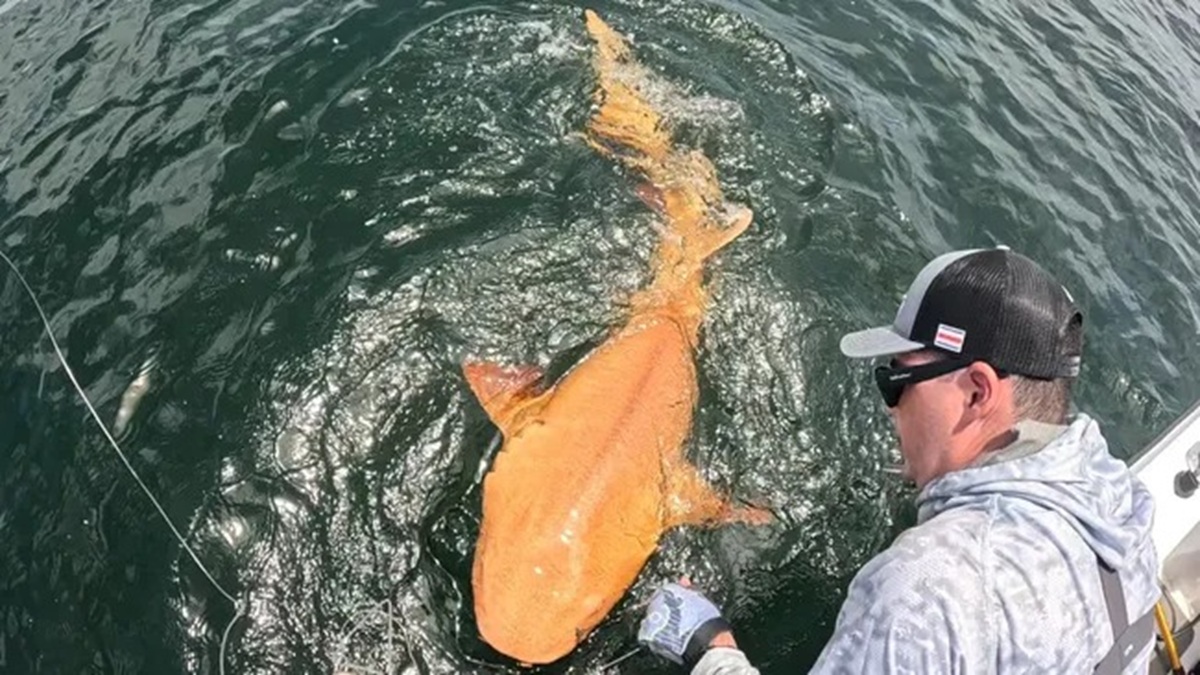
Found at 37 Meters Deep in the Caribbean, the Nurse Shark About 2 Meters Long Showed Intense Orange Coloration Associated with Confirmed Xanthism and Signs of Ocular Albinism, Rare Genetic Combination Never Documented Simultaneously in the Species.
Sport fishermen captured and released in 2024, off the coast of Costa Rica, a 2-meter-long, bright orange nurse shark with white eyes, marking the first confirmed case of xanthism in the species, with signs of albinism, described in a study published in August.
Occasional Catch and Immediate Release
The discovery occurred by chance off the eastern coast of Costa Rica, when sport fishermen hooked the shark at about 120 feet, equivalent to 37 m, below the surface during a recreational activity in 2024.
The animal was pulled to the boat by Garvin Watson, owner of the Parismina Domus Dei hotel in the village of Parismina, who reported immediate surprise upon observing the intense orange coloration in sunlight.
-
While the world looks at oil, the war with Iran is already disrupting helium supply from Qatar, affecting car and iPhone chips, threatening AI expansion, and putting pressure on aluminum packaging at the highest value in four years.

-
Global warming will expose a treasure hidden under the ice of Antarctica and may spark an international dispute over gold and valuable minerals.

-
A street vendor from Praia Grande built a robot made of scrap from scooters and washing machines that pulls his popcorn cart on the beach, emits sounds, and interacts with customers, becoming an attraction on the coast of São Paulo.

-
The specifications of the Xiaomi 18 Pro Max have been leaked, and the highlight is a dual 200 MP camera with a new 22-nanometer technology that promises to consume less energy and capture details in shadows and bright areas using LOFIC HDR.


“We couldn’t believe what was before our eyes,” Watson stated in an email interview with Live Science, describing the unusual brightness of the shark during the capture.

Physical Characteristics and Photographic Record
The shark, identified as a nurse shark, measured approximately 6.6 feet, about 2 meters, and featured bright orange skin, a striking contrast to the typical yellowish to grayish-brown coloration of the species.
After photographing the animal, the fishermen carefully removed the hook from its mouth and returned it to the Caribbean Sea, concluding the episode with no apparent injuries to the shark.
The recorded images served as the basis for subsequent analyses conducted by researchers, who thoroughly examined the skin pigmentation and the characteristics of the animal’s eyes.
Scientific Study and Unprecedented Confirmation
The event was described in a study published on August 1 in the journal Marine Biodiversity, which confirmed it as the first definitive case of xanthism documented in a nurse shark.
Xanthism, also known as xanthochromism, is a rare condition that increases yellow pigmentation in the skin and has been observed in frogs, birds, and fish, but had never been confirmed in this species before.
According to the study, although there had been sporadic reports of unusual coloration, including albinism, no case had been scientifically verified until now.
Associated Albinism and Previous Comparisons
In addition to xanthism, researchers noted that the shark lacked the typical black irises, indicating probable ocular albinism, a rare combination known as albino-xanthochromism.
A similar condition was documented in 2018 in a species of ray, Raja montagui, in the Irish Sea, but had never been recorded in nurse sharks.
“We were very surprised and excited to see the xanthism in the photos,” stated the study’s lead author, Marioxis Macías-Cuyare, a PhD student in biological oceanography, also to Live Science.
Possible Causes and Animal Survival
Researchers emphasize that xanthism is generally associated with genetic factors, although environmental stress, elevated temperatures, and hormonal imbalances may also influence pigmentation, as discussed in the study.
The survival of the shark to adulthood is noteworthy, as such bright colors often represent an ecological disadvantage for species that rely on camouflage in the marine environment.
Macías-Cuyare highlighted that multiple factors could influence this outcome, but all explanations remain speculative until genetic and environmental variables are tested in a controlled manner.








-

-

2 pessoas reagiram a isso.