





 Portuguese
  English
  Spanish
 6 min of reading
  0 comments


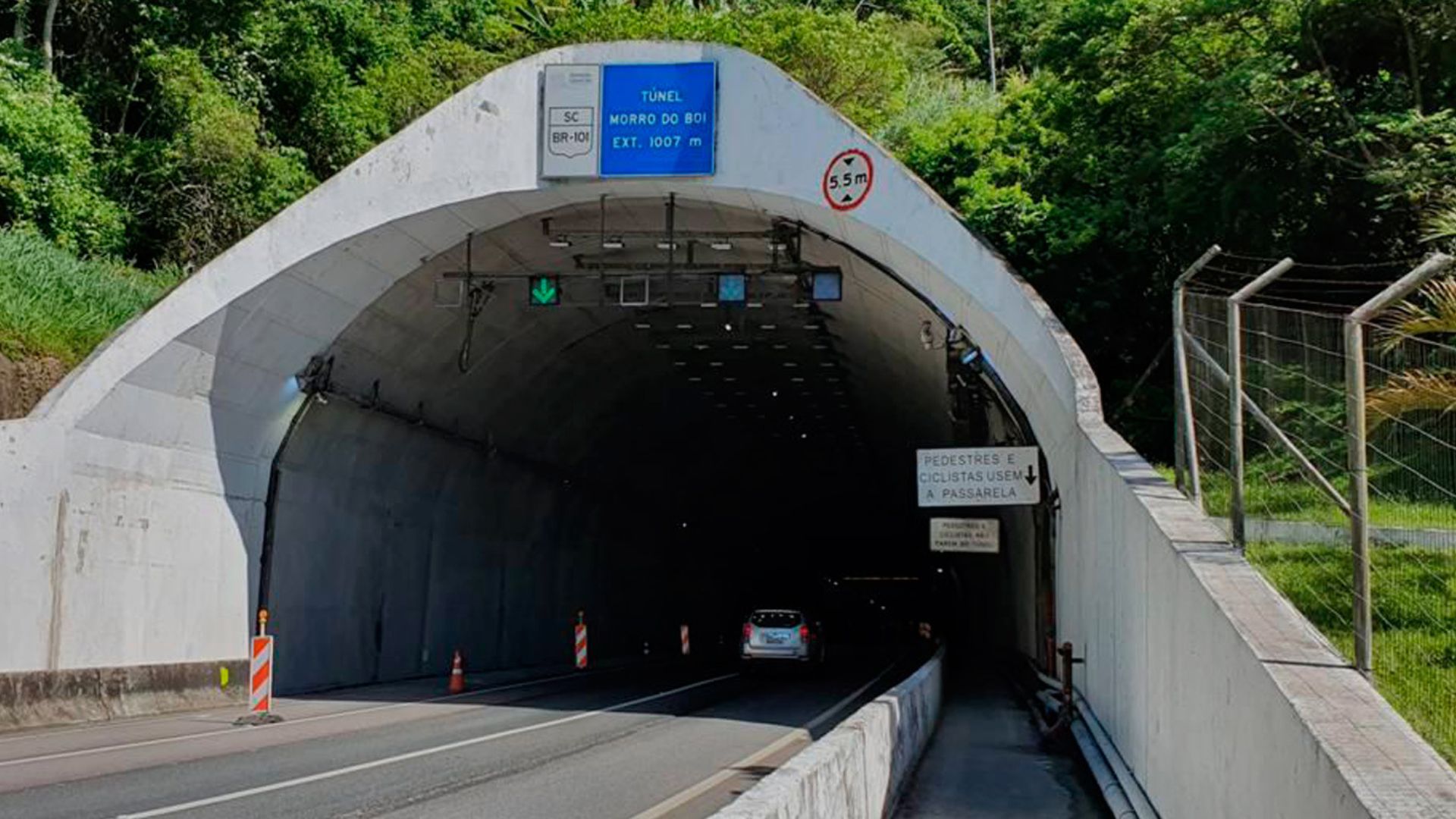
Automation, Sensors, and Cameras with Artificial Intelligence Begin to Command Security Routines Inside One of the Most Strategic Tunnels on BR-101 in Santa Catarina. Modernization Integrates Ventilation, Lighting, and Real-Time Incident Response, Focusing on Reducing Risks and Accelerating Protocol Activation.
The Morro do Boi Tunnel on BR-101 in Balneário Camboriú (SC) has started operating with an automated system integrated with the control center of the concessionaire responsible for the stretch, combining cameras, sensors, and remote commands capable of identifying abnormal situations and triggering automatic responses within the structure.
The modernization includes equipment aimed at smoke and heat detection, emergency communication, ventilation control, and enhanced lighting, in a combination that changes how the tunnel is monitored and how incidents are managed on the main roadway corridor of the Santa Catarina coast.
Integrated Automation and Real-Time Monitoring
The update was announced by Arteris Litoral Sul, which manages the highway segment under concession, and describes a set of devices that now “reads” the environment in real time.
-
Friends have been building a small “town” for 30 years to grow old together, with compact houses, a common area, nature surrounding it, and a collective life project designed for friendship, coexistence, and simplicity.

-
This small town in Germany created its own currency 24 years ago, today it circulates millions per year, is accepted in over 300 stores, and the German government allowed all of this to happen under one condition.

-
Curitiba is shrinking and is expected to lose 97,000 residents by 2050, while inland cities in Paraná such as Sarandi, Araucária, and Toledo are experiencing accelerated growth that is changing the entire state’s map.

-
Tourists were poisoned on Everest in a million-dollar fraud scheme involving helicopters that diverted over $19 million and shocked international authorities.


Among the changes communicated by the company is the use of cameras with artificial intelligence features to identify out-of-standard events, such as the presence of objects on the road, formation of smoke, and other occurrences that require rapid response.

This type of detection, according to the information released, reduces the dependence on continuous manual observation and shortens the interval between the onset of a problem and the moment the control center receives the alert.
Cameras, Sensors, and Integration with the Operational Control Center
According to the details presented about the automation, the tunnel has gained 19 fixed cameras and four mobile cameras with artificial intelligence, capable of sending alerts to the Operational Control Center.
The renovation also incorporated what the concessionaire describes as a supervision and control system that integrates the tunnel into the operational routines of the highway, allowing continuous monitoring and coordinated activation of internal devices such as fans, lighting, and emergency signaling.
In practice, this creates a closed circuit where the detection of an event can trigger automatic actions while teams are mobilized for assistance.
Structure of 1,007 Meters in a High-Flow Area
The change occurs in a structure of 1,007 meters in length, located in an area known for high traffic during peak periods and for being situated on a stretch of rugged terrain, where the margin for detours is limited.
The very configuration of the tunnel, with channelized traffic and physical restrictions on overtaking within the segment, means that any occurrence has the potential to generate queues and increase risks.
Therefore, the focus on automation usually concentrates on three pillars: early detection of anomalies, rapid response to preserve visibility and breathable air, and clear guidance to the driver to reduce secondary collisions.
Ventilation, Lighting, and Emergency Systems in the Security Package
Arteris reported that the modernization involved the replacement and installation of approximately 550 pieces of equipment throughout the project, covering electrical systems, monitoring, communication, and operational safety items.
Among the components usually associated with this package, and mentioned in public communications about Morro do Boi, are the updates for ventilation, lighting, and power, as well as fire-fighting systems and emergency communication.
In road tunnels, these elements form the basis of risk control because they address the factors that deteriorate most quickly in the event of an incident: air, visibility, and orientation.
How Automation Shortens Response Time in Incidents
Automation, however, is not limited to installing sensors.
The differentiator mentioned in the announcement is the integration of data into a control logic.

When smoke is detected, for example, the system can guide the operation of fans and reinforce lighting and alarms, while simultaneously activating operators in the control center.
This results in a shorter and more standardized decision-making flow, reducing the chance of delays between event perception and protocol execution.
In a closed structure, seconds make a difference to prevent a small situation from turning into a low-visibility scenario and risk of pile-ups.
Investment, Equipment, and Execution Without Stopping BR-101
The concessionaire and regional vehicles that reported the completion of the work indicated a total investment of around R$ 36 million for the set of improvements, in addition to a period of interventions that extended over more than two years.
The financial volume indicates that this is not just a one-off “upgrade,” but a broad renewal, with a direct impact on internal infrastructure and the systems that support 24-hour operation.
In projects like this, much of the effort goes into adapting existing structures to more modern equipment without completely halting traffic, which involves nighttime windows, partial closures, and safety planning for workers and users.
Morro do Boi Tunnel as a Monitored Asset in the Concession
The Morro do Boi Tunnel also appears in public reports monitoring special artworks associated with the concession contract, reinforcing that the tunnel integrates the set of assets permanently monitored in the managed network.
This type of monitoring, done based on technical standards and periodic inspections, usually records the state of conservation and indicates intervention needs, creating a history that helps justify and plan modernization efforts.
The presence of the tunnel in this documentation is an indication of structural relevance within the concessioned stretch and the level of institutional attention regarding its condition.
What Changes for Drivers and Traffic Management

From the user’s perspective, the most visible changes are likely to be the more responsive signage and the incident response capability, especially in situations requiring oriented evacuation or immediate speed reduction.
Even when there are no emergencies, more efficient lighting and power systems and integrated operation with the control center contribute to predictability, as they reduce the chance of internal failures leading to unexpected closures.
For traffic management, automation increases the capacity to record events, identify patterns, and calibrate procedures, creating a richer database on the tunnel’s behavior at different times and flows.
Intelligent Tunnel Technology and Critical Infrastructure
The strategy of “adding intelligence” to road tunnels has been adopted in several countries, particularly in structures with high volumes and limited maneuvering space, as it reduces reliance on human intervention in the first minute of a crisis.
In the Santa Catarina case, the highlight is the combination of cameras with artificial intelligence, integration with a supervision and control system, and modernization of essential equipment for ventilation, lighting, and safety.
The result is a tunnel that ceases to be just a passage and begins to function as a monitored environment as critical infrastructure, with automated protocols and traceability of occurrences.
If a tunnel just over one kilometer is already operating with technology capable of detecting anomalies and reacting on its own in emergencies, what will be the next bottleneck on BR-101 to receive a similar “brain” to reduce risks and bottlenecks on the Brazilian coast?









-

-

-

-

-

-

26 pessoas reagiram a isso.