





 Portuguese
  English
  Spanish
  3 min of reading


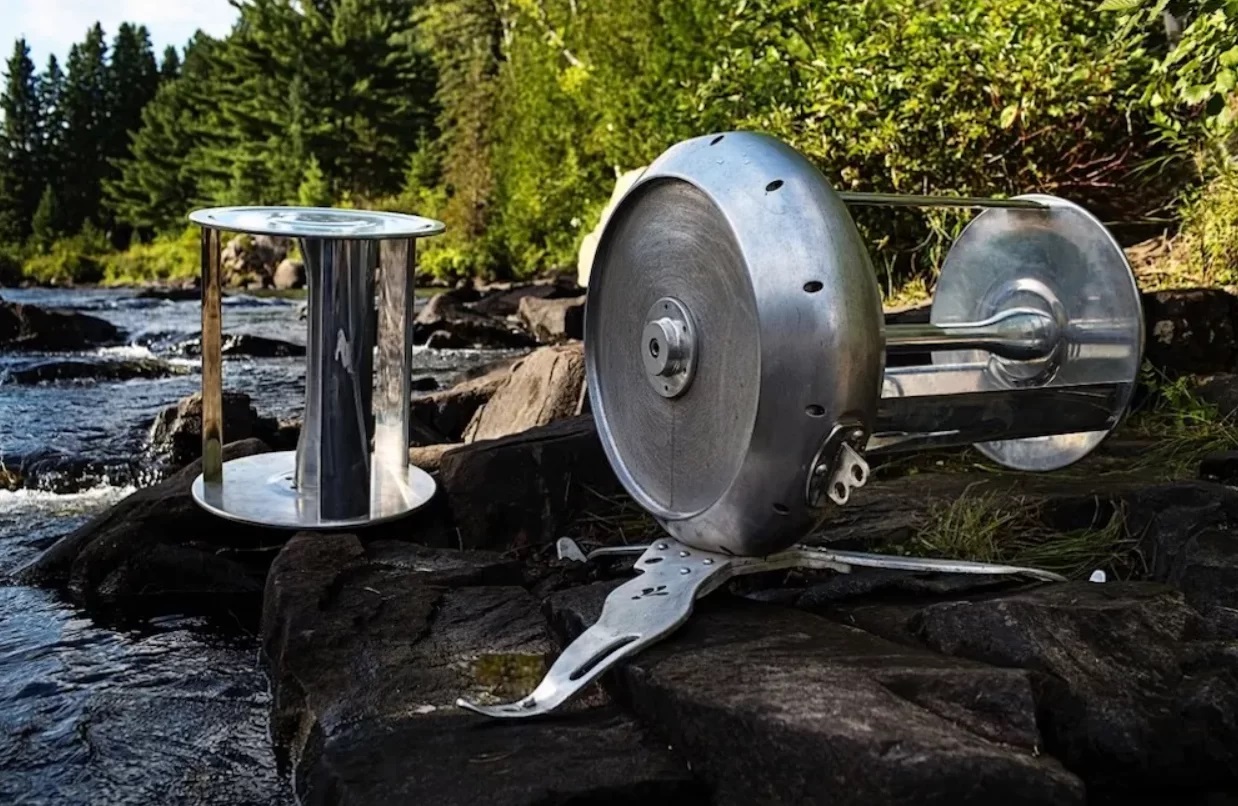
Canadian Company Develops Hydrodynamic Turbine Capable of Powering a House Alone with Clean Energy. The Equipment Can Generate 12 kWh of Electricity.
Decentralizing electricity generation is one of the ways to make energy more accessible in remote areas. In Montreal, the Canadian company Idénergie created a great small-scale energy production project by developing a new portable hydrodynamic turbine. The company used a Darrieus-type rotor for the turbine, which is capable of converting the kinetic energy of a river current into clean energy, without causing any harm to the marine ecosystem.
Each Hydrodynamic Turbine Can Produce Up to 12 kWh
The river current drives the rotation of the company’s turbine, which activates the generator. The energy generated is then converted into clean energy due to the integrated smart transformer. This converted electric energy is then sent to the batteries via an electrical cable.
The batteries are recharged 24 hours a day, and from there, an inverter transforms direct current into alternating current to power electrical devices. Each hydrodynamic turbine of this model can supply an entire house, generating up to 12 kWh per day.
-
A startup backed by OpenAI has started selling a $20,000 robot for household tasks, but when the robot doesn’t know what to do, an employee puts on a virtual reality headset, sees the inside of the house through a camera, and operates each movement. The CEO said that without this, he cannot improve the product.

-
Scientists create a semiconductor that mimics the human brain using hydrogen and boost a new generation of smart chips with learning capabilities and the potential to revolutionize artificial intelligence applications.

-
The radio has been in more than half of Brazilian households for decades, and in 2024, for the first time in history, the number of households without a device surpassed those with a device, with a decrease of 2.3 million in just one year.
-
A “silent skill” is allowing Brazilians to earn up to R$ 22,000 per month without a degree and become indispensable for companies that rely on millions of data to survive.


The exact production may vary depending on the water speed available; however, even with the minimum capacity, the device generates enough energy to support the functioning of common household elements such as a TV, computer, refrigerator, and lighting.
The company responsible for the production of the hydrodynamic turbine also highlights the fact that its turbine model is quite practical as an advantage. This is because installation requires only three people with minimal experience. No crane, modifications to the riverbed, or any expensive civil works are necessary.
Energy Turbine is Made of Easily Recyclable Metals
Inspired by IKEA furniture, the equipment that generates electricity can be shipped anywhere in the world disassembled, inside a box and can be assembled on the riverbank using only Allen wrenches.
The device itself is completely waterproof and made of metals, among other materials, that can easily be recycled at the end of its life cycle. The hydrodynamic turbine is an alternative model of energy generation that uses only the river flow to operate. Unlike a hydroelectric power plant, which requires the construction of dams, forming lakes, and thus generates a significant impact on aquatic fauna and on populations living near the site of hydroelectric power plants.
Company Develops Floating Platform with Plastic That Generates Electricity
In addition to the hydrodynamic turbine, the company Sea Wave Energy Limited (SWEL), developed a pilot project for a floating platform that converts energy from waves into clean energy, named Waveline Magnet.
The equipment is a floating platform composed of various parts in a system interconnected by a column. The product was designed to be lightweight and modular, generating clean and renewable energy, and also to be robust enough to withstand any aquatic environment, even oceans with large waves. The design is very simple and also has great ease of installation and maintenance.
The project of the floating platform powered by wave energy was created using recyclable materials like reinforced plastic, which really contributes to the sustainability of the device. Just one platform can generate 100 MW of energy, according to initial tests. The equipment has already been tested in open waters, and depending on the tide and the strength of the waves, electricity generation can increase.





Seja o primeiro a reagir!