





 Portuguese
  English
  Spanish
  4 min of reading
  0 comments


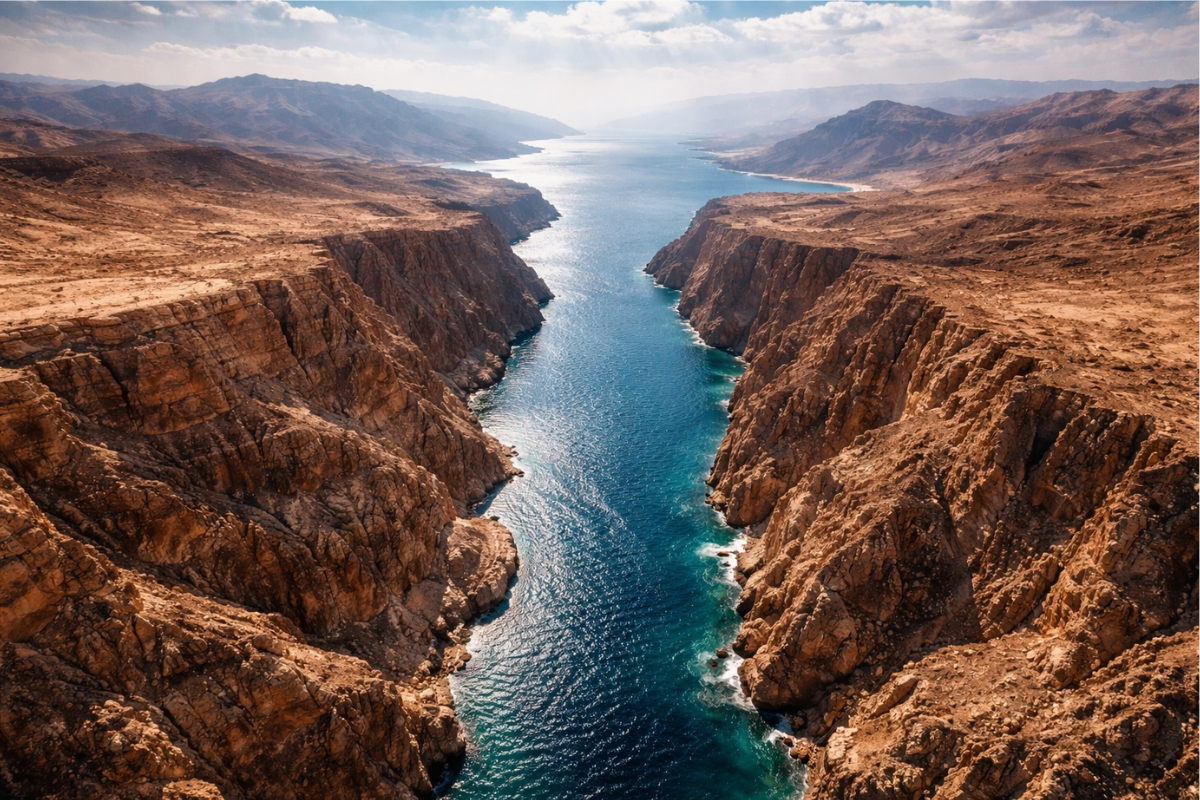
New Study Reveals That the Gulf of Suez Has Never Stopped Opening: The Separation Between Africa and Asia Has Been Active for Millions of Years, Advancing 0.5 mm Per Year and Raising Previously Ignored Seismic Risks
For many years, geology taught that the Gulf of Suez, that narrow strait that partially separates Africa from the Middle East, was a “failed” rift. The classic narrative said that the tectonic fissure tried to open about 28 million years ago, when the Arabian Plate began to move away from the African Plate, but that this process would have stopped 5 million years ago, leaving the region as a simple gulf, rather than a new ocean in formation.
It turns out that this story is changing. A lot.
Recent research shows that the Gulf of Suez has never stopped opening. The separation has just slowed down. According to a new study published on November 3 in the scientific journal Geophysical Research Letters (AGU), the rift is still expanding by about 0.5 millimeters per year.
-
Motorola launched the Signature with a gold seal from DxOMark, tying with the iPhone 17 Pro in camera performance, Snapdragon 8 Gen 5 that surpassed 3 million in benchmarks, and a zoom that impresses even at night.

-
Satellites reveal beneath the Sahara a giant river buried for thousands of kilometers: study shows that the largest hot desert on the planet was once traversed by a river system comparable to the largest on Earth.

-
Scientists have captured something never seen in space: newly born stars are creating gigantic rings of light a thousand times larger than the distance between the Earth and the Sun, and this changes everything we knew about stellar birth.

-
Geologists find traces of a continent that disappeared 155 million years ago after separating from Australia and reveal that it did not sink, but broke into fragments scattered across Southeast Asia.

It may seem small, but for tectonic processes this is significant, and it redefines how scientists understand the evolution of these structures.
The study is led by David Fernández-Blanco, a geoscientist at the Institute of Deep-Sea Science and Engineering of the Chinese Academy of Sciences. He told Live Science that the results shake the binary notion that rifts either “succeed” (like the Red Sea, which is opening an ocean) or “completely fail.”
According to him:
“We are showing that there is an intermediate path, where a rift can slow down, but without really dying.”
What Always Seemed Quiet Has Never Really Been Still
The Gulf of Suez has always been treated as the perfect example of a rift that did not evolve into an ocean. However, the region had been showing small signs of tectonic life. Some sections exhibit ancient coral reefs elevated above sea level, something that doesn’t happen without structural forces pushing the ground upwards. Light tremors still occur occasionally. And there are geological faults that appear to be lifting land blocks.

For Fernández-Blanco, there was a gap between the dominant discourse and the physical clues:
“What caught our attention was the contrast between the narrative of total tectonic inactivity and the scattered signs of continuous activity.”
These “clues” motivated the team to closely analyze the entire extent of the rift, about 300 kilometers, observing the geography and the paths of rivers that cut through the rocks. When a river has an irregular profile that cannot be explained by erosion alone, the likely culprit is tectonic movement.
In addition, the researchers investigated ancient interglacial reefs, formed when sea levels were higher during warm periods. Many of them are now 18 meters above the current level. The explanation? Slow and continuous movements of the crust.
Rifting Has Slowed, but Not Ended, and This Changes Everything
Combining all this data, the study concluded that the rift indeed reduced its speed about 5 million years ago, when part of the tectonic activity shifted to the Dead Sea region, where a new boundary emerged between the African and Arabian plates. Even so, the process in the Gulf of Suez has not ceased.
The current rate of extension even resembles that which occurs in the western United States, where crustal expansion forms the famous set of mountain ranges and valleys known as the Basin and Range Province.
For Fernández-Blanco, this reinforces something important:
“Changes in tectonic boundaries do not necessarily mean that a rift will be turned off. The forces driving rifting are more persistent and complex than the simple movement of plates.”
Implications: More Seismic Risk and Many “Failed” Rifts May Not Be Dead
The discovery has practical effects. If rifting has never stopped, then the Gulf of Suez may be more vulnerable to earthquakes than previously thought. The region, which includes coastal areas of Egypt and important industrial facilities, may need a review of risk assessments.
Furthermore, the study paves the way for other rifts considered “failed,” in various parts of the world, such as in East Africa and even in Europe, to be reassessed with modern mapping and dating technologies.
In the words of the researcher:
“We may find that Earth’s tectonic systems are more dynamic and persistent than we thought.”
In other words, what was believed to be geologically dead may actually be just sleeping, or rather, slowly opening a path that could one day become an ocean.








-

-

-

-

-

11 pessoas reagiram a isso.