





 Portuguese
  English
  Spanish
  4 min of reading
  0 comments


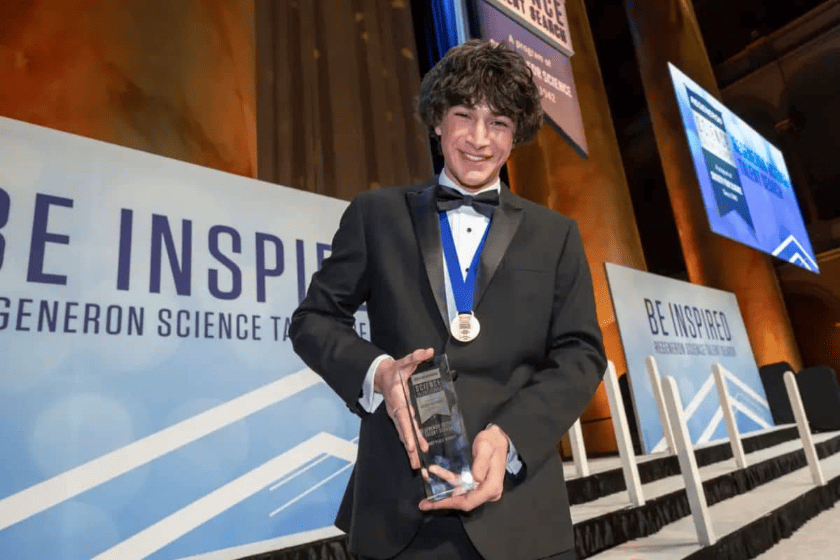
Discovery Earned Prestigious Award and Caught the Attention of the Scientific Community for the Volume and Precision of the Analysis Made by the Youngster
A high school student found 1.5 million space objects previously unknown. At just 18 years old, American Matteo Paz used artificial intelligence to analyze a massive forgotten NASA database.
As a result, he received US$ 250,000 (R$ 1,452,000.00) for the discovery and had his work published in one of the leading scientific journals in astronomy.
From Curious Observer to Award-Winning Scientist
Matteo’s journey began as a child when he attended public star-gazing lectures at the California Institute of Technology (Caltech). In 2022, he joined the Planet Finder Academy, an educational program aimed at young people interested in astronomy.
-
The coldest seawater ever recorded in Earth’s history was hidden under extreme ice 717 million years ago and reached an impressive -15°C.

-
China has launched the world’s first floating artificial island, a scientific structure designed to face open seas, test equipment weighing hundreds of tons, and reach depths of 10,000 meters.

-
China accelerates global science and may surpass the United States in 2 years with increased public investment, continuous growth, and direct impact on the global technological competition.
-
Scientific studies indicate that drought may be strengthening a much greater silent threat: more resistant superbugs.


There, he was mentored by Davy Kirkpatrick, a senior scientist at IPAC, a center that operates data from various NASA space missions. Early in their meetings, Matteo told Kirkpatrick he wanted to publish a scientific paper. Instead of discouraging the young man, the scientist accepted the challenge.
“He said, ‘OK, then let’s talk about it‘,” Matteo recalled.
The Forgotten NASA Database
The proposed project involved data from the NEOWISE telescope, a space observatory that operated for more than a decade mapping the sky in infrared.
The original mission was to identify near-Earth asteroids, but the NEOWISE files contained much broader information, with signals of other phenomena, such as quasars, variable stars, and eclipsing binary systems.
Even retired, the telescope left a legacy of nearly 200 billion lines of observations. However, these data had not been fully analyzed, especially regarding variability—changes in the brightness of objects over time.
Kirkpatrick suggested a more contained project, observing a small part of the sky. But Matteo wanted to go further.
Intelligent Algorithm to Detect the Invisible
Thanks to his background in mathematics and computer science, the young man developed an algorithm based on machine learning.
He had studied advanced calculus since middle school and learned to apply artificial intelligence techniques to temporal data.
This knowledge allowed Matteo to create a system capable of detecting small variations in infrared brightness, signaling objects that traditional methods could not identify.
After two years of refinement and collaboration with astronomers, the model was able to process the entire NEOWISE database.
The result was the identification of 1.5 million variable celestial sources that had not yet been cataloged.
New Window to the Universe
The discovery not only increases the number of known objects in space but also expands the possibilities for studying the behavior of cosmic phenomena. Quasars, stellar explosions, and binary stars can now be better understood.
“The model I implemented can be used in other temporal studies in astronomy and also beyond,” Matteo explained. He cites possible applications in areas such as stock market analysis and atmospheric pollution monitoring.
His method, called “Submillisecond Fourier and Wavelet Model,” was designed to capture both fast events and slow changes—patterns that often go unnoticed by traditional approaches.
From Learning to Mentorship
After his first involvement in 2022, Matteo returned to the Planet Finder Academy in 2024 as a mentor for new high school students. Now a paid employee at Caltech, he continues to work with Kirkpatrick at IPAC.
Meetings with his mentor, according to him, are relaxed and productive. “Every meeting with Davy is 10% work and 90% just chatting. It has been really nice to have someone to talk to about science this way,” he said.
Kirkpatrick also recognizes the value of mentoring new talent. “If I see their potential, I want to make sure they are reaching it. I will do everything I can to help them.”
Catalog Will Be Launched in 2025
The discoveries made by Matteo have not yet been fully disclosed. The catalog containing the 1.5 million objects is set to be released in 2025. When available, it could become an important reference for the astronomical community.
Matteo’s publication in the The Astronomical Journal was signed only by him, an unusual feat for someone so young. The impact of his work could change the way scientists observe variability in the cosmos.
By transforming ignored data into new discoveries, Matteo demonstrated how the combination of curiosity, technical knowledge, and mentorship can open previously unimaginable paths in science.








Seja o primeiro a reagir!