





 Portuguese
  English
  Spanish
  4 min of reading
  1 comment


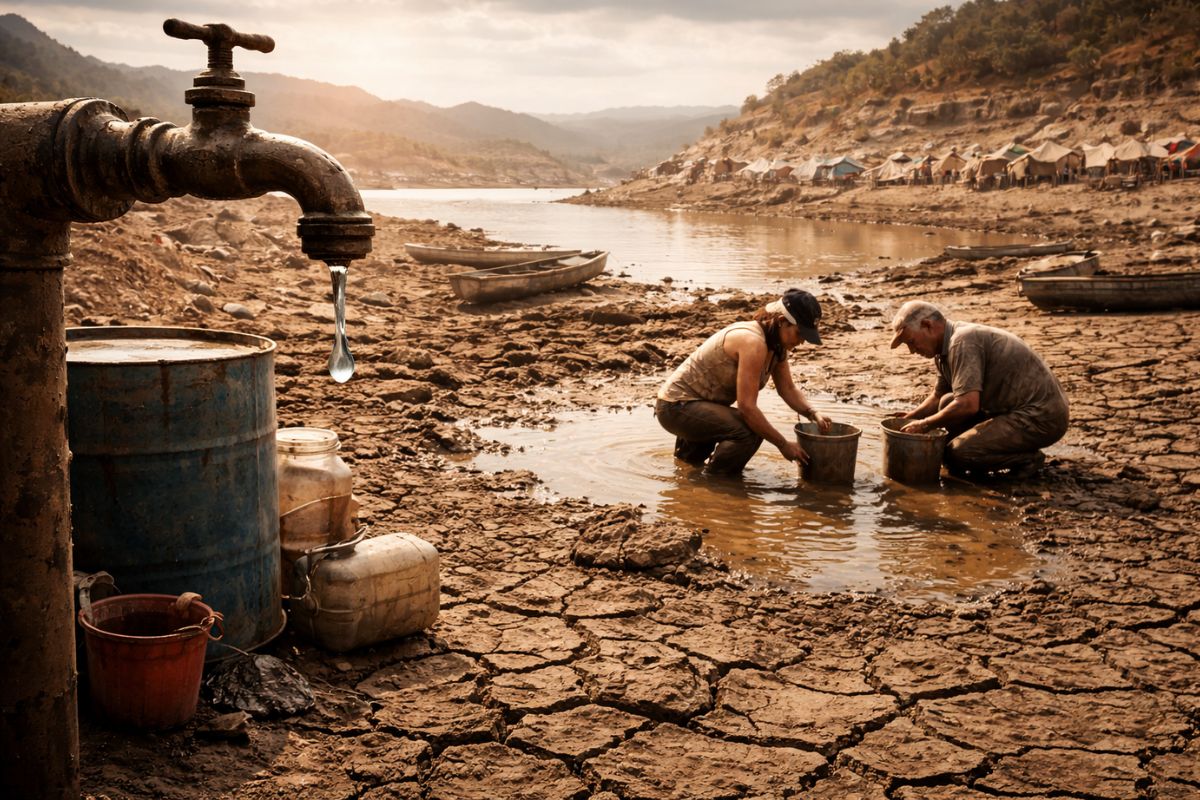


New International Alert Issued on January 20, 2026 States That the UN Identifies a Water Failure: Water Consumption Has Continued to Exceed Natural Replenishment. The Diagnosis Claims 4 Billion People Are Annually Water Scarce and Exposes Risks for Cities, Food, and Energy.
The new international alert issued by the UN describes a turning point: water consumption has reportedly begun to exceed the capacity for replenishment continuously, on a global scale. The term “water failure” enters public vocabulary as a summary of a system operating beyond its limits.
In practice, the debate shifts from “will there be a water shortage one day” to “how long can we sustain current consumption without collapsing basic services.” The impact is not uniform, but the chain reaction is predictable, because water supports cities, food, energy, and economic activity.
What the UN Calls “Water Failure” and Why the Term Matters
The UN announced on January 20, 2026, that the world has entered a structural state of “water failure,” defined as the condition in which water consumption continuously exceeds the natural replenishment of water resources.
-
Motorola launched the Signature with a gold seal from DxOMark, tying with the iPhone 17 Pro in camera performance, Snapdragon 8 Gen 5 that surpassed 3 million in benchmarks, and a zoom that impresses even at night.

-
Satellites reveal beneath the Sahara a giant river buried for thousands of kilometers: study shows that the largest hot desert on the planet was once traversed by a river system comparable to the largest on Earth.

-
Scientists have captured something never seen in space: newly born stars are creating gigantic rings of light a thousand times larger than the distance between the Earth and the Sun, and this changes everything we knew about stellar birth.

-
Geologists find traces of a continent that disappeared 155 million years ago after separating from Australia and reveal that it did not sink, but broke into fragments scattered across Southeast Asia.

The concept does not claim that water has run out, but rather that renewal is not keeping pace with extraction.
This difference changes the technical reading.
A system can continue “delivering” water for a while, even while already operating in the red, because society compensates for the deficit by forcing extractions, deepening wells, and accelerating withdrawals, until the cost accumulates in the form of vulnerability and instability.
The Human Portrait of Imbalance and What It Reveals About the Limit
The same diagnosis attributed to the UN states that about 4 billion people, nearly half of the world’s population, face severe water scarcity for at least one month each year.
This number shifts the topic from the abstract field and places water consumption as a recurring social risk variable.
When speaking of scarcity “for one month a year,” the new international alert introduces a frequency metric, not just an intensity metric.
When water stress becomes a calendar issue, it becomes management, affecting household planning, service operation, and economic predictability, especially in cities that already depend on reservoirs and extractions with reduced margins.
Why Cities Feel the Impact First and Why the Effect Is Wider Than It Seems
Impacts include reservoirs at historically low levels, rationing, and productivity losses, in addition to urban problems like ground subsidence in cities.
The logic is that when water consumption rises and replenishment does not keep up, the buffer ceases to exist, and any fluctuation becomes an operational crisis.
Cities also concentrate demand and infrastructure.
When a city needs to source water from farther away, deeper, or with more energy, it pays twice: once for the physical resource and once for operation, reflecting in tariffs, services, and water security.
Agriculture, Food, and the Part of Consumption That Dominates the Account
The diagnosis attributes about 70% of global freshwater usage to agriculture and states that around 3 billion people and more than half of the world’s food production are in areas under high water stress.
This transforms water consumption into a central variable of price and food supply.
There is also the territorial dimension of risk: over 1.7 million square kilometers of irrigated land would face critical levels of scarcity.
When irrigation enters a critical zone, the adjustment is not just technical, it’s economic, because productivity, cost, and predictability come under strain, and the response tends to shift to emergency measures.
Climate, New Uses, and the Extra Push on Water Consumption
The diagnosis links the worsening situation to climate change, citing increased evaporation, irregular rainfall, prolonged droughts, and accelerated melting of glaciers that acted as natural reservoirs.
Between 2022 and 2023, this set of conditions is said to have contributed to over 1.8 billion people experiencing severe drought episodes in different regions.
At the same time, water consumption continues to grow, with cities expanding, agricultural areas increasing, and industrial hubs concentrating.
The new international alert also points to a contemporary demand that pressures already tense systems: data centers for artificial intelligence applications, which require large volumes of water for cooling and consume a lot of energy, often in regions under stress.
Why the Problem Crosses Borders and Becomes Economic Risk
Even when not all watersheds technically enter “water failure,” the effect spreads through trade chains, migration flows, and the climate system itself.
When a producing hub suffers from scarcity, the impact appears in costs, logistics, and price stability, affecting cities that seem “far” from the problem.
That is why the term chosen by the UN carries political and economic weight.
Water failure describes an imbalance that propagates, raising food costs, stressing energy, and amplifying tensions, not because there is a lack of water everywhere, but because water consumption concentrates and replenishment does not keep pace at the necessary rate.
The new international alert from the UN places water consumption and natural replenishment at the center of the same equation, and the diagnosis indicates that the planet is operating in continuous overload.
The practical question is not the word used, but the speed of adjustment, because cities, food, and economies depend on a renewal that cannot be accelerated by decree.
In your routine, where do you perceive the most waste of water and where have you already made real habit changes: at home, at work, in food production, or in daily consumption? What would make you take this new international alert seriously without waiting for rationing in your city?







El problema de la reposición hidrica en todo el mundo seria facil de solucionar si recurrieramos a la potabilizacion del agua extraida de los mares y océanos. Sería bueno recurrir a estas cuencas casi inagotables con un enfoque multiproposito : no solo buscando agua potable sino , al mismo tiempo, aprovechando otros minerales necesarios en la producción industrial de todo otro elemento que sirva o sea útil en otras áreas de la producción.