





 Portuguese
  English
  Spanish
  5 min of reading
  0 comments


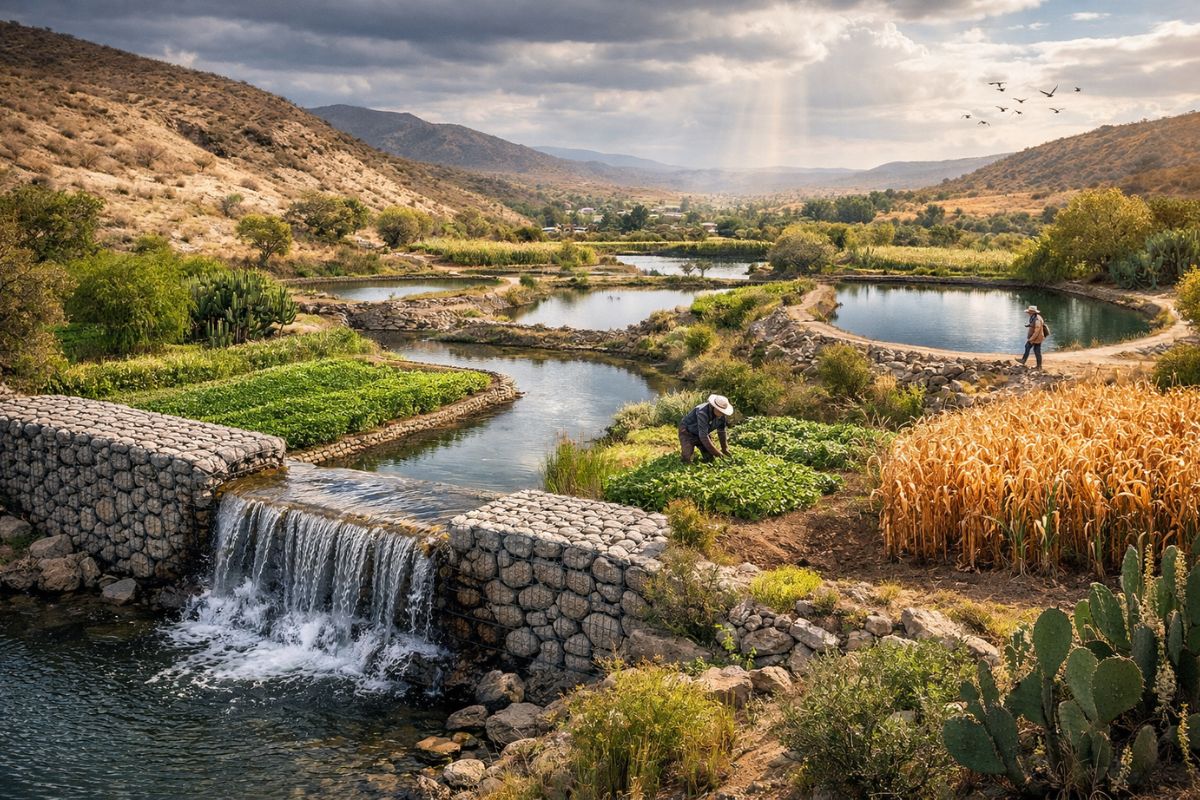
Created by Gisela Herrerías Guerra and Raúl Hernández García, the Water for Ever program learned from ancestral techniques and modern engineering to hold rainwater with retention structures and gabions, form sponge terraces, recharge aquifers, and change the map of clean water for communities in the Mixteca Popoloca in present-day Mexico.
In the semi-arid Mixteca Popoloca, a program born in 1980 bet on an uncomfortable idea for any dry region: instead of “searching for water,” it is possible to “produce water” from the rain itself. The proposal gained traction by managing the runoff that used to flow too quickly, allowing room for infiltration, living soil, and harvests less reliant on chance.
The name Water for Ever carries this ambition without romanticizing the challenge. The logic is simple to explain and difficult to execute: slow down the runoff, spread the water throughout the watershed, and make the subsoil work as a reservoir, without relying on giant works. This is where retention structures, gabion dams, and the sponge terrace strategy. arise.
What Does “Producing Water” Mean in a Semi-Arid Landscape

The expression “producing water” is not a linguistic trick.
-
Friends have been building a small “town” for 30 years to grow old together, with compact houses, a common area, nature surrounding it, and a collective life project designed for friendship, coexistence, and simplicity.

-
This small town in Germany created its own currency 24 years ago, today it circulates millions per year, is accepted in over 300 stores, and the German government allowed all of this to happen under one condition.

-
Curitiba is shrinking and is expected to lose 97,000 residents by 2050, while inland cities in Paraná such as Sarandi, Araucária, and Toledo are experiencing accelerated growth that is changing the entire state’s map.

-
Tourists were poisoned on Everest in a million-dollar fraud scheme involving helicopters that diverted over $19 million and shocked international authorities.


At the heart of the program, it describes a physical sequence: rain falls, runoff flows, the structure holds, sediment deposits, and infiltration occurs.
When this is repeated, the soil starts to retain moisture for longer, changing the agricultural calendar and the capacity to sustain vegetation.
The key point is that the program does not try to stop all the water from flowing downstream.
The strategy is to retain part of the volume along the watershed while still allowing some to continue its journey to downstream communities.
This distribution, when functioning, reduces erosion, decreases runoff peaks, and creates a more predictable base for domestic use and planting.
Retention Structures and Gabions as Engineering to “Slow Down” Runoff

The retention structures serve as the first level of control. They are containment structures built along waterways to slow down the flow and give time for the soil to absorb.
By spreading small interventions across the territory, the program avoids concentrating risk at a single point and increases the chances of each rainfall yielding some real gain.
The gabion dams operate under the same philosophy but with different materiality: wire cages filled with stones.
When water encounters the obstacle, it stops, loses speed, and deposits sediments, forming sponge terraces.
It is a mechanism that transforms destructive energy into soil accumulation, and this new soil becomes a support for plants and biodiversity.
Sponge Terraces and the Artificial Confined Aquifer
When sediment accumulates behind a gabion dam, the sponge terrace is not just a metaphor. It acts as a porous layer that stores infiltrated water and releases it gradually, prolonging moisture even after the rains have ended.
In practice, the landscape stops being just a runoff corridor and becomes a recharge surface.
The process, described in the program, can culminate in the formation of an artificial confined aquifer.
The infiltrated water passes through filtering layers of stone, gravel, and sand until it reaches cylinders that function like a traditional well, delivering cleaner water.
The technical detail that matters here is the filtration through layers: it helps stabilize quality and reduce the turbidity typical of runoff.
Territorial Scale, Numbers, and the Social Cost of Abandonment
The Water for Ever program was not limited to a single experiment. The methodology has been replicated throughout the Mixteca Popoloca region, with an estimate of benefiting 275,000 people through 1,600 regeneration actions.
These numbers do not tell the whole story, but they indicate that the bet was not merely aesthetic, but rather a water management policy on a basin scale.
There is a social element that always arises when discussing small works: maintenance and adherence.
In Estanzuela, in Zapotitlán, Puebla, the program describes 300 families benefiting from the rehabilitation of a masonry dam and the construction of a buffer tank.
Community volunteer work emerges as the driving force because the return is direct for those living with scarcity: water for domestic use and for agriculture, especially milpas.
The Water Museum as a Public Laboratory and Global Network
The Water Museum functions as an educational space and environmental education center, with one significant difference: it does not limit itself to displaying objects.
The models are replicated hundreds of times in real soil and water conservation works, serving as guides for interventions that need to fit within the territory, the budget, and local knowledge.
In 2017, UNESCO requested the Water Museum to lead the formation of a global network of water museums. The network currently brings together 60 museums from all continents, placing the program in an international circuit of education and water management.
The weight of this is not prestige, it is method: the territorial experience becomes a reference for other regions that also seek to hold rain without turning the river into an enemy.
When Water Becomes Harvest and Biodiversity
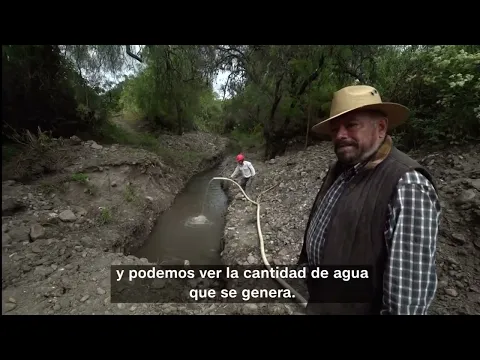

The most visible gain is the green patch appearing where aridity once dominated.
The program describes how infiltration and the recharge of springs in the highlands generate clean water that supports agriculture and improves domestic use.
The presence of biodiversity, in turn, arises as a consequence of wetter soil and less violent water cycles.
In a cited example, a dam of this size can hold between 2,000 and 3,000 cubic meters of water. It is not a number to impress, but rather to measure: the semi-arid changes when rain stops being just a disaster or just a promise.
By combining retention structures, gabion dams, and sponge terraces, the program aims to transform the logic of the place, from survival to production.
The story of the Water for Ever program in the Mixteca Popoloca shows that, in dry regions, the discussion is not merely about “having water” or “not having water.”
It is about how rain is treated when it arrives, how the soil responds, and who takes on the continuous work of maintaining the structures, from the retention structure to the artificial confined aquifer.
If your city or rural area also copes with runoff that washes away soil and, weeks later, leaves dust and empty taps, what seems more honest to you: betting on a few gigantic works or repeating many small solutions like retention structures and gabions? Have you seen any program work in practice where you live?










-

-

-

-

-

22 pessoas reagiram a isso.