





 Portuguese
  English
  Spanish
  5 min of reading
  0 comments


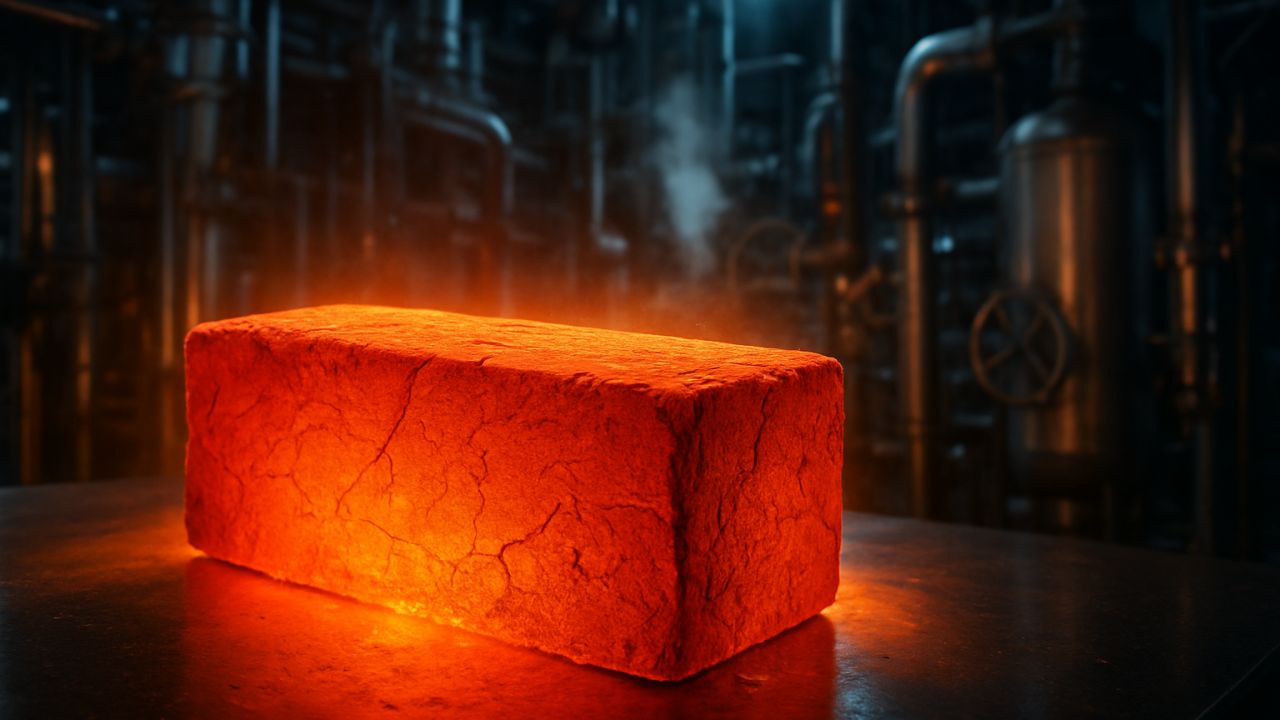
Thermal Batteries Based on a Heated Brick Promise Renewable Heat 24/7, Replacing Fossil Fuels in a Trillion-Dollar Market.
The global industry, the largest consumer of fossil fuels on the planet, may be on the verge of being revolutionized by a surprisingly simple technology: a heated brick. Companies like Rondo Energy are developing thermal batteries that use a refractory brick to store solar and wind energy in the form of extreme heat, reaching temperatures of over 2,000 degrees Fahrenheit. The goal is to provide clean and uninterrupted heat for heavy processes, such as steel and cement production.
The potential impact of this innovation is enormous. In Pueblo, Colorado, a community marked by decades of pollution from a coal plant, a new project aims to transform the area into a clean energy hub, as detailed by Atmos Earth. The proposal not only promises to decarbonize local production but also to rewrite a history of environmental damage, improving air quality and the public health of thousands of people.
The “Annoying Problem” of Industrial Heat
No part of the global economy burns more fossil fuels than the industrial sector. Almost everything we consume, from the steel in our cars to the cement in our homes and the plastic in our packaging, relies on intense industrial heat for its manufacture. This heat is responsible for more than a quarter of all fuel burned in the world and, consequently, for a massive share of greenhouse gas emissions.
-
Motorola launched the Signature with a gold seal from DxOMark, tying with the iPhone 17 Pro in camera performance, Snapdragon 8 Gen 5 that surpassed 3 million in benchmarks, and a zoom that impresses even at night.

-
Satellites reveal beneath the Sahara a giant river buried for thousands of kilometers: study shows that the largest hot desert on the planet was once traversed by a river system comparable to the largest on Earth.

-
Scientists have captured something never seen in space: newly born stars are creating gigantic rings of light a thousand times larger than the distance between the Earth and the Sun, and this changes everything we knew about stellar birth.

-
Geologists find traces of a continent that disappeared 155 million years ago after separating from Australia and reveal that it did not sink, but broke into fragments scattered across Southeast Asia.
The challenge of decarbonizing this sector has always been consistency. Renewable sources, such as solar and wind, are intermittent by nature; the sun does not shine 24 hours a day, and the wind does not blow continuously. John O’Donnell, founder of Rondo Energy, realized that for heavy industry to transition to clean energy, it needed not only renewable electricity but also renewable energy on demand. The key was not just to generate but fundamentally to store that energy efficiently.
How Does the Heated Brick Work?
The solution, while appearing rudimentary, is a feat of thermal engineering. Rondo Energy’s heat battery functions as a “rechargeable furnace”. It consists of a steel container, roughly half the size of a basketball court, filled with stacks of a heated refractory brick. When electricity from solar panels or wind turbines is abundant (and cheap), it is directed into the container, heating the bricks to scorching temperatures.
This extreme heat is stored in the bricks for hours or even days. When a nearby factory needs energy for its processes, the system simply pushes air through these glowing bricks. The result is a blast of superheated air or steam, at the exact temperature needed to forge steel, burn cement, or catalyze chemical reactions. The process is adjusted by AI systems, directly replacing fossil fuel boilers with clean heat, 24 hours a day.
O’Donnell, who previously worked with the complexities of nuclear fusion, admits that the heated brick is a “boring” solution by comparison. However, its greatest advantage is immediate viability. Unlike futuristic technologies, thermal batteries use materials and supply chains that already exist and can be implemented today in existing industrial facilities, offering a quick path to decarbonization.
The Potential of a Trillion-Dollar Market
The economic potential of this technology is as vast as its environmental impact. Analysts from the think tank Energy Innovation estimated in a 2023 report that thermal batteries could make the cost of industrial heating with renewable electricity competitive with natural gas. According to the study, this technology could replace 75% of fossil fuel use in the industrial energy demand of the United States.
Experts believe this could be the next trillion-dollar market, following the trajectory of solar energy and lithium batteries. Rondo Energy has already secured US$ 160 million in investments, and a coalition of companies, the Thermal Battery Alliance, has been formed to accelerate the global deployment of these solutions, as noted in a report by Atmos Earth. The decline in the production costs of wind and solar energy is creating the perfect conditions for the massive expansion of these heating batteries.
Challenges and the Case of Pueblo
Despite the optimism, heavy industry remains cautious. “They don’t want to take risks, especially if it’s such an essential element of their production,” explained Doron Brenmiller, director of Brenmiller Energy, another company in the sector. To overcome this barrier, some companies are offering “heat as a service”: they finance, build, and operate the thermal batteries, and the industrial customer simply signs a long-term contract to purchase steam or hot air, without taking on the risk of the infrastructure.
In Pueblo, Colorado, the transition is seen as an urgent necessity. The city, which hosts the Comanche 3 coal plant, has suffered for years from high rates of respiratory diseases and cancer. With the planned closure of the plant, a proposal emerges to host one of the largest clean energy hubs in the U.S., using thermal batteries to store wind and solar energy. The plan calls for the consumption of 800 megawatts of renewable energy to “charge” the batteries, which would then continuously release 200 megawatts of clean heat to local factories.
The shutdown of the coal plant frees up critical capacity in the power grid, making the project even more viable. For Sal Pace, a former county commissioner, the change could save lives. “The transition from coal to renewable energy would help Pueblo reduce asthma rates and improve quality of life,” he said. The project offers the city the chance to “turn the tide,” transforming its legacy of pollution into a future of innovation and clean air.
The transformation of a simple heated brick into a high-capacity battery shows that the solution to complex problems is not always glamorous, but rather practical. The large-scale adoption of this technology now depends on incentive policies, such as the Inflation Reduction Act in the U.S., and the willingness of the industry to abandon decades of reliance on fossil fuels.
Do you agree with this change? Do you think it impacts the market? Leave your opinion in the comments, we want to hear from those who live this reality.






-

Uma pessoa reagiu a isso.