





 Portuguese
  English
  Spanish
  5 min of reading
  0 comments


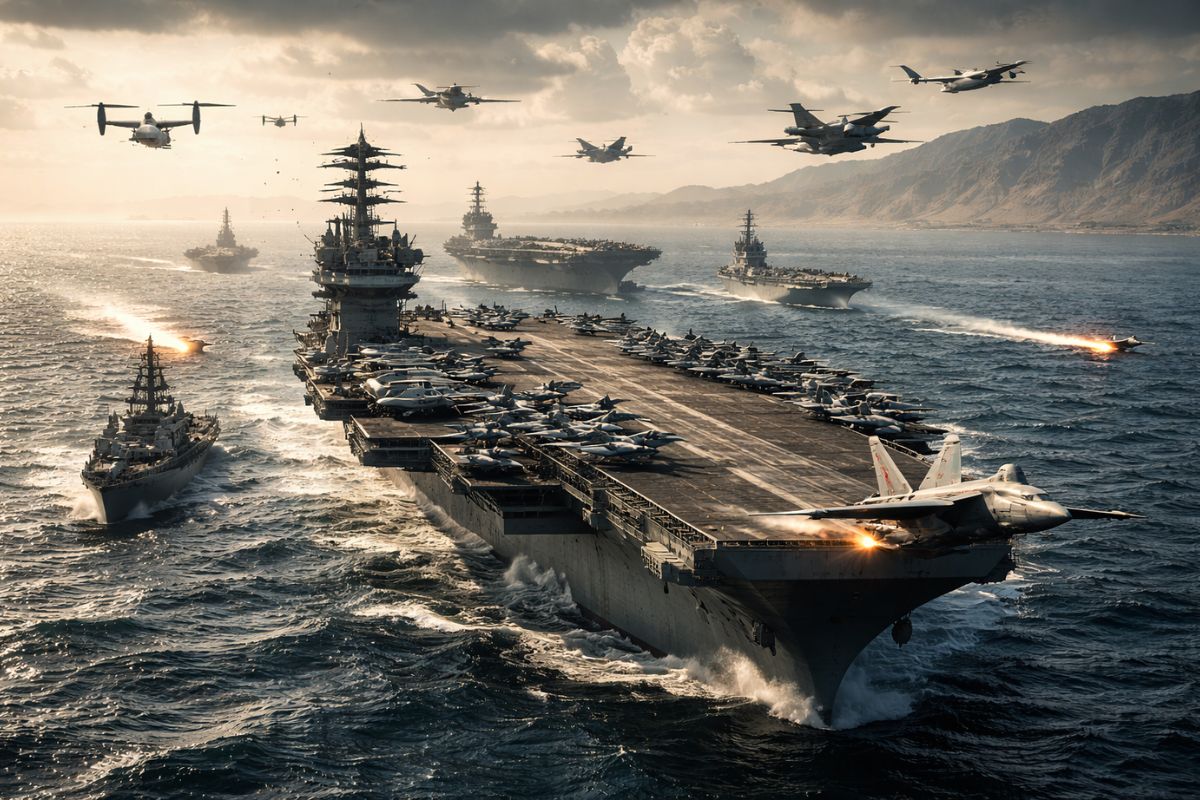
Open Source Intelligence Reports Indicate That The U.S. Navy Concentrated About One Third Of Its Deployed Ships In The Persian Gulf Near Iran, Including Two Aircraft Carriers And Escorts, With Air Reinforcement And The Strait Of Hormuz As A Bottleneck, For Weeks If Diplomacy Fails Today
The movement attributed to open source analysis has rekindled a type of unease both inside and outside the Persian Gulf that often appears before major crises. When the U.S. Navy assembles groups of aircraft carriers and increases its air package around Iran, the debate ceases to be abstract, even for those who do not follow the topic.
There’s one detail that makes the situation particularly sensitive: the Strait of Hormuz is not just a line on the map, but a chokepoint of global oil trade. Just one incident there can turn a regional crisis into inflation and ripple instability, and that’s why numbers and dates gain political weight.
The Build-Up Of Forces In 2026 And What Has Been Confirmed

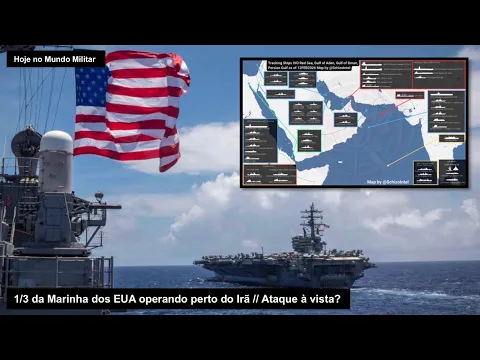
On Monday, February 16, open source intelligence analysts indicated that about 1/3 of the currently deployed U.S. Navy ships were operating in or around the Persian Gulf, in areas near Iran.
-
Friends have been building a small “town” for 30 years to grow old together, with compact houses, a common area, nature surrounding it, and a collective life project designed for friendship, coexistence, and simplicity.

-
This small town in Germany created its own currency 24 years ago, today it circulates millions per year, is accepted in over 300 stores, and the German government allowed all of this to happen under one condition.

-
Curitiba is shrinking and is expected to lose 97,000 residents by 2050, while inland cities in Paraná such as Sarandi, Araucária, and Toledo are experiencing accelerated growth that is changing the entire state’s map.

-
Tourists were poisoned on Everest in a million-dollar fraud scheme involving helicopters that diverted over $19 million and shocked international authorities.


The central reading is simple: this is not merely a symbolic presence, but a critical mass to sustain military options.
At the end of January, an aircraft carrier, the USS Abraham Lincoln, accompanied by destroyers, cruisers, and submarines, was already operating in the area of U.S. Central Command.
On February 13, the Pentagon confirmed that a second aircraft carrier, the USS Gerald R. Ford, would leave the Caribbean Sea for the same theater, increasing to two nuclear carriers and close to two dozen escorts.
Two aircraft carriers are not a neutral gesture; they are a mobile combat infrastructure.
Why The Strait Of Hormuz Pulls Ships Like A Magnet

The most cited reason for the concentration of the U.S. Navy near Iran is geographical, and it is also economic.
The Strait of Hormuz is described as the most important chokepoint for the world’s oil transit, through which more than one-fifth of what is consumed on the planet passes. When that enters the calculation, any crisis ceases to be local.
The reasoning behind the fear of escalation is condensed in a single example: a shot from an Iranian anti-ship missile at an oil tanker could interrupt about 20% of global oil flow.
It’s the math of risk, not rhetoric, and it explains why the Persian Gulf fills with American warships whenever Tehran becomes the center of a crisis.
The Comparisons With 1991 And 2003 And The Difference That Changes Everything
The references to 1991 and 2003 resurface because, in both cases, there was a pattern of pre-war at sea, with aircraft carriers projecting air power and submarines or escorts armed with cruise missiles.
In 1991, during the Gulf War, the deployment was massive: more than 165 ships, including six aircraft carrier groups, and the embarked aviation conducted approximately 20,000 sorties during the main period of the air conflict.
In 2003, during the invasion of Iraq, the naval component was also significant, totaling five aircraft carrier strike groups and about 150 U.S. and coalition ships.
There was also the weight of Tomahawk cruise missiles, with 381 launched on just the first night and close to 1,000 throughout the campaign.
What makes the parallel work is maritime logic; what prevents the equivalence is the absence, so far, of the massive land buildup.
What The U.S. Navy Can Do Without A Ground Invasion
The plan described for 2026 is more compatible with an air and missile campaign sustained from the sea and regional bases, something that, in theory, allows for punishment and degradation, but not necessarily an occupation.
The U.S. Navy, by combining embarked aviation, submarines, and escorts with launch capabilities, gains the ability to attack in layers, first degrading defenses, then hitting military infrastructure and command nodes, and then maintaining pressure with recurrent attacks.
This model often comes accompanied by observation and surveillance means, drones, reconnaissance aircraft, and tanker planes, as well as electronic warfare resources to hinder sensors and coordination from Iran.
When someone prepares to operate for weeks, the message is that there is an operational option ready, even if diplomacy remains in dispute.
Oil, Mines, And Politics: What Could Ignite The Persian Gulf

If the chokepoint is the Strait of Hormuz, a recurring threat comes back to the debate: the possibility of Iranian mines as a strategic tool.
The naval presence of the U.S. Navy also works, in this reading, as an attempt to keep the Strait of Hormuz free and unobstructed, reducing the risk of a global oil crisis.
At the same time, the political context taints any analysis. The report that the Trump administration views regime change as a desire appears as a backdrop, but what is observed, in this snapshot, is a smaller apparatus than in 1991 and 2003 and without clear signs of total invasion.
The question that remains is not whether there is attack capability, but what the acceptable objective is and what cost would be tolerated.
What is visible today is a combination of signals: two aircraft carriers, escorts, air reinforcement, and the concentration of a significant portion of the U.S. Navy in the Persian Gulf near Iran, with the Strait of Hormuz as a factor that transforms any shock into a global problem.
Still, what separates 2026 from 1991 and 2003 is what does not appear: the land buildup on a scale for occupation.
If you have followed any international crisis up close, what detail usually convinces you that the escalation is real: the presence of aircraft carriers, political rhetoric, movement in the Strait of Hormuz, or the lack of ground forces? And, looking at the Persian Gulf and Iran, which of these signals would you take more seriously now?










-

-

-

-

-

19 pessoas reagiram a isso.