





 Portuguese
  English
  Spanish
  5 min of reading
  2 comments


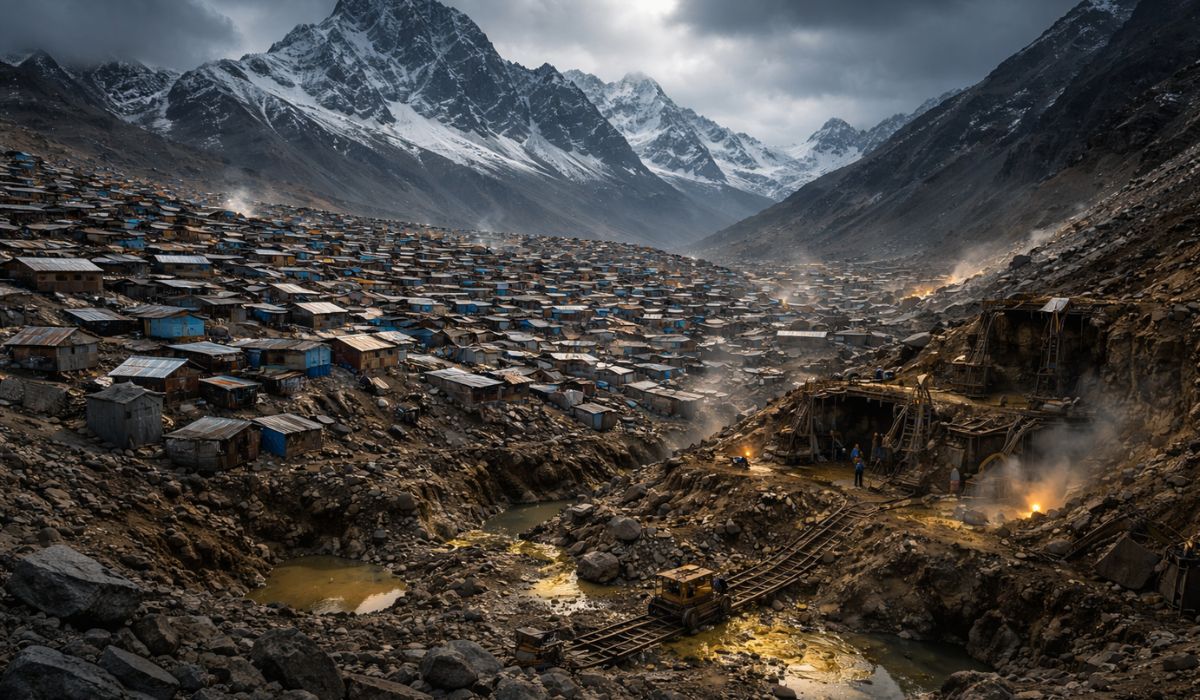


At Over Five Thousand Meters Above Sea Level, A City Grew Driven By Gold Mining, Without Urban Planning And With Poor Services, Attracting Thousands Of People Despite The Environmental, Health, And Safety Risks Associated With Informal Activity.
Located at about 5,100 meters above sea level, in the Puno department in southern Peru, La Rinconada is often cited in international reports as one of the highest cities in the world.
The municipality developed from gold mining in the Andes and has an estimated population of tens of thousands, attracted by the possibility of earning income through mining, despite adverse living conditions.
The rapid growth occurred without urban planning.
-
USA and China compete for Brazil over resources that could be worth trillions — rare earths put the country at the center of a global dispute

-
Friends have been building a small “town” for 30 years to grow old together, with compact houses, a common area, nature surrounding it, and a collective life project designed for friendship, coexistence, and simplicity.

-
This small town in Germany created its own currency 24 years ago, today it circulates millions per year, is accepted in over 300 stores, and the German government allowed all of this to happen under one condition.

-
Curitiba is shrinking and is expected to lose 97,000 residents by 2050, while inland cities in Paraná such as Sarandi, Araucária, and Toledo are experiencing accelerated growth that is changing the entire state’s map.


Reports from outlets like National Geographic indicate that much of the city lacks sewage systems, regular garbage collection, and structured access to health services.
Most of the housing is improvised and spreads around the mines, in an environment marked by low temperatures, dirt streets, and the accumulation of waste.
Even in the face of these limitations, La Rinconada continues to receive new residents.
Experts consulted by international publications explain that the increase in gold prices over recent decades has helped maintain a steady flow of workers, many coming from other regions of Peru, willing to face the risks associated with the activity.
Urban Growth Driven By Gold Mining
Urban expansion directly accompanied the mining activity.
According to National Geographic, the former miners’ camp transformed into a large population cluster without the state proportionally expanding the availability of basic services.
The city lacks a formal sanitation system, and garbage collection is irregular, exacerbating environmental and health issues.

Population estimates vary by source, fluctuating between 30,000 and 50,000 inhabitants, a number that can change throughout the year due to the presence of temporary workers.
This instability complicates official surveys and the planning of public policies for the region.
Despite the mineral wealth, most of the resources generated by mining do not translate into local investments.
Reports indicate that many miners live with unstable income, dependent on daily extraction success or failure, while parallel activities, such as informal commerce, emerge to meet the basic needs of the population.
How The “Cachorreo” System Works In La Rinconada
Much of the work in La Rinconada occurs outside the formal economy.
One of the most common models is known as “cachorreo”.
According to the International Labour Organization, in this system, the miner works for weeks or even a month without a fixed salary and, at the end of the period, gains the right to extract gold on their own for a short time.
If no gold is found that day, the worker receives no payment.
The ILO classifies this model as a practice associated with labor exploitation, as it does not guarantee a minimum income or social protection.
Informality also prevents access to basic labor rights, such as accident insurance.
National Geographic reports that many agreements are made verbally, without contracts.
In some cases, payment includes only food and shelter.
Researchers monitoring the region state that this system helps explain the persistence of workers even under high-risk conditions, as the possibility of finding gold serves as an incentive, even if uncertain.
Use Of Mercury And Environmental Impacts Of Mining
Besides working conditions, gold extraction in La Rinconada involves significant environmental risks.
Reports describe the use of mercury in the gold separation process, a common practice in artisanal mining.
After forming an amalgam with the precious metal, the material is heated, releasing toxic vapors into the environment.
According to scientific studies cited by international publications, prolonged exposure to mercury can cause damage to the nervous system and other organs, depending on the level and duration of contact.
Research on artisanal mining indicates contamination can affect soil, waterways, and air, impacting not only workers but also residents of the area.
This situation is compounded by other environmental factors.
The dust generated by mining activity and limited ventilation within the galleries contribute to respiratory problems, according to experts studying occupational health in informal mining areas.
The Challenges Of Living At Over Five Thousand Meters Above Sea Level
Living at over five thousand meters above sea level represents a constant physiological challenge.
Research cited in scientific journals indicates that at this altitude, the amount of oxygen available in the air is significantly lower than at sea level.
This condition can cause symptoms such as fatigue, headaches, and breathlessness.

Studies on Andean populations show that some residents develop adaptations over time.
Still, researchers point out that a portion of the population may experience hypoxia or chronic mountain sickness, a condition associated with cardiovascular changes and decreased physical capacity.
A report from O Globo states that, despite these physiological adaptations, life expectancy in La Rinconada does not exceed 35 years.
Oxygen saturation values measured in acclimatized individuals at altitudes similar to the city’s are well below the standards observed in low-altitude regions.
These data are used as references in studies on human habitation in extreme areas.
Violence, Informality, And Lack Of Official Data
The absence of regulation also affects public safety.
International reports mention cases of thefts, homicides, and conflicts related to gold trading.
A 2020 investigation by Reuters reported actions by Peruvian authorities against human trafficking networks in the area and incidents of violence in underground mines.
Although La Rinconada is often described as a violent city, consolidated data on crime is scarce.
Researchers and journalists highlight that local official statistics are not always available or up-to-date.
This limitation complicates the confirmation of specific numbers, such as homicide rates or average life expectancy.
In this context, La Rinconada is often cited as an example of how mineral wealth does not always translate into better living conditions.
The municipality remains dependent on an economic activity marked by informality, environmental risks, and structural limitations.








O Peru merece ter um sub mundo humano deste?
É mais uma Potosi na America Latina para regozijo dos Ratos de plantão