





 Portuguese
  English
  Spanish
  8 min of reading
  21 comments


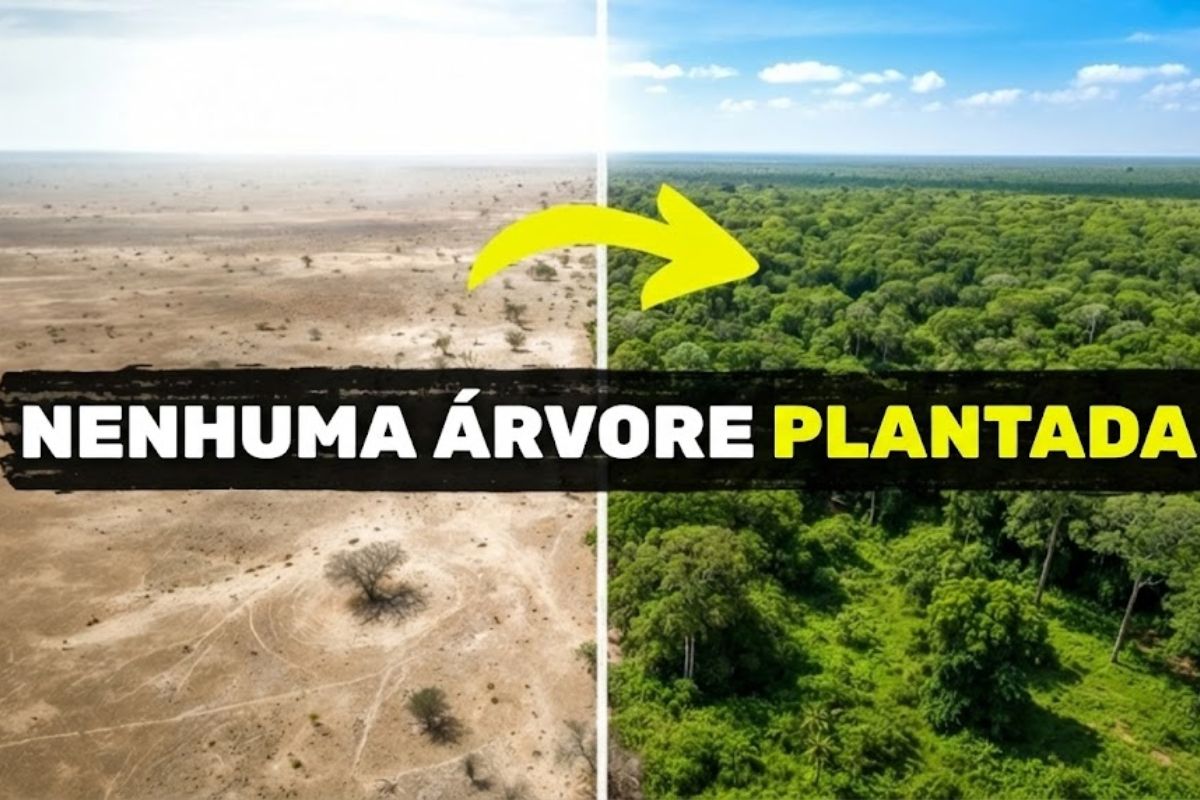


In Tanzania, the idea that forest grows without a single tree being planted takes shape by reactivating a network of dormant subterranean roots. The Kisiki Hai technique, known as FMNR, replaces weak seedlings with selective pruning, reduces costs, and accelerates shade, moisture, and soil against desertification in practice.
The account follows a field mission in Tanzania and states that forest grows without a single tree being planted when farmers decide to reactivate what is already alive beneath the surface. The logic is straightforward: there is a network of subterranean roots and still-active stumps, and the work becomes selecting sprouts, pruning the excess, and guiding growth, instead of relying solely on seedlings.
The proposal arises from a race against desertification in dry lands. Africa is described as the region that loses the most forest, with deserts advancing over areas once covered by trees. The report mentions that Tanzania loses an estimated 469,000 hectares of forest per year, and that Africa loses 3.9 million hectares per year, a scale comparable to the size of Switzerland.
Why Planting Trees Fails in Dry Lands and Becomes a Management Issue

In the section dedicated to the diagnosis, the field team asks why not plant trees, as it seems the most obvious answer.
-
Remains with battle wounds of over 100 soldiers from the Roman Empire are found beneath a football field in Vienna, leaving everyone surprised.
-
Elon Musk notes Brazil and lowers the price of his internet, Starlink, promising to connect all corners of the country with affordable plans, 10,000 satellites, and 1 million active users in the national territory!

-
Man creates an infinite source of FREE electricity at home with a PVC wind turbine using a repurposed motor.

-
An aquatic seed consumed for centuries in Asia is going viral in the West after studies highlighted its antioxidant compounds and potential anti-inflammatory properties. It pops like popcorn, has low fat content, and is already being called the new functional snack.


The conclusion presented is that, in the dry lands of Tanzania, planting trees often fails.
The material recalls grand announcements like “planting 20 million trees” and “one trillion trees,” and also mentions that even religious leaders participated in symbolic actions, without ensuring lasting results.
The central point, however, is technical and operational.
In the last two decades, billions of dollars have been invested in tree planting in the dry areas of Africa.
Some projects thrived, but many were poorly managed and failed.
The report describes climate and soil so severe that it is necessary to get the combination of species, location, protection, and maintenance right, requiring time and money that many families in Tanzania do not have in their daily lives.
Niger in 1980 and Tony Rinaudo: When 80% of Seedlings Die and the Strategy Changes

To explain the turnaround, the report goes back to Niger in 1980, described as a scenario of ecological and humanitarian crisis, with accelerated desertification and severe drought.
In this context, a young agronomist, Tony Rinaudo, went to the country to combat the advancing desert and took the standard route: planting thousands of trees.
The result was a reality shock. Tony Rinaudo reports that nothing worked sustainably or economically viable and that over 80% of the seedlings died.
The breaking point comes when he delivers a shipment of seedlings to villages and notices a “bush” that, upon closer inspection, was not a weed: it was a tree sprouting from a stump, signaling that the subterranean roots were still alive.
The “Subterranean Forest”: Living Subterranean Roots, Multiple Sprouts, and Hidden Opportunity
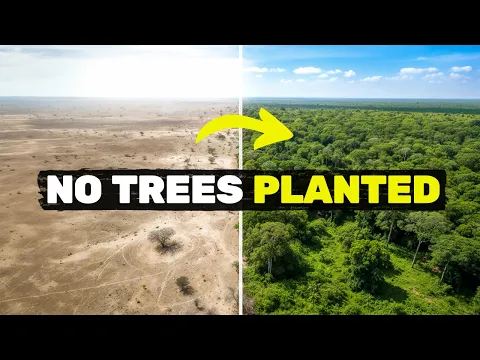

From this observation, the report presents the idea of a “subterranean forest,” a vast system of dormant subterranean roots beneath the soil, capable of restoring large degraded areas.
The mechanism described is that many native trees were cut down, but their root systems remained alive; therefore, instead of trunks, multiple sprouts emerge that look like bushes scattered across the landscape.
The material cites an example of a native tree called Camel’s Foot and states that these species once formed extensive forests before historical transformations.
It also claims that, during the colonial period, the landscape was redrawn: native trees were removed for plantations, crops, and fuel, and traditional soil care methods were replaced by practices that depleted the land.
Even after independence, practices deemed unsustainable continued, while the demand for land, charcoal, and firewood grew, pressuring regeneration.
Kisiki Hai and FMNR: The Method That Selects Sprouts and Makes Trees Reappear
The central technique has two names in the report. In English, it is called farmer managed natural regeneration, abbreviated as FMNR.
In Tanzania, it is referred to as Kisiki Hai, a Swahili expression translated in the material as “living stump.”
The principle is to transform what appears to be a bush back into a tree, without replanting from scratch, because the subterranean roots already carry energy and structure.
The practical step is simple but not random. Kisiki Hai within FMNR asks the farmer to identify a living stump and observe the sprouts.
Then, they choose one or two more vigorous sprouts and remove the others, so that the energy of the root system favors a dominant trunk.
After that, they mark the stump and let it grow, returning to maintain pruning and protect development, depending on the area and pressure on land use.
Auxin and Physiology: Why the “Bush” Appears and How Pruning Guides the Trunk
The report includes a technical explanation based on the hormone auxin.
When a tree grows, the main sprout releases auxin, which suppresses the expansion of other sprouts and concentrates energy in a strong trunk.
When the tree is cut down and becomes a stump, auxin production ceases, but the subterranean roots remain alive, allowing dozens of sprouts to compete at the same time.
Kisiki Hai acts at this point: it eliminates excessive competition and guides growth to one or two sprouts, accelerating the formation of a trunk.
The study insists that this growth is faster than planting a seedling, precisely because the subterranean roots are already established.
It is in this combination that the promise of forest growing without a single tree being planted gains operational support within FMNR.
Cited Timeline: One Year, Three Years, Five Years
The material presents a timeline to visualize the impact of FMNR in Tanzania.
The transformation is described as noticeable in one year, clearer in three years, and striking in five years.
The idea is that the tree does not start as a vulnerable seedling but as a sprout supported by mature subterranean roots, which reduces the time until shade and stability.
By insisting on this comparison, the report confronts decades of tree planting campaigns: the difference is not just in intention, but in the biological starting point.
Seedlings require survival in a harsh climate, while FMNR uses systems already adapted to the local environment.
Effects on Soil and Water: Shade, Retention, Clouds, and Productivity
The regeneration described goes beyond “bringing trees back.”
As more trees reappear through Kisiki Hai and FMNR, shade helps cool the ground and reduce thermal stress on the soil.
The subterranean roots hold the soil, decreasing soil loss and increasing stability for cultivation.
The material states that the moisture released by trees can help form clouds and bring back rain, improving production conditions.
The practical goal is to make the land more productive for families, allowing them to plant food, feed livestock, and rebuild livelihoods in areas pressured by desertification.
The argument is that FMNR restores ecological functions cumulatively: each recovered tree increases shade and structure, and this feeds the cycle of soil recovery.
From Forgotten Technique to Movement in Tanzania: Training, Champion Farmers, and Scale
The report describes that the traditional technique was nearly forgotten, but has returned with strength and turned into a national movement in Tanzania.
The turning point would be in education and in farmers starting to “recreate their own trees with their own hands,” without relying on external projects that require expensive inputs.
The local leadership mentioned is Samwel Msanjila, connected to the LEAD foundation.
He is presented as someone who spent 15 years leading the country’s re-greening and training farmers to apply Kisiki Hai and FMNR. The LEAD foundation states that this strategy has already transformed 500,000 hectares of land in Tanzania, indicating that the change hasn’t been limited to isolated demonstrations.
18 Million Hectares Restored: The Number Cited for FMNR Around the World
Beyond the focus on Tanzania, the report expands the scale and states that up to 18 million hectares have already been restored by bringing “subterranean forests” back to life.
The Kisiki Hai technique appears as one of the cheapest forms of forest regeneration because it shifts the cost from seedlings to knowledge, pruning, and management.
This contrast aims at decades of high spending with inconsistent results.
The study does not claim that all tree planting fails, but reinforces that many billion-dollar projects have failed due to poor management, lack of maintenance, and inadequacy to the climate and soil, which helps explain why desertification continues to advance.
Dodoma as a Diffusion Laboratory: 4,800 Homes, Three Years, Eight Villages
The region of Dodoma in Tanzania is presented as a stage for organized diffusion. The model cited is that of “champion farmers,” chosen to become specialists in Kisiki Hai and teach the method to rural communities.
After an intensive course, they would spend the next three years empowering and educating 4,800 homes, bringing the technique to remote areas.
The support described includes training 32 new champion farmers in eight villages in central Tanzania.
To increase reach, the initiative includes smartphones, bicycles, and community events, logistical tools to ensure the FMNR and Kisiki Hai circulate without depending on large external structures.
Ecosia in the Report: 240 Million Trees and Ongoing Support to the LEAD Foundation
Ecosia appears in the report as financial support linked to advertising revenue from searches, directed towards responsible reforestation projects.
The material states that Ecosia has already planted over 240 million trees around the world and has supported the LEAD foundation for years, in addition to having committed support for three more years.
In the same section, it is mentioned that, with community funding, the network could restore 3,000 hectares of degraded land.
Operationally, the arrangement combines local training, basic logistics, and funding to expand FMNR and Kisiki Hai, aiming to contain desertification without repeating the failure rate seen in poorly managed plantings.
What It Means in Practice That Forest Grows Without a Single Tree Being Planted
The phrase forest grows without a single tree being planted serves both as a synthesis and as a technical provocation.
The synthesis is that the focus shifts from the nursery to the subsoil: instead of attempting to start a new forest, Kisiki Hai and FMNR reactivate the subterranean roots of native trees that remained alive and dormant.
The provocation is that success depends on continuous management, correct pruning, and protection of growth, rather than a one-time planting event.
By relating the annual loss of 469,000 hectares in Tanzania and 3.9 million hectares in Africa, the report suggests that the main challenge is pace.
FMNR tries to buy time by using already established subterranean roots, while desertification advances and pressures soil productivity.
In your reading, Kisiki Hai and FMNR may be more effective than traditional planting in Tanzania to curb desertification, or is the scale still too small for the size of the problem?






Vocês já pensaram fazer reuniões no mundo sobre regeneraçoes sobre tudo isso no mundo da Natureza renascente nós Países com a tese de Fernando Santos da Arte REFLORESTAR É PRECISO
Ojalá esto se aplique lo antes posible en las áreas que actualmente se están desertizando y las que ya hay en España.
Sim, o sistema citado acima com certeza tem mais viabilidade, vejo isso na prática eu uma área que adquirir e estou tentando reflorestar.