





 Portuguese
  English
  Spanish
  5 min of reading
  0 comments


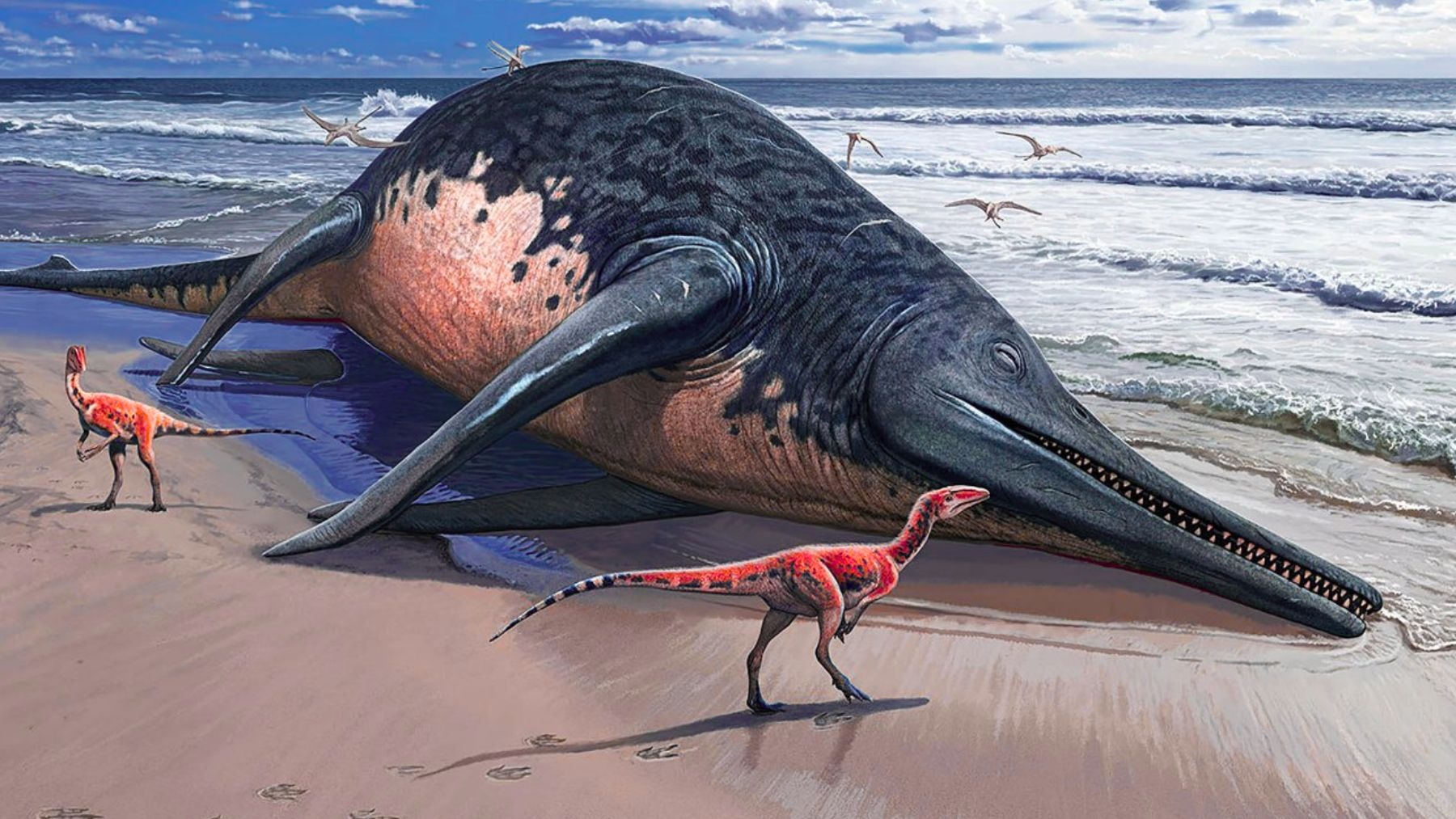
The Discovery Made by an 11-Year-Old Girl on an English Beach Revealed Fragments of a Gigantic Jaw, Allowing Scientists to Identify a New Ichthyosaur Up to 26 Meters Long That Lived About 202 Million Years Ago
A discovery made by an 11-year-old girl on a beach on the west coast of England led scientists to describe a new giant marine reptile, with an upper jaw over 2 meters and an estimated body length between 20 and 26 meters.
The identification of the animal, named Ichthyotitan severnensis, stemmed from the observation of large bone fragments at Blue Anchor, an English coastal area, and resulted in the recognition of the largest marine reptile formally described to date.
Casual Discovery Revealed Bones of Exceptional Proportions
Fossil hunter Ruby Reynolds was 11 years old when she walked along the mud banks of Blue Anchor in May 2020 and spotted fragments of an unusually sized lower jaw exposed by the tide.
-
China has created a mass-produced hypersonic missile that costs the same as a Tesla, and this is changing everything in modern warfare because the United States cannot defend itself without spending millions.

-
100% Brazilian technology transforms agricultural waste into a meat-scented ingredient using fungi from the Amazon rainforest. The process does not use excessive water or chemicals, and it also increases the nutritional value of the final product.

-
Psychology reveals that adults who avoid conflicts at all costs are not balanced individuals, but rather children who learned in the worst way that expressing emotions brought punishment and now live paralyzed by the fear of expressing themselves.

-
Goodbye pet hair on clothes: a washer with an internal filter promises to remove up to 5 times more hair than regular machines and uses an XL trap dryer system to capture what remains.


The material attracted attention due to its extreme size and was later associated with a similar fragment found in 2016, nearby in Lilstock, about 10 kilometers away, in the same geological unit.
Both finds occurred in the Westbury Mudstone Formation, a sedimentary layer known for preserving fossils from the late Triassic, a period marked by large marine reptiles and profound environmental changes.
The comparison between the bones revealed an almost exact match in shape, internal structure, and proportions, indicating that they belonged to the same species and not to unrelated giant individuals.
Preserved Jaw Allowed Estimates of Body Size
The best-preserved fragment of the Blue Anchor specimen corresponds to a surangular bone from the lower jaw, which would have exceeded 2 meters in length when complete, according to researchers involved in the study.
Based on cautious scaling obtained from other known ichthyosaurs, scientists estimated that the animal would have been about 25 meters in total length, with a likely variation between 20 and 26 meters.
If these estimates are confirmed by new discoveries, Ichthyotitan severnensis surpasses all formally described marine reptiles, approaching the length of a modern blue whale.
The research team was led by paleontologist Dean Lomax, who highlighted the scientific relevance of the find even in light of the fragmentation of the material available for analysis.
Scientific Publication Formalized New Genus and Species
The official description of the new giant ichthyosaur was published in the scientific journal PLOS ONE on April 17, 2024, following detailed morphological and histological analyses of the recovered fragments.
Subsequently, on January 16, 2025, the journal published an editorial correction, a common procedure in the scientific community for technical adjustments and additional clarifications in the academic record.
The new scientific name, Ichthyotitan severnensis, means “Giant Fish-Lizard of the Severn,” in reference to the scale of the animal and the region associated with the found fossils.
The formalization of the name consolidated the discovery as part of the global scientific record, allowing for future comparisons with other large marine reptiles from the Triassic period.
Bone Microstructure Revealed Clues About the Animal’s Growth
In addition to size, researchers analyzed the microstructure of the jawbone and identified distinct histological characteristics, similar to those observed in other previously known giant ichthyosaurs.
The internal pattern of the bone suggests an unusual mode of growth and remodeling of the bone tissue, differing from that observed in smaller ichthyosaurs, indicating specific adaptations to gigantism.
The outer region of the bone shows consistent signs of active growth at the time of the animal’s death, indicating that the individual had not yet reached its maximum size when it died.
This evidence reinforces the hypothesis that these giant marine reptiles had prolonged growth strategies necessary to reach such extreme dimensions over their lifetimes.
Even so, the authors of the study emphasize that all estimates remain provisional, due to the absence of a more complete skeleton that would allow for definitive conclusions.
Species Lived Close to a Major Mass Extinction
Ichthyotitan severnensis lived about 202 million years ago, during the late Triassic period, specifically in the Rhaetian Age, when shallow seas covered parts of what is now the United Kingdom.
Just above the layer where the fossils were found, the geological record indicates an environmental upheaval associated with the boundary between the Triassic and Jurassic periods, marked by a global mass extinction.
Researchers suggest that this lineage of giant ichthyosaurs probably disappeared during this event, as later marine reptiles never reached similar sizes again.
This temporal context helps explain why such colossal forms emerged and disappeared over a relatively short span of marine life history.
Dynamic Coast Favors Discoveries and Imposes Risks to Fossils
The coastal region of Somerset, where Blue Anchor is located, is characterized by intense natural erosion, with unstable cliffs, frequent storms, and constant movement of marine sediments.
This process can expose fossils buried for millions of years, but it can also quickly destroy them after exposure if they are not identified and recovered in time.
In the case of Ichthyotitan severnensis, part of the fragments was initially left stuck to the rock by an unknown member of the public, while others were collected later on the shore.
Repeated visits allowed researchers to reconstruct nearly two-thirds of the giant jaw, preventing the sea from permanently reclaiming the fossilized material.
Discovery Highlights Importance of Collaboration with the Public
The trajectory of the discovery demonstrates the relevant role of local observers and amateur collectors in science, especially in coastal environments subject to rapid natural erosion.
Researchers stress that unusual finds should be carefully documented and communicated to specialists or museums, ensuring proper preservation and rigorous scientific analysis.
It was this combination of public attention, contact with specialists, and systematic return to the site that allowed a casual find to be transformed into a scientific discovery of global significance.
The jaw found by a child on an English beach ultimately expanded understanding of marine gigantism in the Triassic, even from incomplete fragments.








-

-

-

8 pessoas reagiram a isso.