





 Portuguese
  English
  Spanish
  6 min of reading
  0 comments


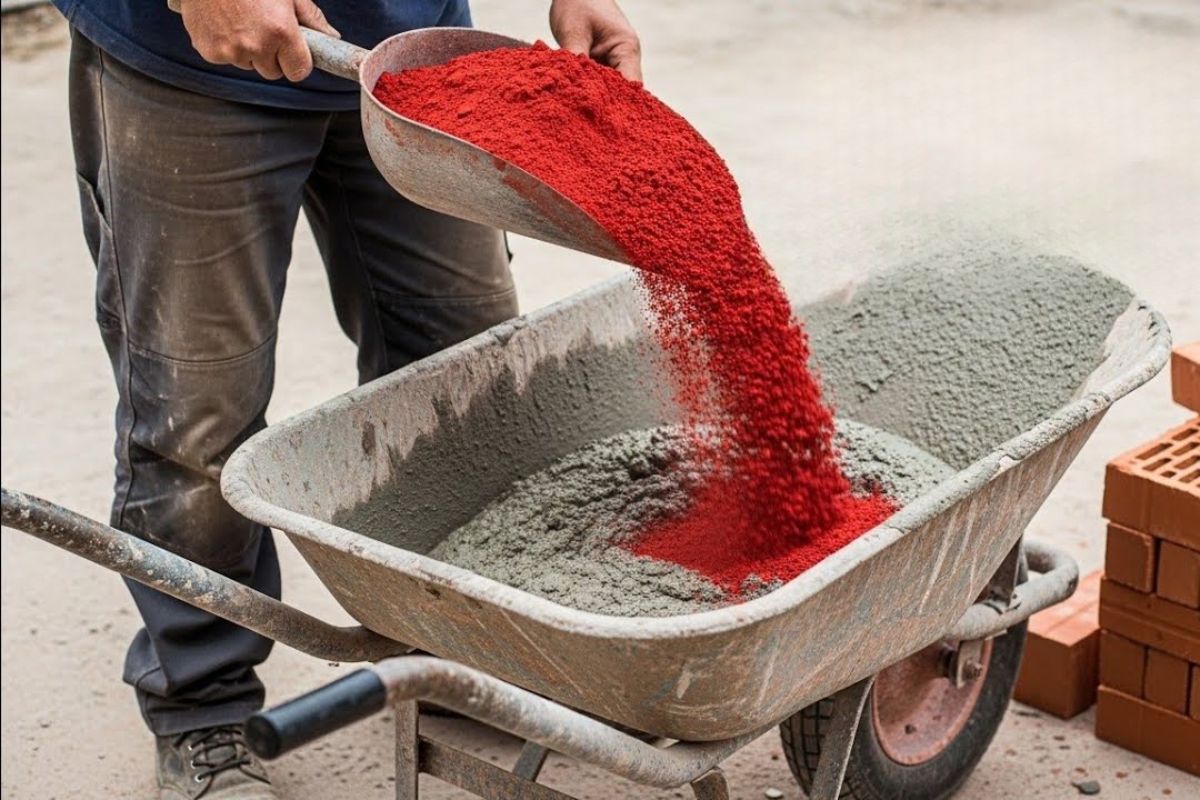
The Homemade Mixture Made With AC3 Mortar, Cement, PVA Glue, And Powder Pigment Was Applied Over Thick Concrete Floor That Was Already Clean, In Two Coats With A Short Interval, And Showed That A Simple Renovation Can Yield Much, Cover Old Stains, And Create A Firmer Finish Without Breaking The Floor.
The homemade mixture gained traction precisely because it targets a common problem in small construction and home renovation: thick floors, sidewalks, slabs, or concrete areas with an unsightly, stained, and aged appearance. Instead of breaking everything, the method presented uses AC3 mortar, cement, PVA glue, and powder pigment to create a new surface layer with a renewed appearance and direct application.
Interest increased after a colorless version had already gone viral, and subsequently, the pigmented variation emerged. The proposal is simple in discourse, but it depends on proportion, cleanliness, and patience between coats. The appeal lies in the promise of spending less, yielding well, and quickly changing the appearance of the floor, without replacing the old base.
How The Homemade Mixture Is Assembled And Why The Proportion Defines The Result
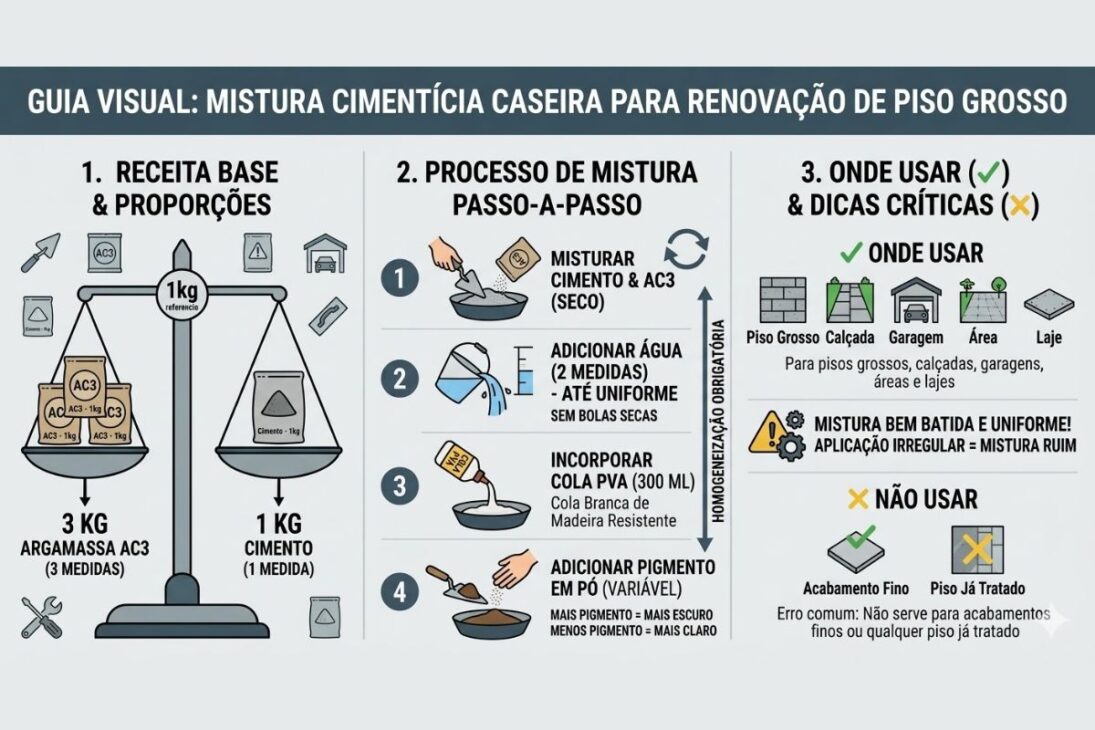
The base of the homemade mixture starts from an objective recipe. There are three measures of AC3 mortar for one measure of cement, using the same container as a reference. In the presented example, each measure equals 1 kg, forming 3 kg of AC3 mortar and 1 kg of cement. Then, two measures of water are added, sufficient to reach a well-mixed point, without dry clumps and with a uniform consistency.
-
A forgotten cord on the floor of a basement in Vienna leads a plumber to a box containing 30 kilograms of gold with Mozart’s face, hidden before World War II. The treasure, worth 2.3 million euros, was just centimeters away from a worker who ignored the sign a day earlier.
-
A couple buys an old chalet, breaks the kitchen floor for renovation, and finds over a thousand coins of gold and silver hidden since the English Civil War over 4 centuries ago.

-
Rigid bags with their days numbered: new trend prioritizes comfort in 2026.

-
YouTuber creates an excavator equipped with a giant 4.5-meter sword to challenge his brother to a rematch, and the invention quickly goes viral on social media.


Next, PVA glue is added. For this same proportion, the recommendation was to use 300 ml of PVA glue, described as wood glue, one of the more resistant types found in hardware stores. After the glue, powder pigment is added, which was considered the best choice to achieve color more quickly and with less quantity than liquid pigment. This part does not have a fixed amount in the provided base, because the shade depends on the desired outcome: more pigment darkens, less pigment lightens.
The central point here is that the mixture was not presented as material for any surface. It was designed for the renovation of thick floors, sidewalks, garages, areas, and slabs. This is important because it prevents a common mistake: assuming the same recipe is suitable for fine finishes or for any previously treated floor.
For this reason, thorough mixing was treated as a mandatory step. The homemade mixture needs to be well blended, with cement, AC3 mortar, PVA glue, and powder pigment incorporated evenly. If the mixture does not reach this point, application will lose consistency right on the first pass with the squeegee.
Where The Application Works And Where It Should Not Be Improvised
The demonstration clearly defined the field of use. The homemade mixture was indicated for thick floors, sidewalks, garages, areas, and slabs. The goal is to renew a rustic base that is already clean, with visual wear and old dirt. Before applying, the area must be swept, cleaned, and free of oil or residues that hinder adhesion.
On the other hand, there was an explicit restriction: burned cement floor does not fit into this logic in the same way. The practical explanation was straightforward. This application was designed for a rougher surface, where the new layer can grab better and spread more stably. On a smooth or painted floor, the base needs different preparation, and in the case of painted areas, the guidance was to sand everything with coarse sandpaper, like 100 or 150, before attempting any covering.
This detail is crucial because it separates a possible renovation from a rushed attempt. The method did not appear as a universal solution for any ugly floor. It emerged as a specific resource for rustic concrete bases, where the coarse texture leaves room for the new layer to cover stains and standardize the visual reading.
There is also an implicit technical limit. The homemade mixture promises renewal and resistance, but it relies on an existing floor that needs to be solid. It was not presented as a structural correction, but as a superficial recovery coating in common usage areas.
The Squeegee, The Time Between Coats, And The Second Pass Change The Appearance Of The Floor
After cleaning, the base is moistened, and the homemade mixture begins to be poured onto the floor. The spreading is done with a squeegee, pulling the material to cover the surface and distributing the layer continuously. It is at this stage that the ugly, stained, and irregular floor begins to disappear under a new film made with AC3 mortar, cement, PVA glue, and powder pigment.
The first coat does not conclude the process. The recommendation was to wait 30 to 40 minutes and then apply the second. In the example shown, it was already possible to walk normally at this stage, but with the caveat that, if the floor still could not bear touch, one should simply wait a bit longer. The second pass uses a clean squeegee and serves as a refinement of the first layer. It is this pass that better seals the coverage and consolidates the renewed appearance.
A third coat was not ruled out, but treated as optional. According to the demonstration, two were already sufficient to deliver a satisfactory result. This impacts cost and yield because the proposal went viral precisely for using few coats and quickly transforming the appearance of a very worn base.
The yield itself was seen as one of the strong points. With a relatively small amount poured on the floor, the coverage advanced significantly. The previous reading is of material that spreads well and achieves more yield than the initial appearance suggests, as long as the floor is of the right profile and the mixture has been prepared correctly.
Why The Homemade Mixture Went Viral So Quickly Among Those Who Want To Renovate While Spending Less
The strength of the homemade mixture comes from a direct combination: renewed appearance, few coats, simple application, and seemingly lower cost than breaking the old floor. In small construction, this carries significant weight. Those who have sidewalks, garages, slabs, or stained areas often seek exactly this: a solution that hides wear without opening a heavy renovation.
Another important point is the perception of resistance. In the demonstration, it was stated that the composition with AC3 mortar and cement already makes the layer resistant, and the presence of PVA glue adds reinforcement for adhesion. The powder pigment, in turn, amplifies the visual appeal because it delivers color without requiring immediate subsequent painting. The method goes viral because it promises to solve ugliness, wear, and visual monotony in a single practical step.
It also helps that the recipe is memorable. Three measures of AC3 mortar, one of cement, two of water, 300 ml of PVA glue, and powder pigment according to the desired shade. This simplicity of repetition tends to greatly boost construction and renovation content because it transforms a technique into something that seems immediately replicable.
But the viral spread also stems from the contrast. The starting floor was ugly, thick, stained, and full of marks. The final floor appears more uniform, colorful, and with a much cleaner reading. When the visual transformation is significant and the process seems accessible, the trend is indeed to become a sharing craze.
The homemade mixture with AC3 mortar, cement, PVA glue, and powder pigment draws attention because it addresses both cost and appearance at the same time. It was not presented as a miraculous solution for any situation, but as a direct way to renew thick floors, sidewalks, garages, areas, and slabs with few coats and without breaking the old base.
In your view, does this homemade mixture really have the potential to become a trend in civil construction, or does it work better as a specific solution for very specific rustic floors?









Seja o primeiro a reagir!