





 Português
  Inglês
  Espanhol
  6 min de leitura
  2 comentários


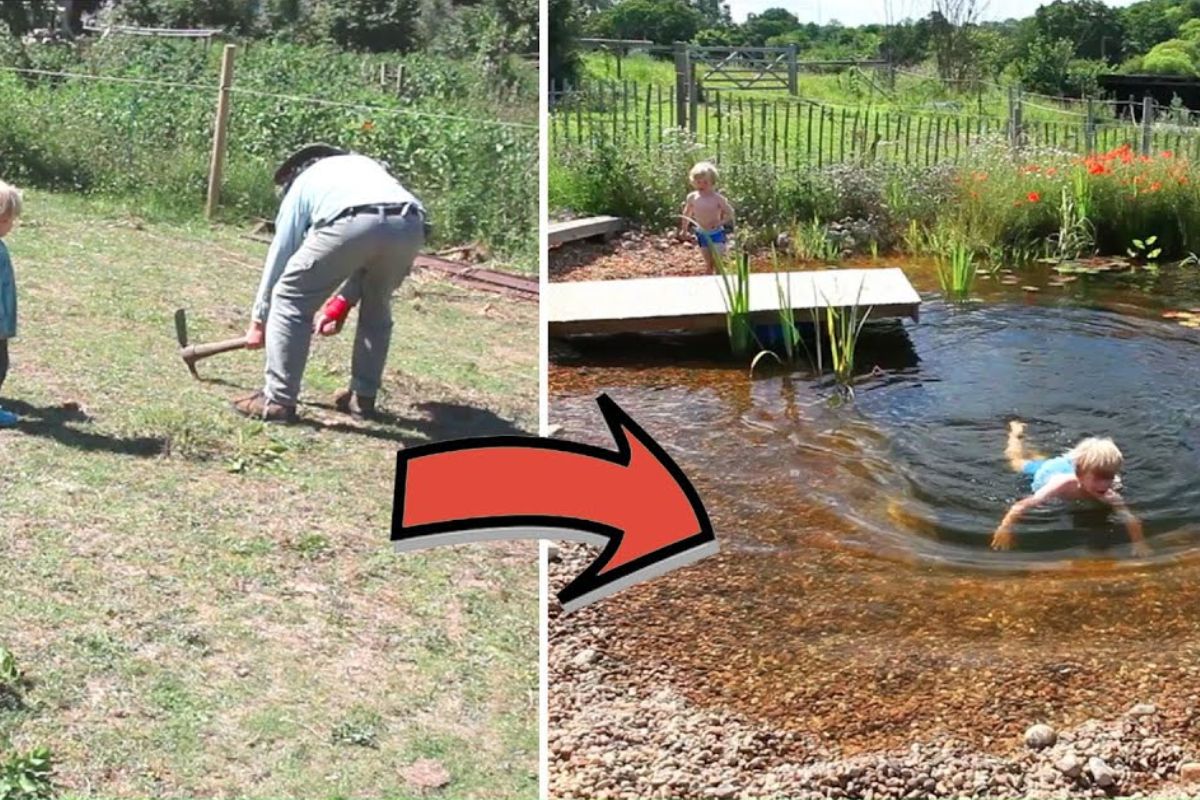


How A Small Hand-Dug Natural Pool Became A Living Ecological Laboratory, Saved A Sloped Lot, Attracted Unexpected Wildlife, And Showed That Soil, Water, And Plants Balance Everything Without Chlorine, Industrial Pumps, Or Truly Aggressive Chemicals
Built with an old tractor, protective wool, and heavy tarps, a small natural pool on sloped land became a safe place to swim with kids, a refuge for dragonflies, newts, and water shrews, and a practical demonstration that circulation, gravel, and plants keep the water clean on their own, without chemical intervention.
With few resources but a lot of manual engineering, this small natural pool was dug to about two meters deep, received a block wall, repurposed insulation, a wool lining, and a tarp as heavy as a donkey. Over time, the combination of rain, soil, gravel, and plants created a stable system, where the water remains clear only with ecological balance.
From Sloped Lot to Small Natural Pool for Swimming with Kids

It all started with a simple and straightforward goal: to create a small natural pool where it would be possible to swim with the children.
-
The world’s first octopus farm wants to open in the Canary Islands and is already provoking an international reaction: the plan aims to produce 3,000 tons per year.

-
Drought may be creating stronger superbugs in the soil and helping antibiotic resistance reach hospitals, warns a study highlighting a problem that could grow alongside extreme weather.

-
The biggest scam in history: Napoleon’s France deceived the United States by selling them a territory that was Spanish.

-
Why is the Danakil Desert so dangerous? It has unstable terrain and how extreme temperatures and toxic gases turn the region into one of the most hostile environments on Earth.

The lot, on a hillside, looked promising but required hard work.
The first step was to dig by hand until enthusiasm wore off, and an old tractor with a backhoe came into play, allowing for the desired depth of about two meters as long as the soil’s firmness allowed.
A skeptical friend, Barry, followed the process.
While one talked about ecological dreams and natural pools, the other checked levels with a water measurement tool, worried about millimeters of slope.
The structure needed to respect gravity, ensure that the water surface remained stable, and create a base to separate the swimming area from the planted zone.
This combination of intuition and precise measurement shaped the small natural pool from the beginning.
Artisanal Engineering: Blocks, Insulation, and Tarp Weighing as Much as a Donkey

To contain the water and define the swimming area, a one-meter-high block wall was built.
The concrete was poured over a leveled base, but theory met practice when a block slid like a wet board, pushing water and soil and creating something close to a mini “tsunami” in the forming lake, with slight soil slips at the edges.
From there, the construction gained a more careful rhythm.
As the lot was sloped, pieces of insulation panels from an old turkey shed were repurposed to form a lightweight retaining wall.
Placed on the side with compacted soil on each side, these panels helped hold slopes and define the contours of the small natural pool.
On the leveled soil, a layer of sand was placed, followed by a protective lining of polar wool, responsible for cushioning irregularities and protecting the plastic tarp from the pond.
The tarp, about one millimeter thick, weighed several hundred kilos, comparable to a donkey in mass and stubbornness.
The standard recommendation calls for ten people to drag the material, but the process ended up being solved with creativity and levers, folding the lining close to the walls and floor in a true “giant origami” exercise.
The quality of the sealing at this stage is crucial for the small natural pool to remain stable for years without leaks.
How The Small Natural Pool Filters and Circulates Water Without Chemicals
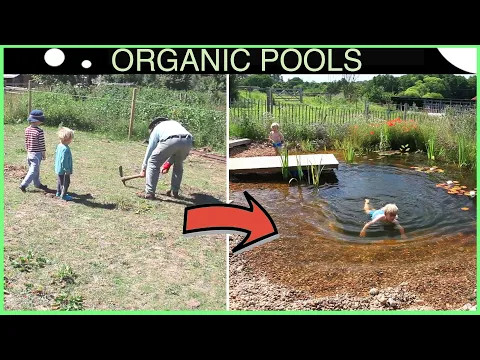

With the structure ready, it was necessary to ensure that the small natural pool did not turn into a cloudy puddle.
Instead of industrial pumps and cartridge filters, the project adopted a bubble-driven circulation system, with perforated pipes distributed around the lake.
This piping creates a slow and constant movement of water, sufficient to pass through the gravel zone and feed the biological filter.
The heart of this filter is a repurposed washing machine drum, transformed into a filtering chamber.
On top of the perforated pipes came a layer of coarse gravel, followed by a new polar wool fabric, and then sand and fine gravel, where plant roots can anchor.
The result is a living filter bed: water circulates through gravel and roots, particles are retained, beneficial bacteria establish themselves, and the system begins to purify the water naturally.
Soil, Plants, and Rainwater: The Invisible Chemical Balance
The choice of supply water reinforces the ecological logic of the project.
Instead of hoses connected to the treated network, the small natural pool is preferably fed by rainwater collected from rooftops.
This water arrives without chlorine, with low dissolved salts, and, as it falls slowly, avoids abrupt shocks to the organisms colonizing the lake.
In the planted zone, the fine gravel and sand provide substrate for a sequence of aquatic species.
A native water lily called Alba was placed to shade the water surface and create shelters for fish, invertebrates, and amphibians.
On the banks, plants such as bog bean, cuckoo flowers, and fringed lilies emerge, forming a belt of vegetation that removes nutrients from the water column.
By absorbing excess nutrients, these plants help prevent algae blooms and keep the small natural pool clearer.
When The Small Natural Pool Becomes A Refuge For Wildlife
Since the first days of filling, the small natural pool began to receive visitors.
Children entered the still-cool water, testing depth and temperature, while the first signs of colonization appeared on the surface and edges.
Dragonflies began to hover over the surface, newts approached discreetly, and wagtails were seen pecking at the water in search of small invertebrates.
Soon, the lake became a stage for aquatic beetles, water shrews, and tiny filtering crustaceans like daphnias, which feed on suspended particles.
By doing this, they help keep the water clear without any application of chlorine.
Year after year, an increasingly broad spectrum of plants and animals became part of the system, reinforcing the stability of this small hand-built aquatic desert.
What started as a project to swim with children became, in practice, a corridor of biodiversity on a domestic scale.
What This Experiment Teaches About DIY Water and Biodiversity Projects
From an ecological standpoint, the experience shows that a small natural pool can function as a living laboratory of biological succession.
The gradual entry of species, the formation of food chains, and the increase in system complexity happen without the need to manualize each step.
Soil, gravel, rainwater, and plants combined create conditions that favor filter organisms and top predators on a micro scale.
At the same time, this case reinforces that this type of project requires minimal technical planning.
Checking levels, building retaining walls, using appropriate linings, and consciously designing the filter are essential steps to avoid structural problems and ensure that the small natural pool is safe for children and functional for wildlife.
It is not a makeshift decorative pond but a water system designed to operate without chemicals, relying on biological processes from start to finish.
What Role Could A Small Natural Pool Play In Your Routine
By transforming a sloped lot into a small natural pool capable of hosting children, dragonflies, newts, water shrews, and filtering crustaceans, this experiment practically showed how a carefully designed body of water can dispense with chlorine, complex pumps, and additives, relying on the interaction between soil, plants, and low-energy circulation.
The result is both a recreational area and a piece of ecological infrastructure.
Given this concrete example of ecological balance created with an old tractor, gravel, repurposed panels, and aquatic plants, to what extent would you see yourself swapping a conventional pool for a small natural pool in your backyard, accepting to coexist closely with insects, amphibians, and plants in exchange for clean water without chemicals?








Muito linda essa piscina/lago!!Amei!!❤️❤️
Ideia prática e desafiadora. Qualidade natural, sobretudo. Imagino a refrescância dessa água. Já iniciei o meu projeto. Minhas mãos já encaliçadas são o carimbo dessa empreitada. Tenho medo de cobras, ms sempre se cria uma forma segura de desfrute. É usar estratégias. Boa matéria.