





 Portuguese
  English
  Spanish
  8 min of reading
  0 comments


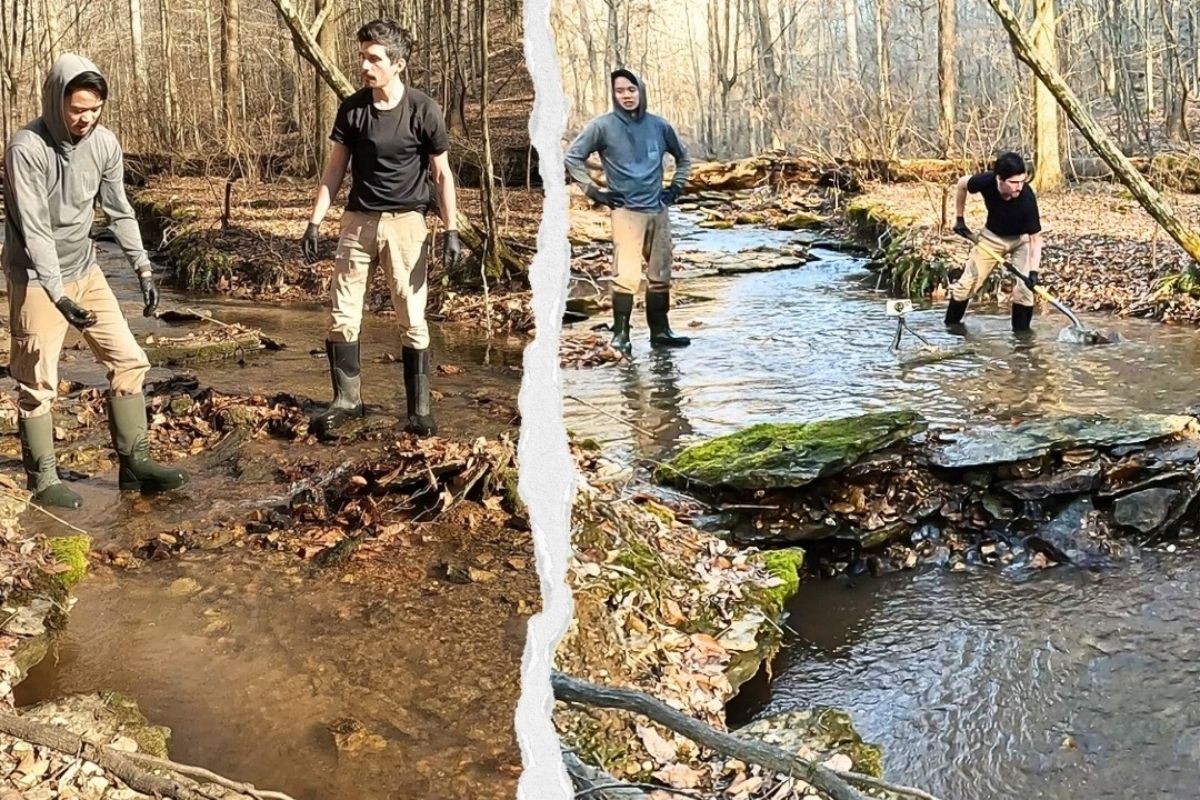
The Stone Dam Built In The Stream Was Designed To Reduce Erosion, Soften The Force Of Water And Create A Cool Pool Linked To A Future Sauna, But The Manual Labor With Stones, Leaves And Fine Material Also Showed How The Bed Responds Quickly When The Flow Starts To Be Contained.
The stone dam began to be assembled at a point in the stream where the runoff had already been marking the ground and concentrating force in a deeper area. The choice of location was not random. There was a practical reading of the course of the water, the direction of the current, and the wear that erosion had already begun, which turned that stretch into the most logical place to try to slow the impact.
At the same time, the work was not born solely as containment. The intention was also to create a cool pool for future use next to a sauna planned for the area. This dual function gives strength to the project: to contain erosion now and, later, turn the stream itself into a more stable, deeper, and more useful space in daily life.
Where The Stone Dam Began And Why That Point Was Chosen
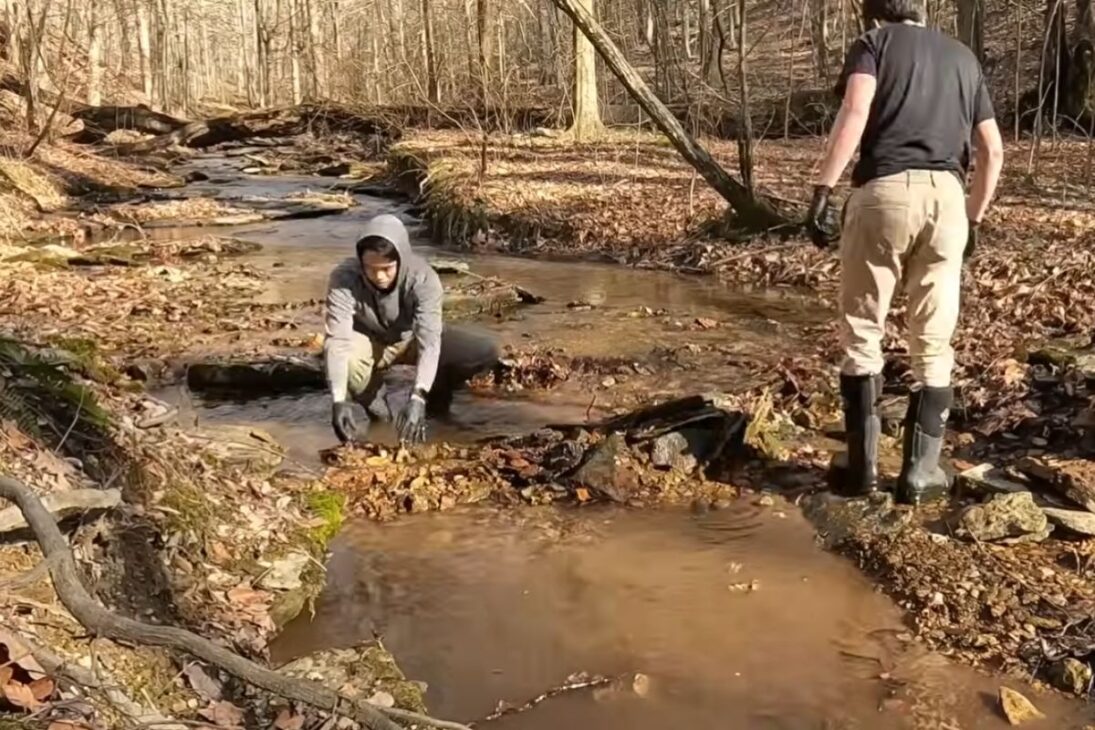
The stone dam was initiated exactly where the course of the stream already delivered a favorable natural design. The group observed the downstream area, identified the deepest stretch, and decided to build from that fit that the land itself already offered. Instead of forcing an artificial barrier at a random point, the idea was to take advantage of what the landscape was already suggesting. This reduces effort, improves the binding of the stones, and increases the chance that the structure will hold water more efficiently.
-
Italian researchers have detected what appears to be a second Sphinx buried under the sands of Egypt, and satellite scans reveal a gigantic underground megastructure hidden beneath the Giza Plateau for over 3,000 years.

-
There are 4,223 drums and 1,343 metal boxes concreted with 50-centimeter walls that store the radioactive waste from Cesium-137 in the worst radiological accident in Brazil, just 23 kilometers from Goiânia, with environmental monitoring every three months.

-
Giant Roman treasure found at the bottom of Lake Neuchâtel in Switzerland reveals an advanced trade system, circulation of goods, and armed escort in the Roman Empire about two thousand years ago.

-
He buried 1,200 old tires in the walls to build his own self-sufficient house in the mountains with glass bottles, rainwater, and an integrated greenhouse.

There was also immediate concern about erosion. If the current continued to strike forcefully in that sector, the wear would tend to advance. Therefore, the stone dam appears as a direct response to the loss of material in the bed and in the nearby banks. By holding back part of the water before it descends with such speed, the project tries to reduce the aggressiveness of the flow and create a retention that better distributes the pressure along the stream.
Another important point is that the construction was designed to follow the “natural places” already shaped by the current. The logic was simple: if the stream had already opened a path and indicated where the water flowed with more force, it made more sense to start there than to fight against the terrain. The decision shows reading of the land, not blind improvisation.
This choice helps to explain why the dammed area began to gain volume so early. Even before all the fine filling was completed, the level of water was already showing signs of rising. The location had depth, had fit, and was already concentrating flow. The stone dam, in this scenario, did not need to create everything from scratch. It merely began to organize a dynamic that already existed in the stream.
How Water Was Contained With Stones, Leaves And Fine Material
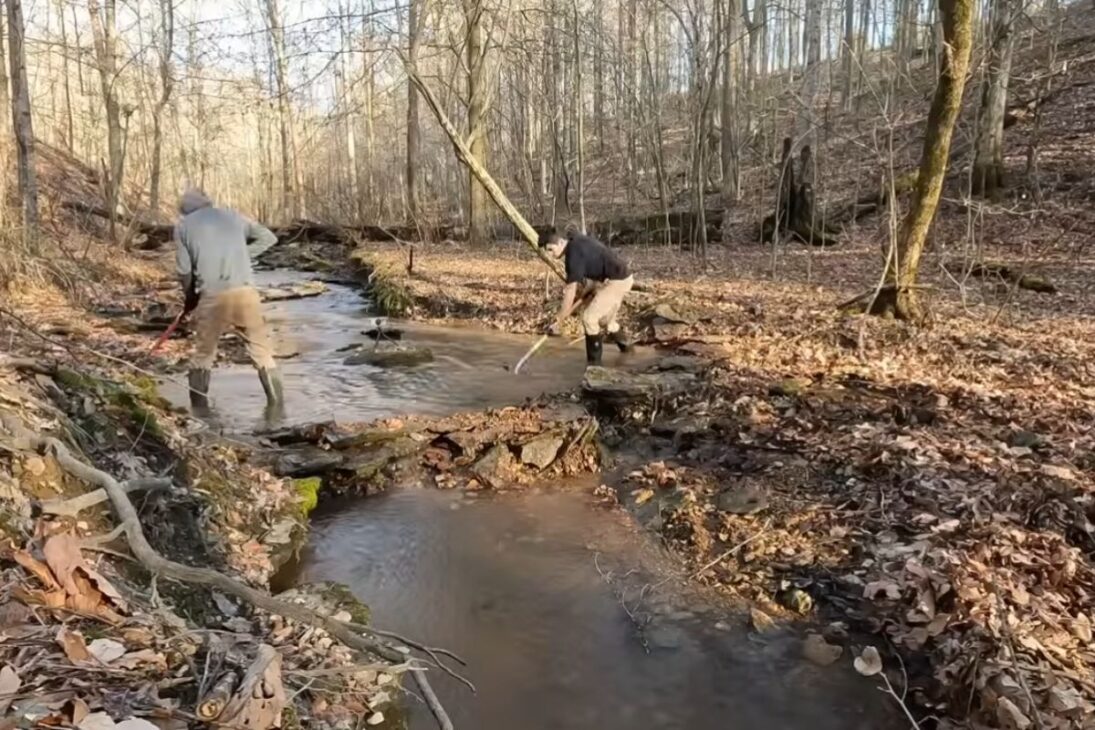
The main structure was formed with stones, but closing the spaces depended on smaller elements. Leaves were treated as a kind of natural mortar between the stones, while fine soil and more refined material were placed exactly where the water insisted on escaping. This detail is the technical core of the work, because a barrier of loose stones without internal sealing leaves many passage points and loses efficiency quickly.
The method used was to observe the current, locate where the water passed with more speed, and fill these openings first. The reasoning follows the basic logic of least effort: the water always tends to seek the path of least resistance. Therefore, the most obvious leak points were covered before the others. Next, the material was agitated to sit better among the stones and occupy the gaps. It wasn’t just stacking stones; it was reading the behavior of the flow and responding to it repeatedly.
Bubbles, dirt in motion, and the stronger current served as clear signals of where the stone dam still needed reinforcement. Each new perceived opening required more filling. This successive adjustment work shows that containment in a stream does not resolve in a single step. First comes the base of stones, then the locking, then the refining. Stability appears through accumulation of corrections, not through a single gesture.
This process also reveals why erosion can be slowed down without disappearing immediately. While the stone dam reduces the speed of the water, it needs, at the same time, to consolidate its sealing. If the current finds escape below or between larger blocks, part of the force remains concentrated in those points. Therefore, the use of fine and organic material is not a secondary detail. It is an essential part of transforming the stream into a more stable area.
What The Stone Dam Has Already Changed In The Stream
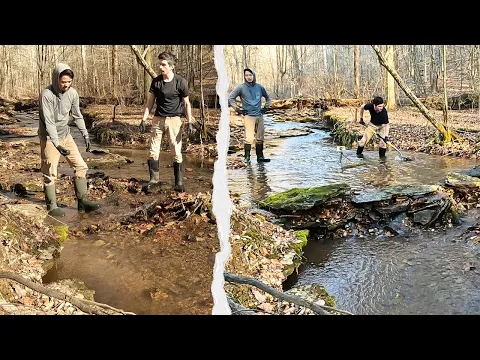

Even during construction, signs of change were already visible. The level of water rose to the point of almost submerging a rock that was previously clearly above the surface. This type of alteration is important because it shows that the stone dam began to retain volume even before being fully consolidated. When a fixed reference on the bank or bed starts to be reached by water, it becomes clear that the flow has already been partially reorganized.
This increase in water body changes the reading of the stream. What was once just a faster passage begins to take on the characteristic of retention. It is precisely from there that the future cool pool is born. It is not about inventing a complete artificial lake, but about taking advantage of the damming to create a deeper, calmer stretch suited for quick immersion linked to sauna use. The work, therefore, combines practical function, terrain adaptation, and leveraging the natural course.
Erosion is also being faced more intelligently when the force of the current decreases at that critical point. If the water stops hitting so violently, the tendency is to reduce the direct attack on the ground and the vulnerable edges. This does not mean that the process disappears, but it indicates a clear attempt to control where and how the wear occurs. The stone dam does not eliminate the dynamics of the stream; it tries to discipline it.
Moreover, the retention creates an immediate visual and functional effect. The area begins to appear more stable, deeper, and more organized. Instead of just flowing, the water begins to occupy space with a different rhythm. This change is decisive for the final objective of the cool pool, because without retention there is not enough depth, and without depth, the idea of immersion loses meaning.
Cold, Safety And Life In The Stream During Construction
The work in the stream exposed another central condition of the project: the temperature of the water. The use of gloves was not an aesthetic detail, but a direct response to the cold. The explanation given resembles the effect of a wetsuit, where the layer of water retained next to the body gets a bit warmer than the external environment. This helps understand that the stone dam was not built in comfort, but in direct contact with a still quite cold course.
There was also a practical concern about spiders seen earlier on site. The gloves provided additional protection to avoid contact with bites through the skin. This detail reinforces that the construction was dealing not only with stones and currents but with a natural environment full of variables. Every manual intervention in a stream requires reading of the land, the weather, and also the surrounding fauna.
The presence of a crayfish during the work adds another important element. The animal was removed and returned to an improvised shelter among the stones. This shows that the stone dam interferes in a living space, where the flow of water sustains small shelters and microenvironments. The “shelter for crayfish” mentioned in the process makes it clear that the work was not happening over a void, but over a miniature ecosystem.
This point weighs because any alteration in the stream affects not only the flow but also the natural refuges of small animals. Therefore, the construction was adjusted at the same time as the environment reacted. The stone dam is a small work in size, but large in its capacity to change depth, current, shelter, and use of that space.
Why The Future Cool Pool Gives Complete Meaning To The Work
The idea of a cool pool changes the interpretation of the entire project. Without it, the stone dam could be read merely as an attempt to halt erosion. With it, the project gains a second layer: to transform the stream into a functional support for a future sauna. This gives long-term objective to what began as emergency containment.
The choice makes sense because the cold water is already present naturally in the course. Instead of seeking another solution, those responsible decided to adapt the existing terrain so that it could provide enough depth and retention for this use. The cool pool does not arise as adornment but as a logical extension of what the place already offers. The challenge was precisely to tame the flow a bit without erasing the nature of the stream.
For this reason, the work also depends on the fine adjustment between large stones, leaves, and smaller sediment. For a cool pool to function, it is not enough just to hold back some of the water. It is necessary to maintain a more stable level, reduce the most evident leaks, and create a mirror that does not disappear quickly. The stone dam needs to serve both the terrain and future use at the same time.
In the end, the strength of the project lies in this combination. The same barrier that attempts to contain erosion also begins to design a space for immersion. The same intervention that reorganizes the water also prepares the area for another type of occupancy. It is a solution simple in appearance, but quite strategic in practice.
The stone dam built in the stream shows how a manual intervention, made with reading of the land and attention to the flow of water, can confront erosion and still open the way for a cool pool linked to a larger plan. The result is still taking shape, but the initial signs are already appearing in the water level, in the containment of the course, and in the change of the space.
In your opinion, does a stone dam like this tend to solve more erosion issues, or is the greater gain really in the creation of the cool pool?










-

-

-

4 pessoas reagiram a isso.