





 Portuguese
  English
  Spanish
  14 min of reading
  0 comments


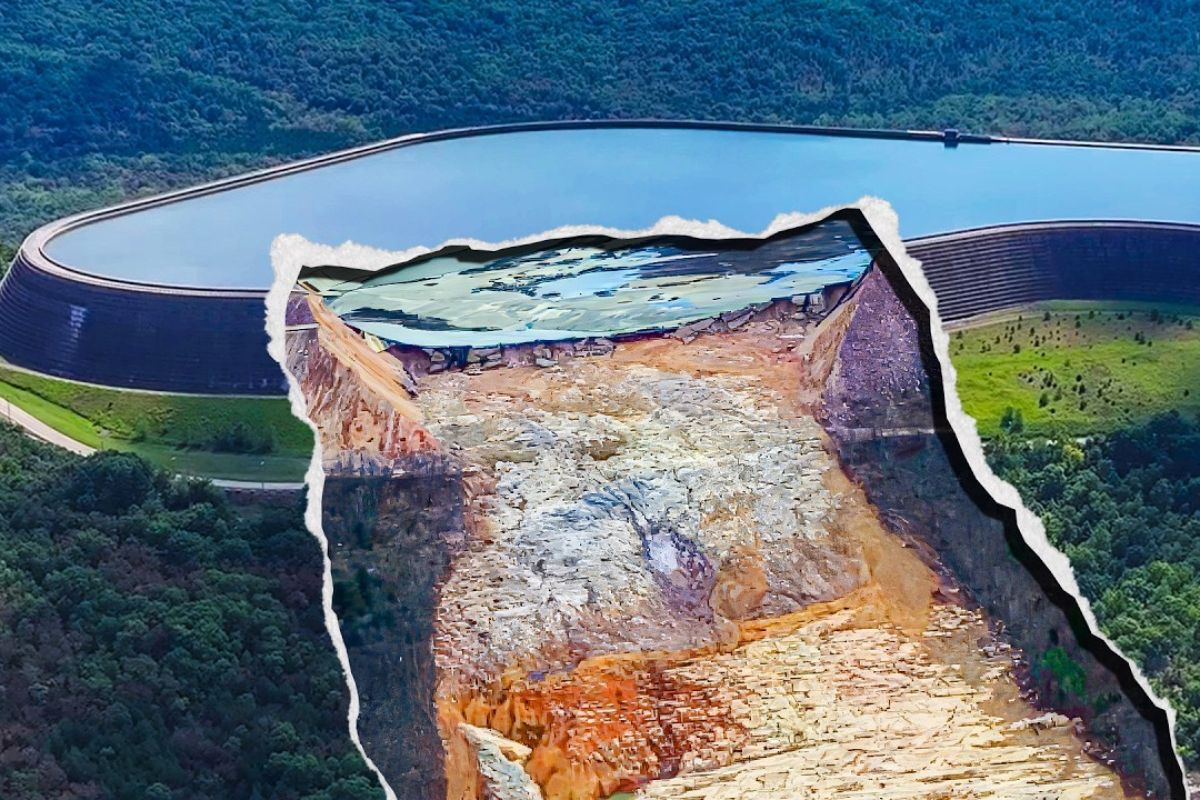
In The Early Hours Of December 14, 2005, The Award-Winning Taum Sauk Plant Overflowed While A Pump Kept Filling The Upper Reservoir; Without An Overflow, With Displaced Sensors And Remote Control, The Water Eroded The Embankment, Knocked Down The Guardrail And Released 6 Billion Liters Over An Entire State Park.
The award-winning Taum Sauk plant, described as a model of modern engineering and recognized for its innovations, turned to disaster after a silent overflow in the early hours of December 14, 2005: the water surpassed the top, hit the concrete guardrail, and began to excavate the rock embankment until it toppled the protection and released about 6 billion liters down the mountain.
The incident exposed a series of decisions and technical vulnerabilities, with faulty level sensors, absence of an overflow, and remote operation without technicians on-site to compare measurements; upon investigating the failure, the scrutiny began to redesign safety practices for dams connected to reservoirs outside the channel.
An Early Morning Of Overflow In Taum Sauk

In the early hours of December 14, 2005, the pumps were nearly finished filling the upper reservoir at the Taum Sauk power plant, marking the end of the daily cycle.
-
Italian researchers have detected what appears to be a second Sphinx buried under the sands of Egypt, and satellite scans reveal a gigantic underground megastructure hidden beneath the Giza Plateau for over 3,000 years.

-
There are 4,223 drums and 1,343 metal boxes concreted with 50-centimeter walls that store the radioactive waste from Cesium-137 in the worst radiological accident in Brazil, just 23 kilometers from Goiânia, with environmental monitoring every three months.
-
Giant Roman treasure found at the bottom of Lake Neuchâtel in Switzerland reveals an advanced trade system, circulation of goods, and armed escort in the Roman Empire about two thousand years ago.

-
He buried 1,200 old tires in the walls to build his own self-sufficient house in the mountains with glass bottles, rainwater, and an integrated greenhouse.

The water rose to the top of the rock embankment and reached the concrete wall that ran along the top of the dam.
The level reached the edge, but the filling didn’t stop.
One of the two pumps turned off, but the other kept running.
Within minutes, splashes turned into a constant flow, like a stream cascading over the guardrail, flowing against the embankment on the outside.
This overflow initiated erosion that started slowly and then accelerated.
The hole grew deeper and wider, and by the time the pump finally turned off, the base of the guardrail had already been compromised.
The guardrail fell.
The rupture paved the way for a sudden release of water that rushed down the mountain slope toward a state park.
From then on, the award-winning plant, treated as a showcase of modern engineering, entered a cycle of technical scrutiny that would change how to discuss sensors, verification routines, and the presence of an overflow in similar projects.
How The Award-Winning Plant Was Designed To Solve A Timing Problem, Not A Volume Problem

When it was built in the 1960s, the Taum Sauk pumped storage hydropower plant was unlike virtually any other power plant in the world in terms of size and concept.
South of St. Louis, in the Ozark Mountains, the design was created for a specific need: to manage when electricity enters and exits the grid, not just how much is produced.
Large coal plants in the Missouri area could generate a lot of power but struggled to increase or decrease output quickly to meet fluctuating demands throughout the day.
Union Electric, which later merged with Ameren, proposed a solution considered innovative for the time and common today: pumped storage.
In practice, the facility functions like a battery.
It is a net consumer of electricity, which seems counterintuitive for a power plant, but fits the system’s logic: when demand is low, this electricity is used to pump water from the lower reservoir to the upper one, usually at night.
When demand rises during the day, the potential energy stored is converted back into electricity by reversing the flow and operating the reversible turbines as generators.
There are inevitable losses, with evaporation, leaks, and losses in pumping and generation, but reports describe overall efficiency around 70%, enough to justify the enormous cost of building and operating two reservoirs and a plant that does not produce its own electricity.
This point is central to understanding why the award-winning plant was celebrated: it combined hydraulic infrastructure and electrical strategy.
The Upper Reservoir At The Top Of Mountain Proffitt And The Logic Of Height
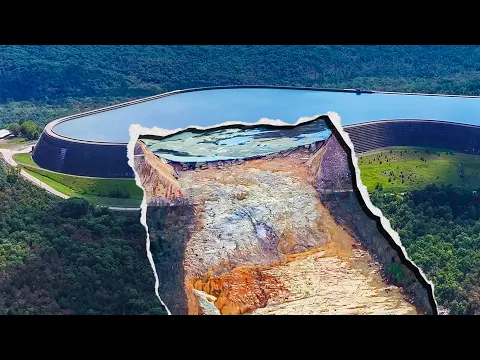

The most unusual part of the installation is the upper reservoir, built at the top of a mountain.
It is a circular dam, also called an annular dike, surrounding the reservoir at the top.
Generally, dams are built across valleys so that the natural topography forms sides and bottom; in the case of an off-channel reservoir like Taum Sauk, it requires building the dam all around, raising costs and complexity.
Height, however, is part of the technical argument.
Reports describe that the available power in a waterfall depends on variables such as flow and height difference, called head.
For a specific power over a specific period, the greater the height difference between the two reservoirs, the less water needs to be moved, reducing infrastructure size.
The mountains in southeast Missouri provided the location that made this possible: about 750 feet, or 230 meters, of height difference between the upper and lower reservoirs.
The upper reservoir was located near the top of Mountain Proffitt, described as the sixth highest peak in Missouri.
The design was named after the state’s highest mountain, Taum Sauk, a location originally chosen for the upper reservoir until there was resistance to construction there, prompting the transfer to a slightly lower peak nearby.
In the work, challenging geological conditions required realigning the design to avoid an area of fragile geology.
The adjustment resulted in a shape described as unique, resembling a kidney. This detail is relevant because, years later, the investigation would list settlements and geometric references as part of the chain that led to the overflow.
Rock Fill, Concrete Panels, And Remote Operation With No Eyes On Top
The original dam was built as a rock fill, essentially a long pile of stones around the perimeter.
Rock fill is durable, requires less compaction, and is described as less prone to typical soil embankment deformations.
The problem is that rock fill does not retain water well because there are many voids between the rocks.
To make the reservoir watertight, concrete panels were installed along the entire inner face. A tunnel connected a Morning Glory inlet through the mountain to the generating plant.
The inlet was built in a basin 20 feet, or about 6 meters, below the bottom of the reservoir to suppress the potential for vortex formation as the system was drained daily.
The remote operation was another cited innovation.
The design was conceived to dispense with technicians on-site, utilizing remote control.
This choice, combined with a reservoir that frequently filled and emptied, increased reliance on sensors and programming logic to determine when to stop pumping.
When the overflow began, the award-winning plant had no immediate human presence at the top to perceive what was happening at the guardrail.
From 100 To 300 Days Of Operation: Cycles, Leaks, And The 2004 Turning Point
For most of its existence, the Taum Sauk station operated an average of about 100 days a year, usually in the warm summer months when electricity demand varied the most between night and day.
The deregulation of electricity markets in the 1990s opened the possibility of selling energy to other utilities, increasing operation to about 300 days a year.
The practical effect was an upper reservoir rising and falling in cycles, frequently twice a day, almost every day of the year.
This rhythm began to pressure known vulnerable points.
The upper reservoir had been leaking since it began operating in the 1960s.
Over time, projects were implemented to deal with this leak, including the construction of small lakes beside the reservoir to capture some water and pump it back.
In the fall of 2004, Ameren decided to invest more than two million dollars to install a geomembrane lining covering the entire reservoir, a measure described as capable of addressing the leak.
From that point on, the challenge became operating level sensors without compromising the geomembrane, maintaining the remote operation that had already been a hallmark of the award-winning plant.
The IEEE, The Water Gushing, And The Alert That Did Not Become An Operational Shutdown
About a year later, in September 2005, the IEEE declared the plant a Landmark of Engineering for its innovations.
The day before the ceremony, participants on a visit witnessed water gushing over the protective wall on one side of the upper reservoir.
The operators quickly switched from pumping mode to generation to lower the water level.
The explanation attributed to the episode was the action of strong winds associated with a lingering tropical storm, which likely caused the overflow.
Even so, the award-winning plant hired an underwater inspection team to check the level sensors.
The inspection brought a finding that shifted the focus from the wind to the instrumentation: the sensors were not where they were supposed to be.
Sensors On Cables, Floating Conduits, And Readings Lower Than The Actual Level
With the geomembrane, there was valid concern that drillings could cause leaks in the future.
The reservoir still needed sensors for remote operation.
Instead of mounting sensors directly on the concrete and drilling through the lining along the entire length, an alternative solution was implemented: two cables installed between anchors at the top and base of the shoulder of the embankment, with sensor conduits attached to these cables to minimize drilling.
The technical description of the problem is straightforward: the mounting system was poorly designed.
The conduits were floating and subject to strong currents as the reservoir filled and emptied.
At some point after spring 2004, they became detached and diverted.
The result was a set of internal sensors providing readings lower than the actual water level.
The award-winning plant began making pumping decisions based on a reservoir that, electronically, appeared lower than it was.
Based on this, operators decided to reprogram the control system to subtract two feet from the upper pump adjustment point.
The original design provided for two feet, or 600 millimeters, of freeboard between the top of the guardrail and the maximum water level.
The operators calculated that doubling this distance would be sufficient to prevent overflow until the annual maintenance, when the reservoir would be drained and permanent repairs could take place. That interval never arrived.
The December 14 Overflow And The Collapse Of The Guardrail
Less than three months after the episode observed before the IEEE ceremony, the overflow occurred again on December 14, this time at dawn, when no one was nearby to notice the flow over the guardrail.
As soon as the retaining wall collapsed, the water rapidly eroded through the dam and released approximately 6 billion liters, or 200 million cubic feet, down the steep mountainside toward Johnson’s Shut-Ins State Park.
The wave uprooted trees and rocks. The time of year was crucial: winter left the park virtually empty, averting a tragedy with more visitors.
Even so, the park superintendent, his wife, and their three children, including a seven-month-old baby, were swept away by the flood when the water destroyed their home.
The entire family survived but with injuries and hypothermia, evidencing that the catastrophe exceeded technical boundaries.
The flow moved to the lower reservoir, where it would have gone later that day in the normal cycle.
Thus, the record shows that there were no major downstream impacts, although the impacts on the slope and in the park were severe. The award-winning plant, which operated like a battery, demonstrated that day the destructive force of water when control fails.
The FERC Investigation And The Portrait Of A Chain Failure
The incident was investigated by the FERC. The findings were described as surprising because they showed that the disaster did not require a single extraordinary error, but rather a combination of oversights.
As in many infrastructure events, each isolated failure might not be sufficient to cause collapse.
Summed up, they produced hundreds of millions of dollars in damages and left human consequences for the affected family.
The report describes a chain of vulnerabilities: embankment material with more soil than anticipated, settlement over time, displaced sensors, poorly positioned safety probes, poorly programmed shutdown logic, lack of field verification, and at the center, the absence of an overflow that would allow controlled water release.
The overflow came to be viewed as the result of a risk architecture, not bad luck.
Settlement Of The Embankment And The Actual Geometry Of The Top
The investigation pointed out that the rocky fill was not as rocky as expected. There was more soil mixed in, resulting in greater settlement over time.
Unstable areas of soil at the foundation of the embankment would not have been adequately cleared, exacerbating the settlement.
Between construction and collapse, portions of the guardrail were two feet, or 600 millimeters, lower than at the start.
This lowering has a practical effect: the reference for the maximum safe level changes.
The settlement was not taken into account when the level sensors were replaced after the 2004 lining. And, with loose and mobile sensors, the logic controllers had no way of knowing the actual elevation of the water in the upper reservoir.
The award-winning plant became dependent on a measuring system that did not know either the real level or the actual top.
Safety Probes, Wrong Location, And The Requirement For Two Signals To Shut Off
Safety probes were installed at the guardrail to serve as a backup and shut off the pumps if the level got too high.
The problem was that they were installed at a point higher than the top of the settled sections. If the water reached these probes, it could already be overflowing parts of the wall at lower elevations.
Safety was calibrated for an idealized wall, not the settled wall.
There was also a programming failure: the shutdown required both sensors to be activated.
During the visit prior to the IEEE ceremony, when water flowed over the wall, the probes did not shut the system down, and no one would have dedicated effort to check why.
Instead of checking critical elevations in the field, such as the top of the guardrail and sensor levels, the response was to add margin and delay permanent repair.
The case also exposed the absence of a simple routine to compare electronic readings with direct observation.
It was noted that it would have been easy to keep someone on-site in the final minutes of daily filling to compare measurements or install a closed-circuit camera.
The owner also did not notify the regulatory agency the first time there was an observed overflow, reducing oversight over the response taken.
Why The Absence Of An Overflow Became The Most Repeated Lesson
The most significant error cited occurred long before the geomembrane and sensors: the original design never included an overflow. For an off-channel reservoir, water inputs are limited, described as direct rain and pumped water. With sufficient freeboard and redundancies in control, designers felt that water would never need a physical route to safely escape over the top.
Experience showed the risk of relying on complicated control systems as the last barrier. Sensors can be displaced. Programming can be done with inadequate logic. Elevations can change with settlement.
When this happens, the water seeks the path it finds. An overflow, on the other hand, is a simple structural piece: once the water reaches the top, it overflows through a designed path.
An overflow is not a magic solution and is not infallible, but it reduces the number of possibilities for an overflow to turn into guardrail failure.
After Taum Sauk, the overflow began to be mentioned as a necessity even in off-channel reservoirs with redundant controls designed to prevent water from reaching the top.
The award-winning plant became an example of how electronic redundancy does not replace a physical safety route.
Normal Accidents, Charles Perrow, And Complexity As Risk
The report introduces a concept to interpret the disaster: such events are described as normal accidents, a term associated with Charles Perrow.
The idea is that, when systems are complex, especially when safety measures add more complexity, the likelihood of failure increases. In other words, failure becomes part of the expected behavior of the system, not an unlikely exception.
In the case of the award-winning plant, safety depended on level sensors, conduits, cables, internal currents, shutdown logic, programming parameters, and remote operation.
The overflow appears as a counterpoint because it is simple compared to an industrial control system.
The story of Taum Sauk shows how a chain of small failures can traverse all these layers and lead to water over the guardrail.
Record Fine, Local Fund, And Agreement To Restore Johnson’s Shut-Ins
The FERC fined the owner $15 million, described as the largest penalty ever issued. Five million were allocated to a fund for improving the area around the project, with mention that recent reports alleged mismanagement of this money.
The state of Missouri filed a lawsuit, and the settlement reached $177 million, with much of it directed toward restoring Johnson’s Shut-Ins State Park, which held a reopening ceremony in 2010.
This set of financial and institutional responses underscores the dimension of the case. The award-winning plant was not treated as a routine operational failure, but rather as an event capable of redefining park, community, protocols, and expectations for dam safety.
Reconstruction With Rolled Compacted Concrete And Inclusion Of An Overflow
While the park was being restored, teams rebuilt the upper reservoir at Taum Sauk. To avoid new licensing, the dam was rebuilt in the same alignment and dimensions as the original design.
The technique, however, changed: instead of repairing the rock fill, Ameren and consultants opted for rolled compacted concrete, a drier mixture, handled with earthmoving equipment and compacted with rollers.
The goal was to address settlement and leakage while also utilizing material from the original embankment. The rock fill was crushed and processed to become concrete aggregate, reducing transportation to the remote site.
The central element of the new project was to include an overflow. The structure was described as the largest rolled compacted concrete dam in the United States.
The award-winning plant reopened in 2010 and was reinaugurated as an IEEE landmark. The project also received the American Society of Dams Excellence in Constructed Project Award.
Upon return, the overflow and the new construction method were presented as a direct response to the overflow and the collapse of the guardrail.
Changes In Supervision And The Creation Of An Internal Safety Standard
After the collapse, the FERC implemented changes in dam safety supervision. A working group was created, and technical guidance was issued addressing the challenges of pumped storage facilities communicated to owners.
Rules were also updated to require an internal dam safety program and a chief dam safety engineer responsible for overseeing the subject, a position that Ameren did not have at the time.
The effect of the case spread. It was noted that distant states, like Hawaii, reinforced their programs.
And a lesson emerged as a synthesis: the need for overflow even for off-channel reservoirs with redundant control systems designed to prevent water from reaching the top.
Energy Storage, Water, And The Contrast With Batteries
For those following the electrical grid, the Taum Sauk case reemerges when discussing storage. As the energy matrix includes more intermittent sources, balancing supply and demand becomes increasingly important.
Traditionally, pumped storage has been the large-scale cost-effective solution, but it carries a price: dams are high-risk structures, which fail rarely, but when they do, they release water with great destructive power.
The report notes that battery storage is becoming cheaper and more widespread, which could change the economics of pumped storage.
Some forecasts cite that by 2030, the United States could have over 400 gigawatt-hours of battery storage in the grid, equivalent to more than 100 Taum Sauks in stored energy.
The risk profile is different from building an upper reservoir on top of a mountain.
Even with this change, the award-winning Taum Sauk plant remains a technical reference. It shows how overflow can arise from inaccurate sensors, how the absence of an overflow removes a physical relief route, and how remote operation requires verification that does not rely solely on programming and electronic readings.
The Taum Sauk case leaves a difficult operational point to ignore: when safety depends on sensors and remote control, monitoring levels and the presence of an overflow cease to be details and become survival barriers.
In energy infrastructure, the lesson appears in both the technical design and the governance model required afterward, with internal safety programs and formalized oversight.
If you follow dam and reservoir projects, it is worth observing how instrumentation decisions, shutdown logic, and physical overflow routes are treated before any public acclaim, because overflow does not wait for a ceremony.
In your opinion, what weighed more on the catastrophe of the award-winning plant: displaced sensors, shutdown programming, remote operation without checks at the top, or the absence of an overflow?









-

-

-

5 pessoas reagiram a isso.