





 Portuguese
  English
  Spanish
 4 min of reading
  5 comments


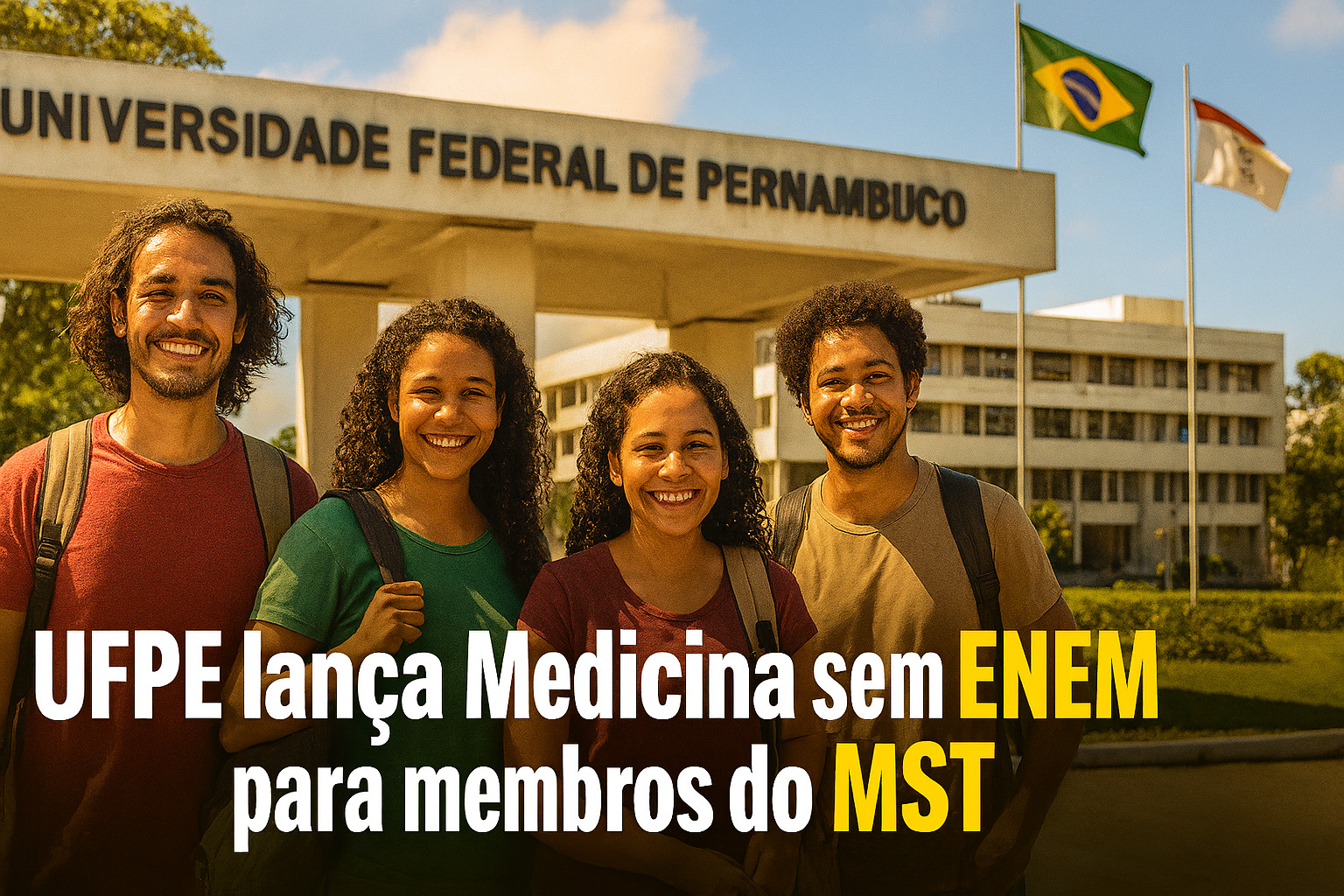


UFPE Launches Unprecedented Medicine Course for MST Members and Agrarian Reform Settlers, No ENEM Requirement, with 80 Slots and Start Date Scheduled for December 2025.
An unprecedented decision in Brazilian higher education is stirring the debate on education, public policies, and social inclusion. The Federal University of Pernambuco (UFPE) announced, in September 2025, the creation of the first medicine course in the country exclusively aimed at agrarian reform settlers, quilombolas, and members of the Landless Workers’ Movement (MST). The project, authorized by the institution and linked to the National Program for Education in Agrarian Reform (Pronera), foresees the offering of 80 slots at the Agreste Campus in Caruaru, and drew attention for a unique detail: it does not require ENEM scores for admission. Classes are set to start on December 2.
A Project Focused on Inclusion and Rural Health
The course is part of a federal initiative aimed at training doctors to work in rural areas and isolated communities, historically affected by a lack of healthcare professionals.
According to the announcement published by the university itself, the selection process will be conducted outside of the Unified Selection System (SISU), and selection will occur through an analysis of academic records and an essay, without the need for a score from the National High School Exam.
-
Take a 100% online and free course at Itaú: Foundation releases 156 options with certificates, registrations open for all of Brazil, unlimited access, areas such as technology, education, and management, and a flexible schedule without tutoring.

-
Senai will pay up to R$ 700 per month for those who take free technical courses: there are 12,000 open positions across Brazil and training with access to the technology market.

-
Take one of the free courses from SENAI! There are over 100 options for training completely online and with a guaranteed certificate in Logistics, Mechanics, Business, Energy, Safety, and much more; see how to enroll and boost your resume with SENAI EAD.

-
Petrobras and SENAI join forces and launch free technology courses that pay up to R$ 706.


The proposal emerged from a partnership between UFPE, the National Institute of Colonization and Agrarian Reform (Incra), and the Ministry of Agrarian Development and Family Agriculture (MDA), within the guidelines of Pronera. The program, created in 1998, aims to expand access to education at all levels for families living in rural settlements, offering courses from literacy to graduate and postgraduate studies.
To learn more about the program, access the federal government’s announcement
According to Incra, the model adopted for the medicine course aims to strengthen primary health care in rural areas, training professionals committed to local realities and to remaining in the regions where they live. Classes are expected to begin in October 2025, with a duration of six years, following the standard of other medicine courses in the country.
Controversy and Debate Over Admission Criteria
The creation of the course, however, has divided opinions and generated intense debate in the academic and medical communities. Entities such as the Federal Council of Medicine (CFM) and the Brazilian Medical Association (AMB) expressed concern over the selection model, arguing that the exemption from the ENEM could “reduce standards of merit and technical quality” in gaining access to the course.
On the other hand, university and federal government representatives defend that the project adheres to strict teaching standards and has a focus on social reparation and educational inclusion.
“The goal is not to create a shortcut but to ensure that individuals from rural backgrounds have the same opportunity to graduate and meet the needs of their own communities,” explained Maria do Socorro Carvalho, the course coordinator and a professor at UFPE, in an interview with Diário de Pernambuco.
The rector of UFPE, Alfredo Macedo Gomes, also emphasized that the course was fully approved by the University Council and complies with all curricular guidelines from the Ministry of Education (MEC). “We are training doctors with technical competence and social commitment. Pronera is a recognized and legitimate public policy that has existed for decades,” he highlighted.
Differentiated Structure and Methodology
The medicine course focused on Pronera will be offered on a full-time basis and will combine theoretical classes, practical lessons, and field modules conducted in basic health units in the interior of Pernambuco. The curriculum will focus on rural public health, primary care, and management of health policies in vulnerable communities.
According to UFPE, students will receive pedagogical support, psychological assistance, and student housing guaranteed during their training. The project further includes partnerships with foreign universities specializing in community medicine, such as the University of Medical Sciences of Havana (Cuba), for exchange programs and faculty training.
The first class will have 40% of women and significant participation from young people from rural settlements in the Northeast. Students will need to prove their connection to MST, Incra, or family agriculture programs.
National Repercussion and Social Impact
The news received widespread coverage in the national press. Outlets like JC Online, Diário de Pernambuco, and G1 Pernambuco highlighted that the course represents a historical milestone in the democratization of higher education, being the first in the medical field with a clear social and territorial focus.
The Ministry of Education praised the initiative, noting that it aligns with the National Policy for Rural Education, aimed at reducing inequalities in access to education. MST leaders classified the program as “a concrete step in the fight for educational equality and the right to healthcare in rural areas”.
From a strategic standpoint, the government sees the project as an inclusion laboratory that could inspire universities in other states to create similar classes, especially in nursing, dentistry, and agronomy courses.
A Milestone in Brazilian Public Education
The UFPE medicine course aimed at MST members is, above all, a reflection of the complex relationship between education, politics, and social equity in Brazil. It symbolizes the effort to bring higher education to historically marginalized groups while reigniting the discussion on access criteria and academic quality.
Regardless of the divergences, the fact is that, for the first time, Brazil sees a federal university open medicine slots without ENEM, based on a project that unites social inclusion, public policies, and the pursuit of a new model for human development in rural areas.










Não tem que ser do MST. Tem que ser assentado
É mais fácil do que fazer escola publica com ensino fundamental e médio de qualidade para os que mais necessitam! Esse é o Brasil !!! Parabéns (ahahahaha)! Agora resta saber se os que se formarem medico assim vão aceitar ficar no campo o resto da vida!
Kkkkkkkk. Brasil se fudeu de vez…!!! Ja nao tem ensino que ENSINE…so tem lavagem cerebral…agora, medicina para mst…que Deus tenha PIEDADE de nos!!!