





 Portuguese
  English
  Spanish
  3 min of reading
  1 comment


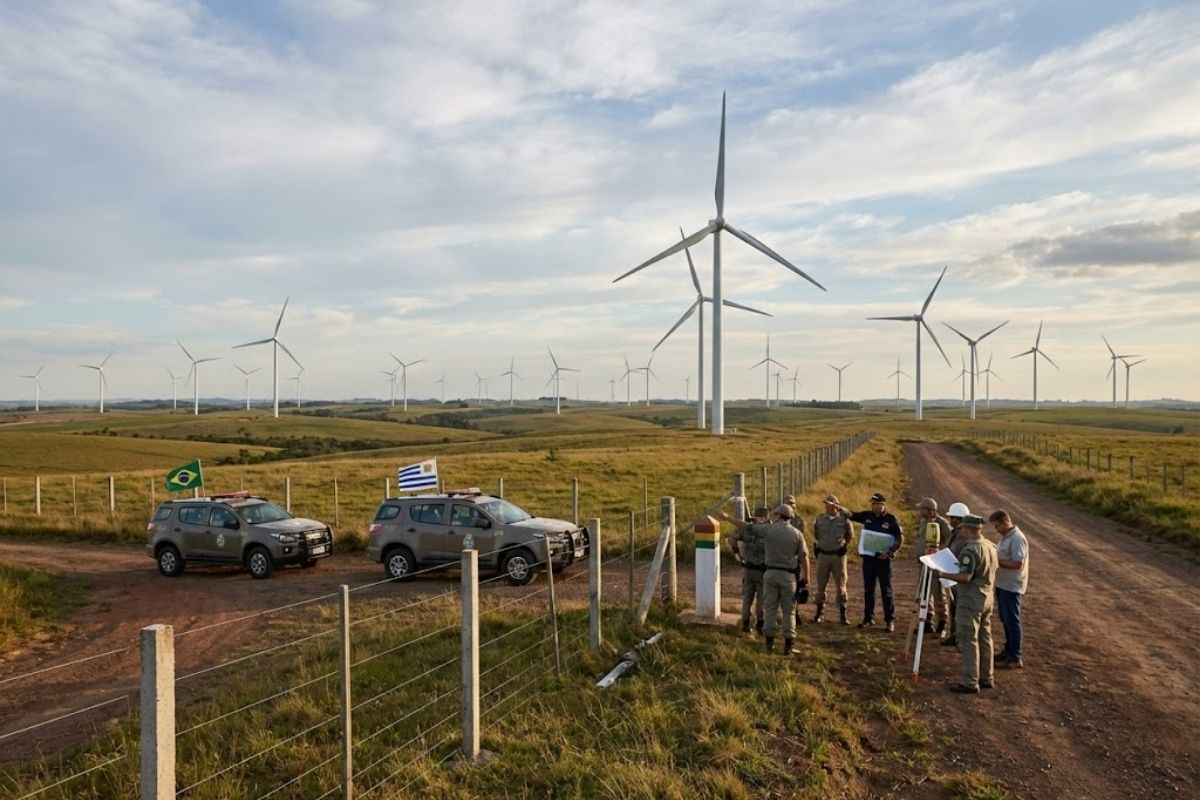


Uruguay Has Returned to Contest the Rincón de Artigas Area, About 237 km² in Santana do Livramento, After the Coxilha Negra Wind Farm Began Operations. The Eletrobras Project Includes 72 Wind Turbines, 302.4 MW, and Is Expected to Supply 1.5 Million, With a Note Sent in June 2025 Formally.
In June 2025, Uruguay formalized a complaint requesting a review of the border in the area known as Rincón de Artigas, in Santana do Livramento (RS), after the Coxilha Negra Wind Farm started operating. The installation of the complex had begun in 2022, according to reports, and the disputed area is estimated to be 237 km².
The impasse is not new: Uruguay has questioned the demarcation since 1934, when Captain Villa Seré pointed out an error in the interpretation of landmarks, despite the treaty of 1851 signed after Uruguay’s independence in 1828. Now, with an energy asset in operation, the dispute gains economic and diplomatic weight.
What Is at Stake: Rincón de Artigas and 237 km² in RS

The area referred to as contested by Uruguay is the Rincón de Artigas, with approximately 237 km², located in Santana do Livramento, Rio Grande do Sul.
-
Brazilian city bets on the business environment to generate jobs and attract investments in the energy sector — secretary reveals strategy at Macaé Energy 2026.
-
50 viaducts, 4 tunnels, 28 bridges, and 40 kilometers of bike paths: BR-262 in Espírito Santo will receive 8.6 billion reais for the largest engineering project in the state’s history, inspired by the Immigrant Highway in São Paulo.

-
Brazil produces too much clean energy and doesn’t know what to do with it: over 20% of solar and wind capacity was wasted in 2025 while investors flee and 509 renewable generation projects were abandoned in the last year.

-
Piauí will produce a new fuel that replaces diesel without needing to change anything in the truck’s engine and reduces pollutant gas emissions by half: truck drivers from all over the Northeast are already celebrating the news that will arrive later this decade.


The Uruguayan argument presented in the report states that the border was demarcated based on a historical error in the interpretation of landmarks.
On the Brazilian side, the registered position is that the territory belongs to Santana do Livramento.
The text also mentions that the daily coexistence between Santana do Livramento and Rivera is traditionally peaceful, even with the border issue resurfacing at specific moments.
Coxilha Negra: 72 Wind Turbines, 302.4 MW, R$ 2 Billion, and Energy for 1.5 Million
The Coxilha Negra Wind Farm, described as located in Rincón de Artigas, is pointed out as the most recent trigger for Uruguay to reinforce its contestation.
The project has 72 wind turbines and an installed capacity of 302.4 MW, with an investment cited of R$ 2 billion.
The report also indicates a projection of supplying 1.5 million consumers with renewable energy.
In this context, the operation of the park adds economic value and political visibility to the contested territory, increasing the sensitivity of the issue for both countries.
Timeline of the Impasse: 1828, 1851, 1934, 1985, 2022, and June 2025
The presented history follows a sequence of milestones that help to understand why Uruguay maintains the claim:
1828: independence of Uruguay, cited as the basis for subsequent agreements.
1851: treaty between Brazil and Uruguay to establish borders after independence.
1934: Uruguayan Captain Villa Seré identifies an alleged error in the interpretation of landmarks and begins to question the demarcation.
1985: Brazil reinforces its presence with the construction of Vila Thomaz Albornoz in Sant’Ana do Livramento, which reportedly increased tensions.
2022: beginning of the installation of the wind farm by Eletrobras, according to the report.
June 2025: Uruguay sends a note requesting a border review and formally reopens the debate.
Diplomatic Weight and Next Steps: Itamaraty, Border, and Energy in Operation
The report indicates that Itamaraty intends to address the impasse with the neighboring country seeking a peaceful solution, without setting a deadline for resolution.
At the same time, the Coxilha Negra Wind Farm continues to operate and contribute to energy supply.
The combination of historical controversy with critical infrastructure tends to harden the technical discussion about limits and landmarks, as any revision would require diplomatic and legal debate, along with direct impacts on territorial planning and asset management.
The challenge from Uruguay regarding 237 km² in RS returns to the center of the debate after the operation of the Coxilha Negra Wind Farm, with 72 wind turbines and 302.4 MW, in an area disputed since 1934 and reactivated by a note sent in June 2025.
The case mixes historical memory, energy, and diplomacy, with negotiations still lacking a public timeline for resolution.
In your view, will Uruguay be able to advance this review in practice, or will the impasse remain limited to the diplomatic field due to historical weight and the infrastructure already operating?







Os limites territoriais entre o Brasil e o Uruguai estão cobsolidados e reconhecidos pacificamente há décadas.
Sem entrar no mérito da motivação do Uruguai em questionar equivoco supostamente havido na demarcação da fronteira, levantado em 1934, – a posse e a ocupação brasileira dos 237 km² reivindicados pelo Uruguai, historicamente se consolidaram, impossível de serem revertidas.
O mais importante é o Brasil e o Uruguai manterem-se pacíficos e cordiais na fronteira atual.