





 Portuguese
  English
  Spanish
  6 min of reading
  0 comments


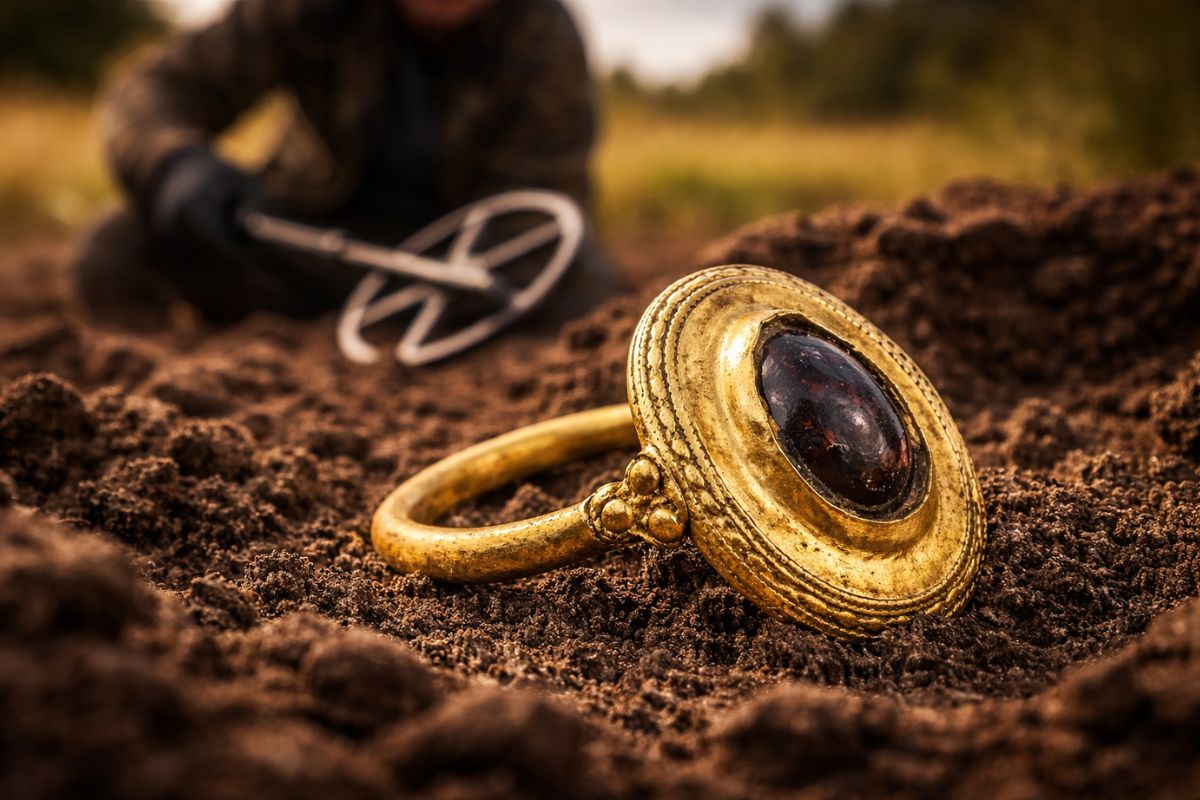
The Golden Ring Found In Emmerlev In Southern Denmark Combines 22-Carat Gold, Red Gemstone, And Frankish Details That Bring The Piece Closer To The Merovingians, Suggesting An Unknown Royal Family And Indicating That The Region Exercised Political Power Much Greater In The Merovingian Era Than Previously Thought.
The golden ring found by Lars Nielsen in a field in Emmerlev, Denmark, seems small in light of the impact it produced. The artifact was located with a metal detector but quickly transitioned from being just a rare object to a piece capable of changing the understanding of who held influence in that part of Southern Jutland between the 5th and 6th centuries.
When the find reached the specialists at the National Museum of Denmark, the analysis pointed to an unusual set of signals: 22-carat gold, a red semiprecious gem, spiral designs, and small clover-shaped reliefs. This level of craftsmanship not only indicates prestige, but also connects the object to aristocratic circuits linked to the Merovingians and raises the hypothesis of a previously unknown royal family in the region.
A Rare Object That Came Out Of A Field And Entered The Center Of Archaeology

Lars Nielsen found the ring in 2020, but the discovery remained confidential while experts tried to understand its significance. This interval helps to measure the weight of the find.
-
A collector bought a black stone in Morocco in 2011 without knowing that he had in his hands a Martian meteorite 4.45 billion years old with ten times more water than any other fragment of Mars ever found on Earth.

-
European cities are building public climate refuges to cope with extreme heat.

-
Excavations for a highway uncovered an intact Celtic city with gold, jewelry, and ancient production structures.

-
Every pineapple you eat is actually up to 200 different fruits fused into one: discover the fascinating process in which each flower opens for just one day and produces the pieces that form the whole fruit over the course of 3 weeks.


It was not just about recording another ancient piece in Denmark, but verifying whether that golden ring could be connected to power structures that were still not very visible on the political map of the time.
Emmerlev had already been attracting attention for other valuable archaeological materials, but the new object elevated the debate to another level.
The fact that an amateur detectorist located the piece in an area already associated with ceramics, gold and silver coins, and gold horns from the first century reinforced the idea that the location was not peripheral.
The discovery suggests continuity of wealth, circulation of status symbols, and presence of elites, something that gives Emmerlev a greater historical weight within Denmark.
Nielsen himself reported being so emotional that he could barely speak upon realizing the uniqueness of the artifact. The reaction is understandable.
Finding a golden ring with such a degree of preservation would already be rare in itself. Finding it in a context capable of pointing to a royal family that has not yet been identified completely changes the dimension of the find.
What The Ring Reveals About The Merovingians And The Local Elite

The researchers observed that the ring exhibits characteristics compatible with Frankish craftsmanship. This information is central because it connects the object to the Merovingians, the Frankish dynasty that dominated a significant part of Western Europe between the 5th and 8th centuries.
Instead of viewing Southern Denmark as a distant edge of these circuits, the piece indicates deeper political and cultural connections.
The archaeologist and curator Kirstine Pommergaard assessed that the golden ring was likely feminine and may have belonged to the daughter of a prince who married a prince from Emmerlev.
This possibility is relevant because it places the object in a known diplomatic logic: gold as a political gesture between powerful lineages.
The ring ceases to be just jewelry and begins to function as a document of alliance, suggesting that the royal family associated with the site maintained strategic relationships with the Merovingians.
The red gem also weighs in this interpretation. Similar examples of stones are already recognized as status symbols among regional elites.
When this information is combined with the 22-carat gold, technical sophistication, and the presence of Frankish elements, the picture becomes more consistent.
Emmerlev appears not as an isolated point, but as a space where symbols of prestige, political marriage, and authority could circulate naturally.
Therefore, the find impacts more than just the chronology of a piece. It compels researchers to reconsider how the links between Denmark and the Merovingians were formed and who, in fact, was capable of participating in this game.
If there was a local royal family connected to this universe, the regional hierarchy might have been far more complex than previously imagined.
Emmerlev, Royal Family And A Center Of Power Greater Than It Seemed
According to experts, the ring may have belonged to a new royal family in the region, previously unknown, but strongly linked to the Merovingians.
This formulation is important because it does not assert a fully identified dynasty but indicates an elite with enough political density to leave material traces compatible with high-level alliances. In archaeological terms, this already represents a significant change in the understanding of the territory.
The site of Emmerlev reinforces this hypothesis because it did not yield just a single exceptional object. The presence of ceramics, gold and silver coins, and ancient gold horns points to an environment of accumulated wealth and long duration.
When different valuable finds start to converge in the same space, the interpretation ceases to be episodic and gains historical thickness. It is at this point that Emmerlev begins to be seen as a more relevant power center in Southern Denmark.
Anders Hartvig, an archaeologist at the Sønderjylland Museum, was straightforward in stating that the person who owned the ring likely also knew the people linked to the gold horns discovered in the area.
The observation does not prove kinship but opens a line of continuity between local elites. If this connection holds, the royal family suggested by the golden ring would not be an isolated case but rather part of a broader aristocratic network.
This helps to explain why the regional power map is being revised. For a long time, Southern Jutland was treated as having lesser influence compared to other areas in narratives about the era of the Merovingians.
Now, Emmerlev emerges as a point of articulation between wealth, material prestige, and possible marital alliances.
The piece changes the scale of the debate because it forces one to question not only who lived there but who governed, negotiated, and connected with other elites.
Why A Single Ring Can Alter The Reading Of An Entire Era
In archaeology, the impact of a discovery does not always depend on the size of the object. The value of a golden ring like this lies in the amount of information condensed in its form, material, and find context.
High-purity gold, sophisticated design, prestigious stone, Frankish characteristics, and association with other valuable artifacts make the piece a political marker, not just ornamental.
The strength of this discovery also lies in what it compels specialists to cautiously admit. The ring does not provide a name, does not display an inscription, and does not by itself resolve the genealogy of the region. Still, it shifts the axis of investigation.
Instead of only looking for external influences on Denmark, researchers begin to consider that there was a local elite in Emmerlev, articulated and possibly integrated into the universe of the Merovingians.
This shift is decisive. A discovery like this does not redraw the past due to excess imagination, but through the accumulation of converging evidence.
The field where Nielsen found the object thus transforms into more than a place of archaeological luck. It becomes the point where a golden ring forces a revision of power relations, the significance of a forgotten royal family, and the position that Denmark occupied in that scenario.
Nielsen even produced a replica to gift to his wife for Christmas, hoping that the story of the find continues within the family.
The personal gesture contrasts with the public dimension of the discovery. While the replica preserves the domestic memory of the encounter, the original reopens a historical discussion about authority, alliances, and prestige in Southern Denmark.










-

-

-

6 pessoas reagiram a isso.