





 Portuguese
  English
  Spanish
  3 min of reading
  0 comments


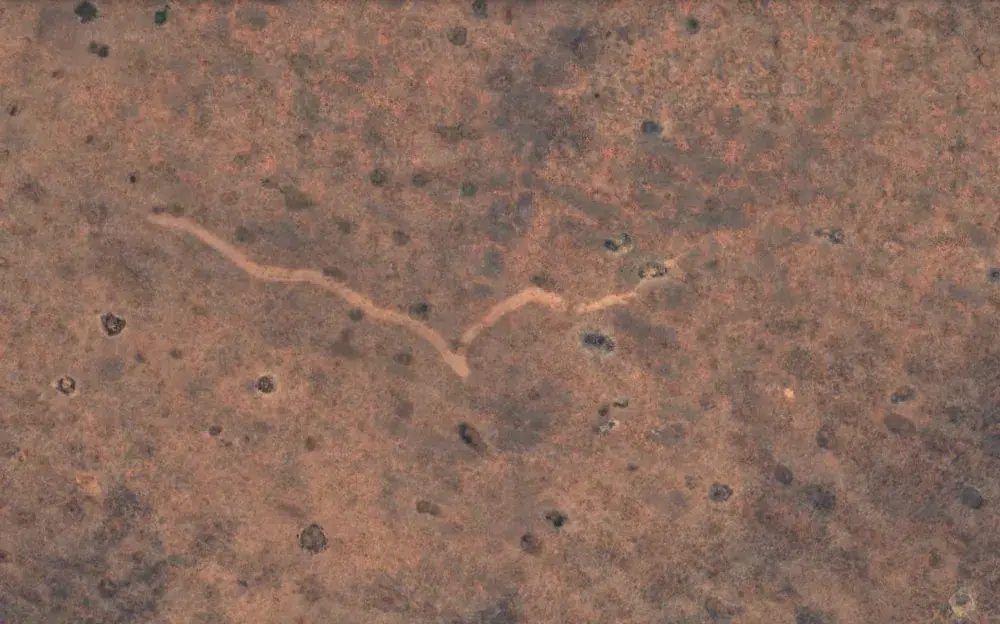
Observing an Unusual Shape on Google Earth, a Man Identified the Trail of a Tornado That Went Unnoticed by Meteorological Authorities, Revealing the Power of the Phenomenon.
In November 2022, a tornado quietly traversed the arid Nullarbor Plain in southern Australia, leaving an 11-kilometer scar on the ground. Despite its destructive power, the event went unnoticed until images from Google Earth revealed the mystery.
Tornadoes, known for their devastating strength, are typically associated with populated areas, where their impact is evident and immediate.
However, when they occur in uninhabited land, their marks can go unnoticed. This is exactly what happened in the remote Nullarbor Plain, a vast dry and treeless region that spans South Australia and Western Australia.
-
Scientists drilled nearly 8,000 meters into the ocean floor above the fault that caused the 2011 tsunami in Japan and discovered that a layer of clay 130 million years old was responsible for making the wave much worse than any model had predicted.
-
Thousands of years after causing the largest eruption of the Holocene, one of the world’s largest supervolcanoes is rebuilding itself beneath the sea south of Japan, receiving new magma and alarming scientists with its transformation.
-
China has activated a magnet 700,000 times more powerful than the Earth’s magnetic field that operates for over 200 consecutive hours while consuming little energy, and now the world wants to know what Beijing plans to do with this technology in 2026.

-
Mercado Livre has started selling medications in Brazil with delivery in up to 3 hours, and the project that launches in São Paulo may expand to the entire country, transforming the way millions of Brazilians buy medicines.


The discovery began unusually. An enthusiast was examining satellite images on Google Earth in search of caves but stumbled upon something unexpected: a long winding mark in the landscape.
The line, which ran east to west, formed a deep “V” in one section, reminiscent of a child’s drawing of a seagull. Intrigued, he reported the find, which quickly reached researchers at Curtin University in Perth.

Screenshot, Google Earth
Technology Reveals the Hidden Power of Nature
Using images and historical weather data, a research team led by Matej Lipar determined that the mark was the result of a powerful tornado. The occurrences took place between November 16 and 18, 2022, during the passage of a low-pressure system and a cold front, conditions conducive to severe storms.
In addition to satellite images, scientists visited the site. The scar remains visible even after 18 months, with a width between 160 and 250 meters. Intriguing details, such as cycloidal marks—small dark loops formed by the tornado’s suction vortices—reinforced the conclusion.
Based on the observations, the team estimated that the tornado reached speeds exceeding 200 km/h and was classified between F2 and F3 on the Fujita Scale, a significant intensity level. The event, which lasted between 7 to 13 minutes, traversed the arid landscape rotating clockwise.
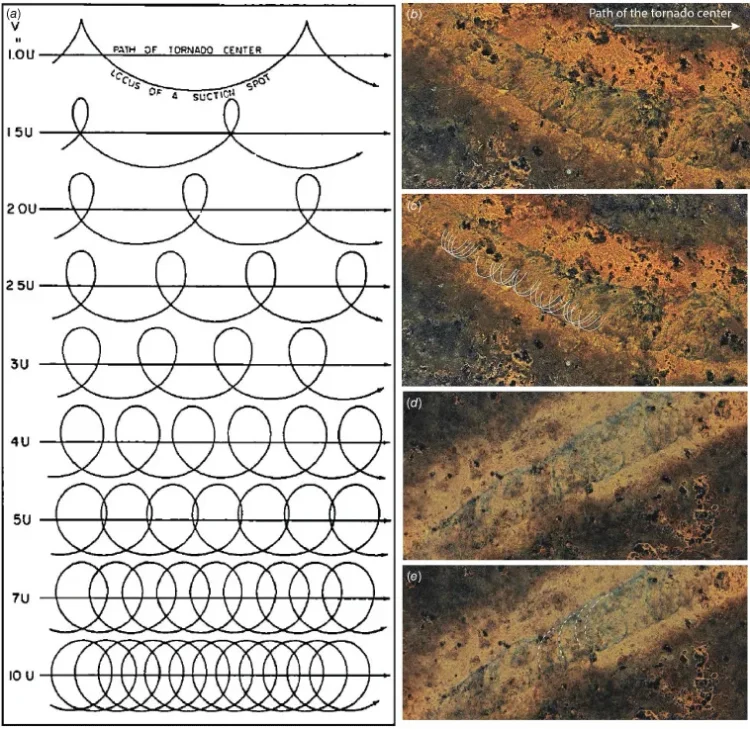
Matej Lipar,
Journal of Southern Hemisphere Earth Systems Science, 2024
Scientific Debate and Estimation Challenges
Although the data is impressive, not all experts agree on the accuracy of the estimates. John Allen, a meteorologist at Central Michigan University, noted that tornadoes of this intensity are rare in Australia and typically associated with prolonged storms. Nonetheless, he emphasizes that the cycloidal marks indicate the passage of a tornado.
The absence of witnesses and material damage makes the characteristics particularly difficult to study. Still, the discovery underscores the growing utility of technologies like satellite imagery to identify and understand extreme weather events, especially in remote areas.
Unpredictable Nature and Lesson for the Future
Beyond its scientific value, the study serves as a reminder of nature’s unpredictable power. “Extreme weather can happen anywhere, anytime,” Lipar wrote in an article for The Conversation. The use of satellites not only allows for tracking isolated events but also helps meteorologists improve forecasting and preparedness for severe events.
The scar on the Nullarbor Plain, now recognized as a mark of a tornado, not only reveals the power of nature but also the importance of technology in unveiling it. Even amid the silence of an uninhabited landscape, the Earth records the stories that science can tell.






-

-

-

6 pessoas reagiram a isso.