





 Portuguese
  English
  Spanish
  3 min of reading
  0 comments


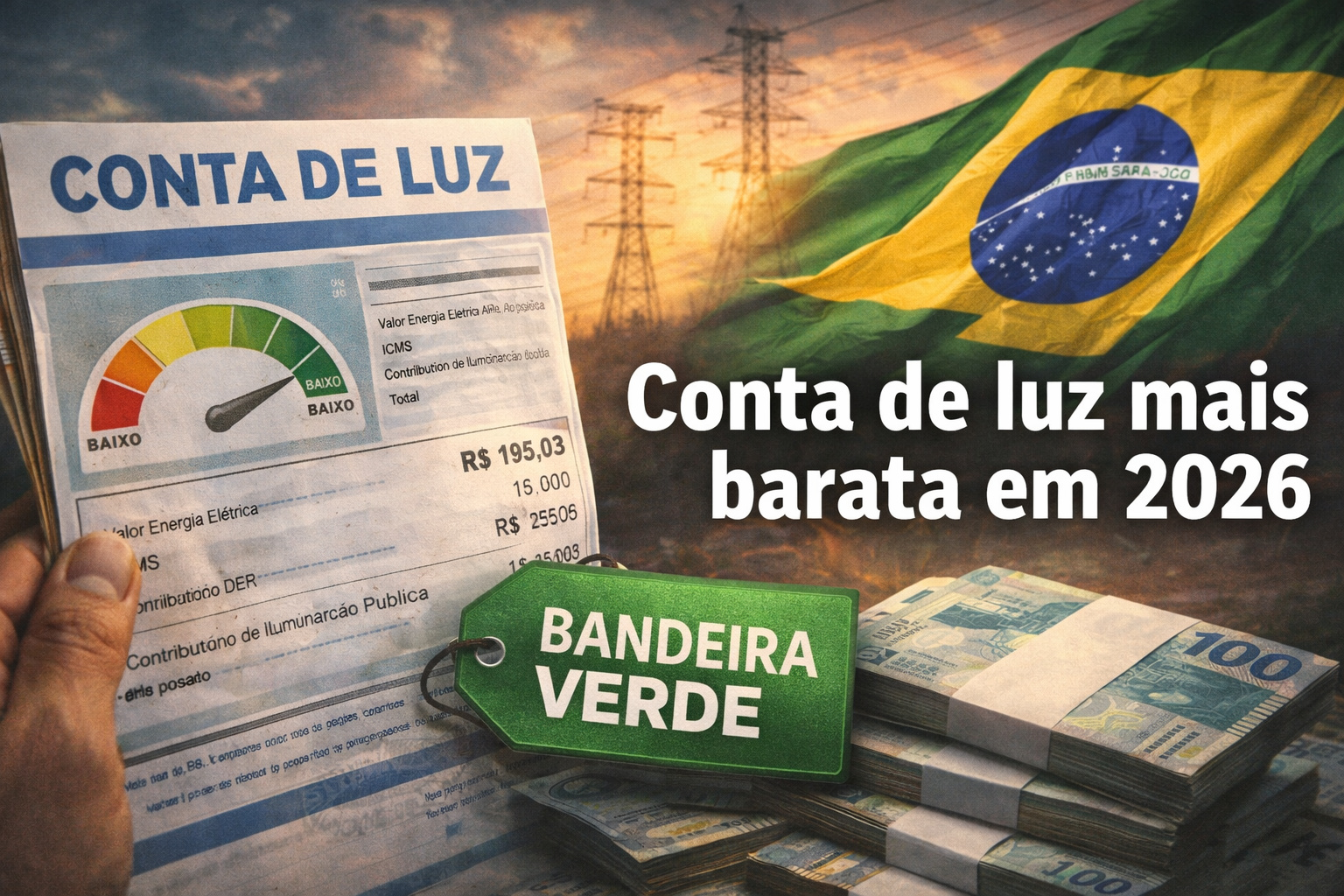
Electricity Bills Decrease in 2026 After Aneel Reduces Tariff Flag to Green and Eliminates Extra Charges on Electricity in Brazil.
The Electricity Bill will become cheaper starting in January 2026. The National Electric Energy Agency confirmed the reduction of the tariff flag to green, which eliminates extra charges on Electricity throughout Brazil. The decision was announced on Tuesday (12/23) and reflects a more favorable generation scenario, even with rainfall below historical averages.
The change directly affects consumers’ pockets. Moreover, it brings immediate relief to families and businesses right at the beginning of the year. Thus, 2026 starts with less pressure on monthly energy expenses.
Aneel Eliminates Extra Charges on Electricity Bills in January
Aneel has defined that the tariff flag for January will be green. As a result, consumers will no longer pay the additional R$ 1.88 for every 100 kWh consumed.
-
Brazilian city bets on the business environment to generate jobs and attract investments in the energy sector — secretary reveals strategy at Macaé Energy 2026.

-
50 viaducts, 4 tunnels, 28 bridges, and 40 kilometers of bike paths: BR-262 in Espírito Santo will receive 8.6 billion reais for the largest engineering project in the state’s history, inspired by the Immigrant Highway in São Paulo.

-
Brazil produces too much clean energy and doesn’t know what to do with it: over 20% of solar and wind capacity was wasted in 2025 while investors flee and 509 renewable generation projects were abandoned in the last year.

-
Piauí will produce a new fuel that replaces diesel without needing to change anything in the truck’s engine and reduces pollutant gas emissions by half: truck drivers from all over the Northeast are already celebrating the news that will arrive later this decade.

Therefore, the Electricity Bill will reflect only the base rate of the distributors. There will be no extra charges related to tariff flags.
This measure applies nationwide. The impact will be seen on the very first bill of 2026.
Generation Conditions Allow for Reduction of the Tariff Flag
According to Aneel, the current scenario favors electric energy generation. Even with below-average rainy periods, the reservoirs maintained stable levels.
November and December ensured sufficient water volume for hydroelectric plants. Thus, the agency reduced the need to activate thermal power plants.
“In January 2026 it will not be necessary to dispatch thermal plants at the same levels as the previous month, which avoids the imposition of additional costs on consumers’ electricity bills,” said Aneel.
As a result, production costs have decreased. Thus, the reduction of the tariff flag became possible.
Second Consecutive Reduction Reinforces Positive Scenario
This decision represents the second consecutive reduction of the tariff flag. Additionally, it marks the first time in eight months with no extra charges on the Electricity Bill.
In November, the flag was at the red level 1. In December, Aneel reduced it to yellow.
At that time, the additional cost fell from R$ 4.46 to R$ 1.88 for every 100 kWh. The agency had already highlighted a gradual improvement in generation conditions.
Now, with the green flag, consumers pay no additional amount. Thus, the benefit becomes even more relevant.
Cheaper Electricity Bill Eases Family Budgets
The reduction of the tariff flag directly impacts the final value of the Electricity Bill. With the green flag, consumers will pay less at the end of the month.
This relief is particularly significant for high-consumption families. Moreover, small businesses also benefit from the reduction in fixed costs.
Therefore, the measure improves financial planning. At the same time, it helps contain price increases in other sectors.
The lower cost of electricity may result in more controlled inflation. The positive effect spreads throughout the economy.
How Tariff Flags for Electricity Work
The tariff flag system indicates the real cost of electricity generation in Brazil. It signals when producing energy becomes cheaper or more expensive.
The green flag indicates favorable conditions. In this case, there are no extra costs on the Electricity Bill.
The yellow flag indicates less favorable conditions. It adds R$ 1.88 for every 100 kWh consumed.
The red flag 1 represents unfavorable conditions, with an additional cost of R$ 4.46. The red flag 2 indicates a very unfavorable scenario, with an increase of R$ 7.87.
Thus, the reduction of the tariff flag in 2026 signals greater balance in the electric sector.
What to Expect from Electricity in 2026
Aneel will continue to monitor reservoir levels throughout the year. The agency will also keep track of rainfall patterns.
Meanwhile, the electricity sector remains focused on supply security. The goal is to avoid sharp fluctuations in the Electricity Bill.
Even with climatic challenges, the current planning supports a more favorable start to the year. Thus, electricity begins 2026 with lower costs.
Finally, the reduction of the tariff flag reinforces a scenario of predictability. For consumers, this means fewer surprises and more control over the Electricity Bill.









-

-

-

4 pessoas reagiram a isso.