





 Portuguese
  English
  Spanish
  5 min of reading
  0 comments


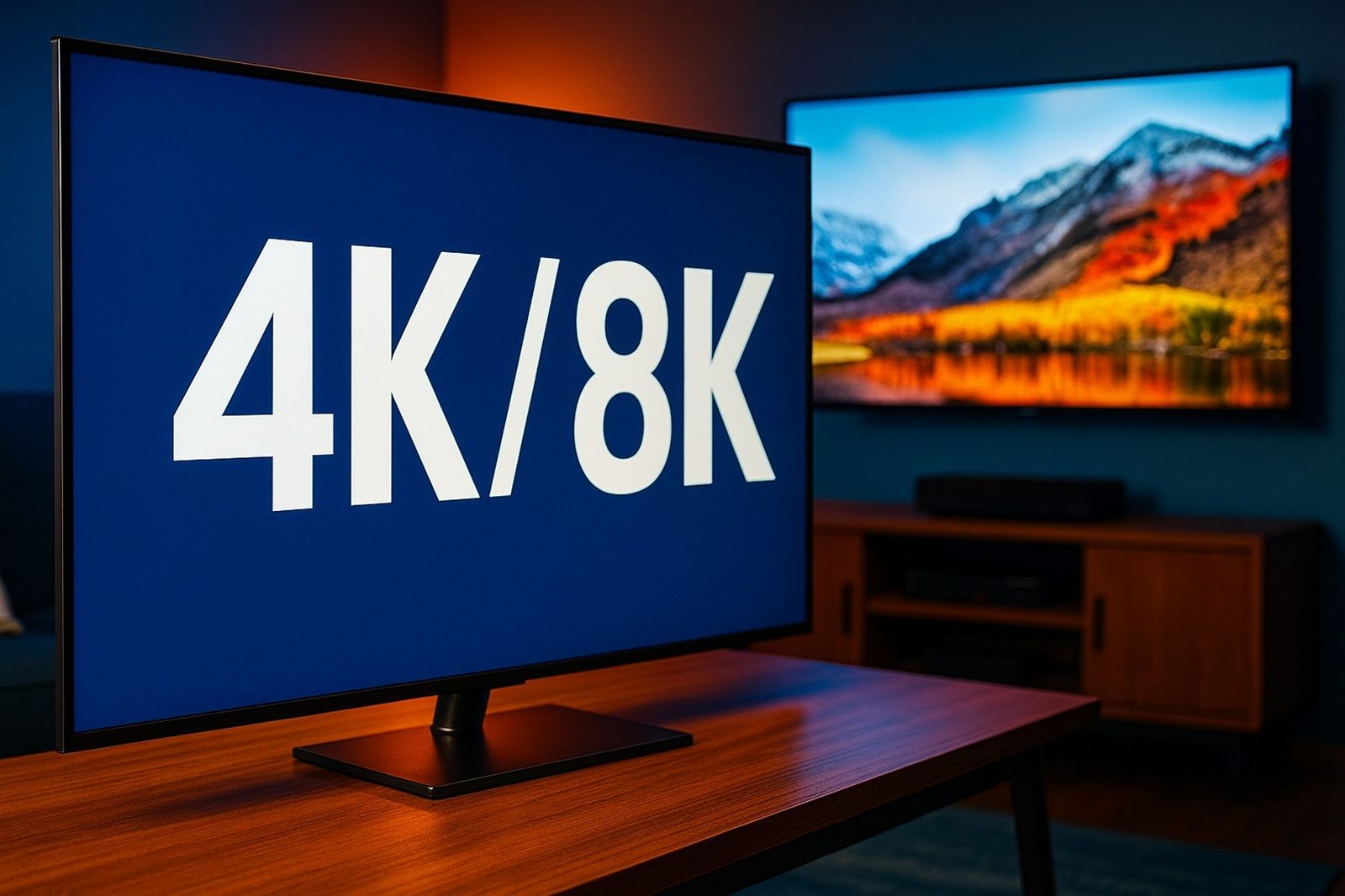
Cambridge University Researchers And Meta Reality Labs Discovered That The Human Eye Has A Physical Limit Of Pixel Perception, Revealing That 4K And 8K Screens May Not Offer Real Visual Gains In Many Home Situations
Researchers from Cambridge University, in partnership with Meta Reality Labs, decided to investigate to what extent the human eye can actually distinguish details on high-resolution screens. The study, published in the journal Nature Communications, revealed that there is a physical limit to pixel perception — which means that, beyond a certain point, increasing screen resolution does not bring any perceptible visual benefit.
The Human Eye Has A Limit
The research sought to answer a common question: is it worth investing in a 4K or 8K TV for better image quality at home? According to the scientists, the human eye can only identify a limited number of pixels, and exceeding that limit is the same as providing more information than the brain can process.
To reach this conclusion, the team conducted detailed experiments measuring volunteers’ ability to detect subtle variations in colored and grayscale images. The tests were conducted with the images being viewed both directly and through peripheral vision, and at different distances between the observer and the screen.
-
While the world looks at oil, the war with Iran is already disrupting helium supply from Qatar, affecting car and iPhone chips, threatening AI expansion, and putting pressure on aluminum packaging at the highest value in four years.

-
Global warming will expose a treasure hidden under the ice of Antarctica and may spark an international dispute over gold and valuable minerals.

-
A street vendor from Praia Grande built a robot made of scrap from scooters and washing machines that pulls his popcorn cart on the beach, emits sounds, and interacts with customers, becoming an attraction on the coast of São Paulo.

-
The specifications of the Xiaomi 18 Pro Max have been leaked, and the highlight is a dual 200 MP camera with a new 22-nanometer technology that promises to consume less energy and capture details in shadows and bright areas using LOFIC HDR.

The results showed that the perception limit depends on several factors, such as screen size, ambient brightness, and the distance between the observer and the device.
In the case of an average living room, about 2.5 meters from the TV to the sofa, the researchers claim that a 4K or 8K TV of 44 inches does not provide a visible advantage over a lower resolution Quad HD (QHD) TV of the same size.
The Science Behind Resolution
To determine this limit, the scientists developed an experimental device with a sliding screen that allowed them to measure what the human eye actually sees. Instead of measuring pixels per inch (PPI), they used the concept of “pixels per degree” (PPD), which indicates how many pixels fit in one degree of the field of vision.
This metric is more accurate because it answers the question “how does this screen appear from where I am sitting?”, rather than just “what is the resolution of this screen?”.
The normal visual standard, known as 20/20 — the same used in eye exams — suggests that humans distinguish details of up to 60 pixels per degree. However, according to the Cambridge research, the human eye can see even more: about 94 PPD in grayscale images, 89 PPD for red and green patterns, and 53 PPD for colors like yellow and violet.
These differences show that the human brain is less efficient at perceiving detailed colors, especially in peripheral vision. “Our brain does not have the capacity to process color details with such precision, which is why there is a significant drop in perception when we look at colored images outside the center of vision,” explained Professor Rafał Mantiuk, co-author of the study.
Perception And Cerebral Processing
The researchers emphasized that while human eyes are limited, it is the brain that truly “constructs” the image we perceive. “Our eyes are relatively simple sensors, but it is the brain that interprets the data and creates the image we believe we are seeing,” said Mantiuk.
The first author of the study, Dr. Maliha Ashraf, pointed out that many technological advances in screens — especially in augmented and virtual reality — are increasingly aimed at increasing pixel density. However, this race for resolution may be unnecessary. “With so much engineering effort to improve screen quality, it is essential to know how far these improvements really make a difference to the user,” Ashraf said.
According to her, until now there had been no experimental studies accurately measuring what the human eye can actually see on modern screens. “Most estimates came from old methods, like vision tests with letters on boards from the 19th century,” she added.
More Pixels, More Cost — Not Always More Quality
The study also shows that adding pixels beyond what the human eye can distinguish can be counterproductive. Screens with excessive resolution consume more energy, are more expensive, and require greater processing power from devices.
“We wanted to understand at what point it no longer makes sense to continue increasing resolution,” explained Mantiuk. The goal was precisely to identify the ideal balance between performance, cost, and energy efficiency.
Based on the results, the researchers concluded that in many home situations, TVs with QHD or Full HD resolution already deliver the maximum possible experience to human vision — especially when the viewer is at an average distance from the screen.
A Tool For The Consumer
In addition to publishing the scientific results, the team developed a practical tool: a free online calculator. Users can input the size of the room, the distance from the sofa to the television, and the screen specifications (such as inches and resolution) to find out the balance point between visual quality and cost-effectiveness.
This tool, according to the authors, helps consumers make more informed decisions when purchasing a TV or other type of display. “The results set a new standard for screen development, with direct implications for imaging, rendering, and video encoding technologies,” stated researcher Alex Chapiro from Meta Reality Labs.
Implications For The Future Of Screens
The data obtained by the team also has a direct impact on the tech industry. Manufacturers will be able to design screens based on realistic visual standards, catering to the majority of the population — for example, creating panels with “retinal” resolution sufficient for 95% of people, rather than aiming for an idealized observer.
This will allow companies to reduce costs and improve efficiency of devices without compromising the visual experience. This applies to both home televisions and smartphones, computer monitors, augmented reality glasses, and even car panels.
The research marks an important turning point: it shows that technological advancement does not always mean better perceptual quality. In many cases, the eyes simply cannot perceive the difference.
The Cambridge and Meta Reality Labs study reinforces that true innovation may not be in indefinitely increasing resolution, but in understanding how far humans can actually see.








Seja o primeiro a reagir!