





 Portuguese
  English
  Spanish
  3 min of reading
  1 comment


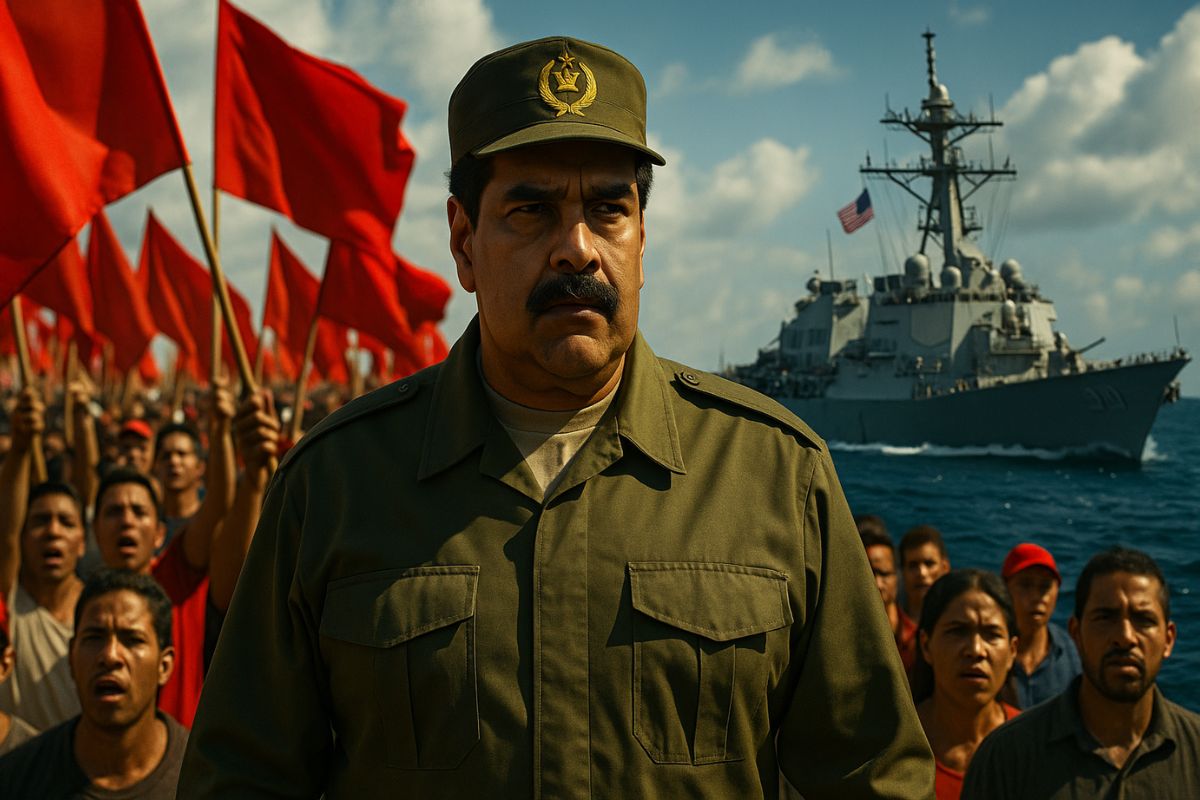

Venezuela Responds to U.S. Pressure with Mass Enlistment; Understand. Nicolás Maduro’s Call Mobilizes Thousands of Venezuelans Amid the Deployment of U.S. Warships to the Caribbean
The Venezuelan decision to adopt a mass enlistment shows the level of tension the country faces amid growing U.S. pressure. According to CNBC, President Nicolás Maduro called on citizens to present themselves at barracks and squares to strengthen internal security and project resistance in the face of U.S. military movements in the region.
The announcement comes days after Washington sent three destroyers and three amphibious ships to the Caribbean, under the pretext of combating drug trafficking. Analysts believe the gesture is more political and geopolitical than operational, rekindling old tensions between Caracas and Washington.
What Does Mass Enlistment Mean in Venezuela?
Maduro’s call led to hundreds of Venezuelans taking to the streets to join the national mobilization. According to the government, the goal is to reinforce popular presence in territorial defense activities, surveillance, and logistical support.
-
Brazilian city bets on the business environment to generate jobs and attract investments in the energy sector — secretary reveals strategy at Macaé Energy 2026.

-
50 viaducts, 4 tunnels, 28 bridges, and 40 kilometers of bike paths: BR-262 in Espírito Santo will receive 8.6 billion reais for the largest engineering project in the state’s history, inspired by the Immigrant Highway in São Paulo.

-
Brazil produces too much clean energy and doesn’t know what to do with it: over 20% of solar and wind capacity was wasted in 2025 while investors flee and 509 renewable generation projects were abandoned in the last year.

-
Piauí will produce a new fuel that replaces diesel without needing to change anything in the truck’s engine and reduces pollutant gas emissions by half: truck drivers from all over the Northeast are already celebrating the news that will arrive later this decade.


However, experts emphasize that high numbers do not equate to effective military capability. While Caracas speaks of up to 4.5 million reservists and volunteers, the country’s military structure remains outdated, with limited equipment and little operational availability compared to high-tech forces like those of the U.S.
Historical Relations of Friction Between the U.S. and Venezuela
This is not the first time tensions have escalated. Since 2002, with the attempted coup that removed Hugo Chávez for 48 hours, the U.S. has been accused of supporting political interventions in Venezuela. In 2019, Juan Guaidó also attempted to orchestrate Maduro’s exit, again amid accusations of U.S. influence.
Now, the difference is that the clash occurs in a more fragmented global landscape, where the competition for oil, strategic minerals, and regional influence makes South America a stage for international pressures.
The Geopolitical Weight of Venezuelan Mobilization
According to analysts consulted by CNBC, Maduro’s strategy is to dissuade Washington through the political cost of any intervention. Rather than directly confronting U.S. armed forces, Venezuela seeks to multiply points of resistance and inflate sovereign rhetoric.
Meanwhile, neighboring countries like Colombia and Guyana face pressures to align with Washington, while Bolivia and Cuba reinforce support for Caracas, repeating the region’s historical polarization.
The Military Issue: Real Capability Versus Discourse
Despite the rhetoric of strength, Venezuela occupies mid-level positions in global military rankings and faces limitations in air defense, submarines, and equipment maintenance. Comparatively, the United States has over 1 million active soldiers, while Caracas has about 330,000 military personnel combined with regular and reserve forces.
In practice, the mobilization of untrained civilians has more symbolic than operational value, serving as a message of national resistance and reinforcing Maduro’s image to his political base.
Impacts for the Region and Risks of Escalation
The deployment of U.S. ships to the Caribbean does not currently represent a direct offensive, but rather a strategic pressure on Caracas. The objective would be to contain the Chavista government and increase surveillance over the flow of drugs and oil.
Nonetheless, the tension creates instability throughout South America. The risk of direct conflict is low, but escalating military maneuvers and aggressive rhetoric could impact diplomatic and economic relations, including with Brazil, which has historically oscillated between rapprochement and distancing from Venezuela.
The decision to invest in a mass enlistment is a way to reinforce the rhetoric of sovereignty and project resistance against U.S. power. However, Venezuela’s actual combat capability remains limited.
What do you think, does the mass enlistment strengthen Venezuela’s position or only further expose its vulnerability to the U.S.? Share your opinion in the comments — we want to hear from those living this reality firsthand.







Não acredito que as forças leais ao Nicolas Maduro, sequer tenham a menor possibilidade de encarar um ato de defesa, já que o país está totalmente sucateado, inclusive as forças armadas. Está retórica de chamamento a população para defender o país, e totalmente nula, já que o cidadão venezuelano está sem a mínima condição de sequer aguentar um treinamento, estão mal alimentados, sem meios de inclusive se movimentar, pois nem gasolina existe para a venda em Boa parte do país.
Quase 30 0/0 da população foi para o exterior, e o dinheiro que circula na Venezuela, são as remessas para manutenção das famílias, feitas por Venezuelanos que migraram para outros países, inclusive o Brasil.